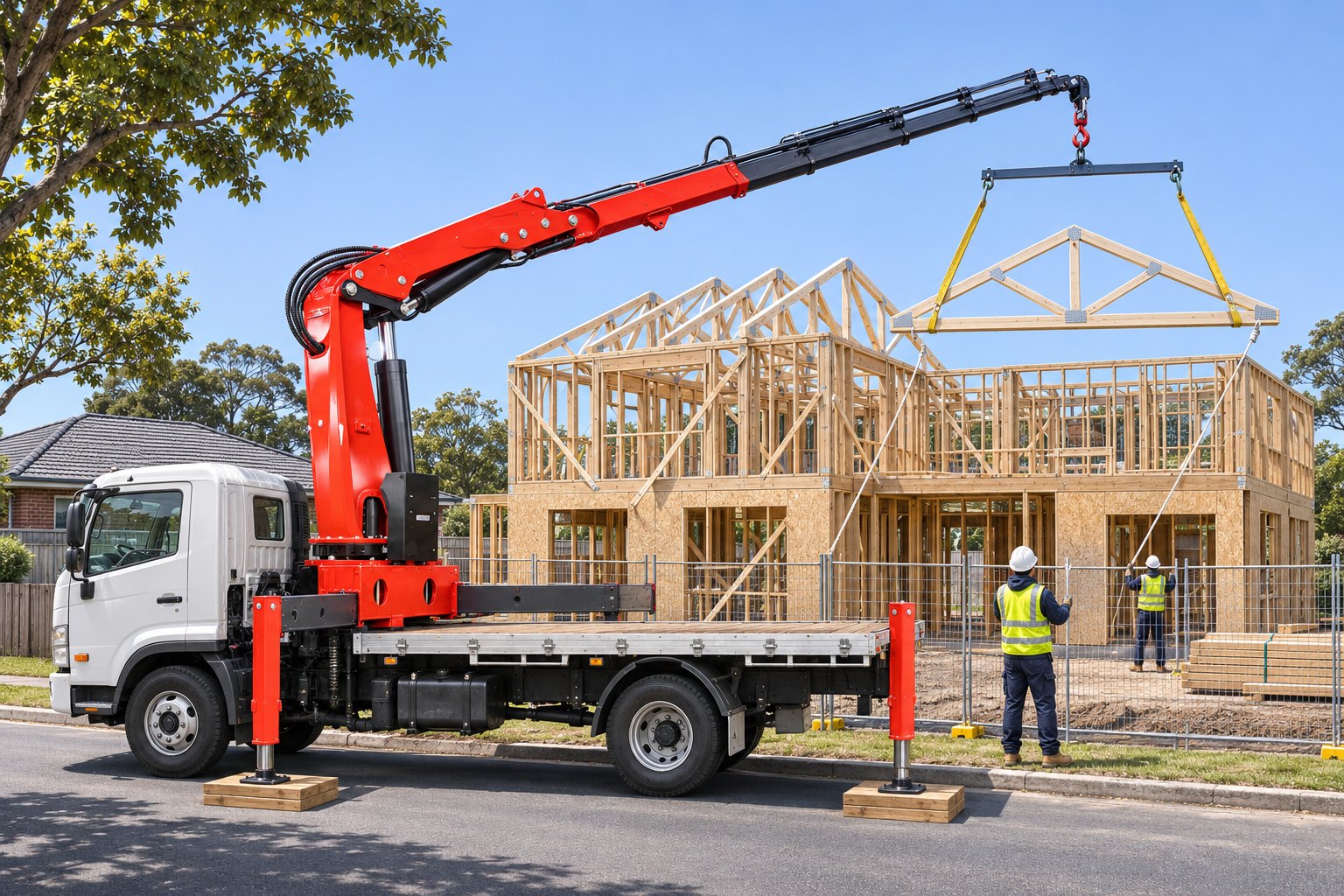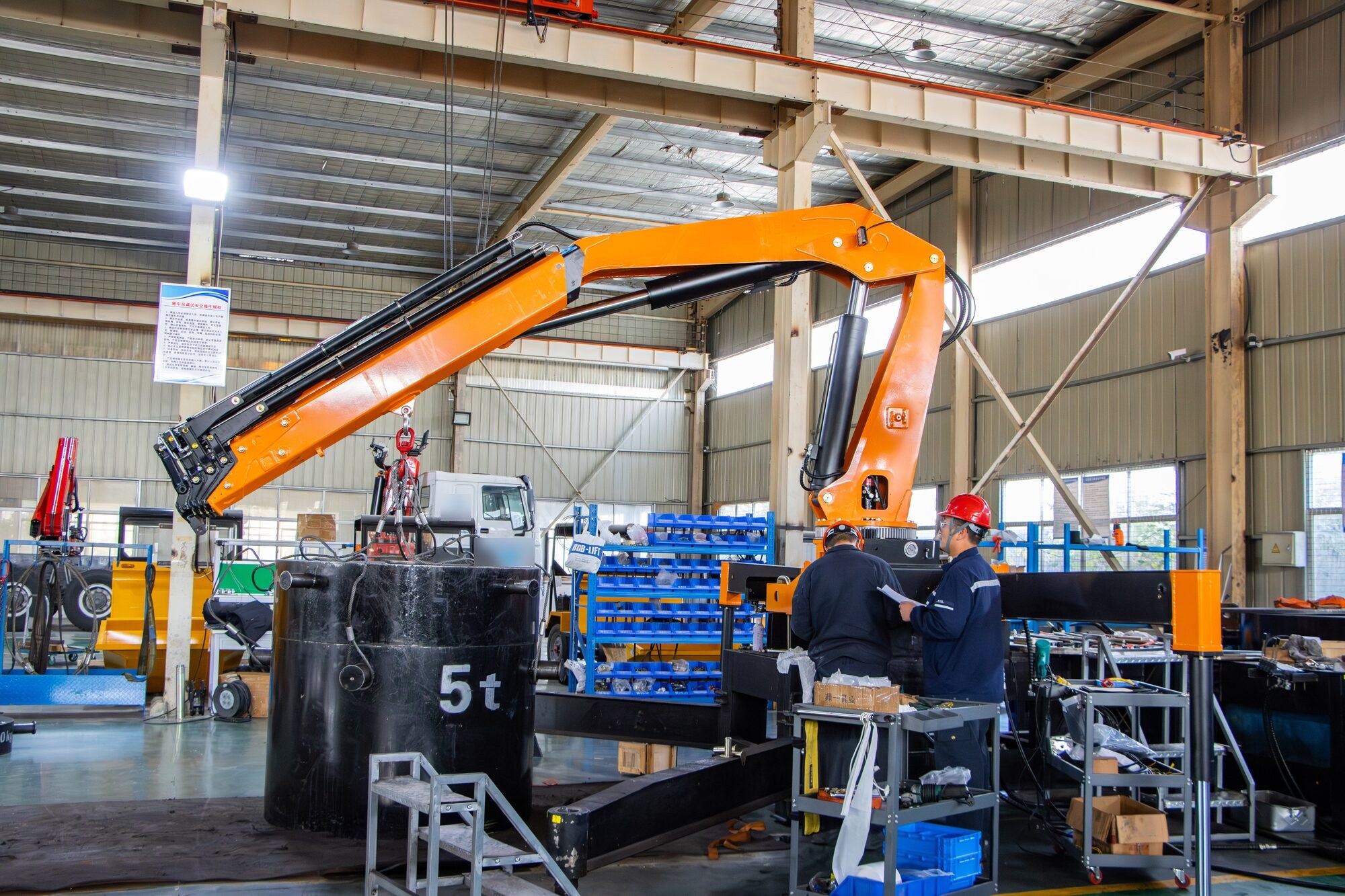

A straight boom crane is a truck mounted crane whose single straight boom slides out in nested sections and lifts the load on a winch rope. Stiff boom crane and telescopic boom crane are other names for it. A folding boom crane is a truck mounted crane whose inner and outer booms are joined by a hinge, so it folds up behind the cab and carries the hook at the boom tip. It is also called a knuckle boom, articulating or loader crane. That single structural difference decides how each crane reaches, how it stows on the vehicle and which applications it suits.
We have manufactured both types in Xuzhou since 2003, and buyers often ask which name refers to which crane. This guide covers the names, how each boom is built, how to tell the two apart and where both types are heading.
Key takeaways
- Straight boom, stiff boom and telescopic boom name one crane type; folding boom, knuckle boom, articulating and loader crane name the other.
- A straight boom crane raises its boom with a luffing cylinder, extends the sections in a line and lifts on a winch rope.
- A folding boom crane bends at a knuckle joint and lifts on a hook at the boom tip, with a winch available as an option.
- In our 5-tonne class, the straight boom SQ5SA3 reaches 8,680 mm and the folding boom SQ5ZA3 reaches 8,050 mm, and both need 1,050 mm of chassis length behind the cab.
- Both types have a future, but US delivery rules favour knuckle booms and small telescopic cranes face competition from telehandlers.
What are straight boom and folding boom cranes called?
Each type has several names, and the preferred terminology changes from one country to the next.
| Name you may hear | Crane type | Where you meet it |
|---|---|---|
| Straight boom crane, straight boom truck | Straight boom | Translated specifications and export quotations |
| Stiff boom crane | Straight boom | Export quotations; also ship-mounted stiff boom cranes |
| Telescopic boom crane | Straight boom | MIAOXUE model names and many manuals |
| Boom truck | Usually straight boom | United States and the Philippines |
| Folding boom crane, folding crane truck | Folding boom | Translated specifications |
| Knuckle boom crane | Folding boom | MIAOXUE model names and many manuals |
| Articulating or articulated crane | Folding boom | US regulations and ASME B30.22 |
| Loader crane, lorry loader | Usually folding boom | EN 12999 in Europe; “lorry loader” in UK usage |
The regulations follow the same division, and the US crane rule groups booms into categories that include “hydraulically extendible” and “articulating type” [1]. The same rule defines an articulating crane boom as “a series of folding, pin connected structural members”, and its scope lists “articulating cranes (such as knuckle-boom cranes)” separately from “commercial truck-mounted, and boom truck cranes” [2]. ASME B30.22 covers articulating boom cranes [3], while ASME B30.5 covers mobile cranes and its 2025 edition illustrates commercial truck-mounted cranes with a telescoping boom [4].
European terminology is less consistent. EN 12999:2020 defines a loader crane as a “power driven crane comprising a column, which slews about a base, and a boom system”, “designed for loading and unloading vehicles” [5], a definition that does not specify whether the boom folds. Wikipedia’s crane article describes a truck mounted crane with a telescopic boom as a “lorry loader”, yet it also equates the loader crane with the knuckle boom crane [6]. So check whether the boom has a hinge rather than which name appears in the document. For a ship-mounted stiff boom crane, see our comparison of knuckle boom and telescopic marine cranes.
How is a straight boom crane built?
A straight boom crane is built around one boom that only becomes longer or shorter and changes its angle. Wikipedia describes a telescopic boom as “a number of tubes fitted one inside the other”, extended or retracted by a hydraulic cylinder “or other powered mechanism” [6].
- Base, outriggers and column: the base is bolted to the truck frame behind the cab, the outriggers carry the load to the ground, and the column slews the boom.
- Luffing cylinder: one large cylinder raises and lowers the boom angle.
- Boom sections: nested sections slide out of each other in one straight line, extended by the telescoping cylinder inside the boom.
- Winch, wire rope and hook block: a hydraulic winch winds the wire rope over the sheaves in the boom head and down to the hook block.
Because a straight boom cannot bend down towards a load, the hook travels on the rope, and our telescopic models carry the winch as standard, as our crane winch guide explains. For example, the drawing of our 5,000 kg SQ5SA3 shows a boom extending from 3,660 mm to 8,680 mm, which is lowered along the deck for road travel.

For more detail, see what a telescopic boom crane is and our crane boom guide.
How is a folding boom crane built?
A folding boom crane is built around two boom arms connected by a hinge, so it moves more like a human arm bending at the elbow than like a fishing rod. A knuckle is the pinned joint between the inner and the outer boom, and it gives the crane type its common name. The base, outriggers and column match those of a straight boom crane.
- Inner boom and main cylinder: the inner boom is pinned to the top of the column, and the main cylinder raises and lowers it.
- Knuckle joint and knuckle cylinder: the outer boom pivots on the inner boom at the knuckle, and a separate cylinder opens and closes the fold.
- Extensions: hydraulic extension sections slide out of the outer boom, and on our “+1” versions an additional manual extension increases the reach.
- Hook at the boom tip: the hook hangs on a short link, so it follows every movement of the tip.
- Optional winch: added when the hook must travel below the truck or far above the tip, shown by the letter J in our model codes.

For road travel, the folding boom closes into a compact package standing upright behind the cab. On the drawing of our 5,000 kg SQ5ZA3 that package is 2,357 mm high, while the unfolded boom reaches horizontally from 4,442 mm to 8,050 mm. Our guide to what a knuckle boom crane is labels every component.
Straight boom vs folding boom: what the structure changes
The SQ5SA3 and SQ5ZA3 make a fair comparison, because both are rated at 5,000 kg and both require the same 1,050 mm of chassis length. The lifting moment is the load multiplied by its working radius, and it is the usual measure of a crane’s real lifting power.
| Feature | SQ5SA3 straight boom | SQ5ZA3 folding boom |
|---|---|---|
| Maximum lifting capacity | 5,000 kg | 5,000 kg |
| Maximum lifting moment | 12.5 t·m | 10.5 t·m |
| Horizontal reach | 3,660 to 8,680 mm | 4,442 to 8,050 mm |
| How the hook moves | On the winch rope | With the boom tip; winch optional |
| Rotation angle | 360° | 400° |
| Crane self weight | 2,100 kg | 2,286 kg |
| Outrigger span | 2,260 to 5,100 mm | 2,272 to 5,122 mm |
| Installation space | 1,050 mm | 1,050 mm |
| Stowed for travel | Boom lowered along the deck | Folded upright behind the cab, 2,357 mm high |
Four practical consequences follow from the geometry of each boom.
- Reaching up or over: the straight boom gives a long, direct line for high lifts, while the folding boom can travel up, over a wall and down on the other side.
- Hook height and depth: on its rope, a straight boom crane can raise the hook well above the truck or lower it into a pit, while a folding boom without a winch stays where the tip can reach.
- Close and low work: the folding boom can work bent under a low roof or close to the vehicle.
- Deck space and payload: the stowed straight boom lies above the deck, which suits long cargo such as pipe, while the folded crane leaves the deck free. Either crane’s weight comes off the truck’s payload.
For a model-by-model comparison of five further pairs from 3.2 t to 12 t, read our article on knuckle boom vs telescopic boom truck mounted cranes, and our guide to truck mounted crane slewing explains the difference in rotation angle.
How can you tell which type you have?
You can usually identify the type within seconds from the boom and the hook, even in a photograph.
- Count the hinges. A straight boom has one pivot at the column, whereas a folding boom has a second pivot, the knuckle, partway along its length.
- Examine the hook. A hook block hanging on wire rope from the boom head indicates a straight boom, while a hook on a short link at the tip indicates a folding boom.
- Look at the stowed position. A boom lying along the deck is a straight boom, and a boom folded upright behind the cab is a folding boom.
- Find the winch drum. Every straight boom crane has one; a folding boom crane may not.
- Read the nameplate. In our model codes, S identifies a straight telescopic boom and Z a folding boom, while J adds a winch, T marks the marine version and “+1” a manual extension.
What are the market prospects for straight boom and folding boom cranes?
Both types have a clear future, but they are developing in different directions. We do not quote market-size figures, because the published forecasts sit in paid reports that cannot be checked, so the points below rest on regulations, standards and our drawings.
US regulations treat the two types differently
The US crane rule for construction excludes certain material deliveries by “articulating/knuckle-boom truck cranes” from its scope [2]. The conditions are strict: materials go to the ground “without arranging the materials in a particular sequence for hoisting”, and sheet goods go onto a structure only with “a properly functioning automatic overload prevention device”. Prefabricated components such as roof trusses stay inside the rule. Because the exclusion names only articulating cranes, it gives folding booms a regulatory advantage in building-supply delivery on US sites.
Our guide to choosing a drywall delivery crane explains what that exclusion covers for board deliveries.
Other machines compete for smaller lifts
Wikipedia notes that rotating telescopic handlers now handle brick pallets and roof trusses on many building sites, and that they “have eroded much of the work for small telescopic truck cranes” [6]. In the opposite direction, Wikipedia’s article on the knuckle boom crane reports that the type is very common on vessels such as fishing boats, because it blocks less deck space. In our interpretation, folding booms are gaining ground wherever space is limited, while small straight boom cranes face increasing competition on open sites.
Heavier folding booms, electric drive and remote control
Our folding boom truck mounted cranes range from the 800 kg SQ08ZA3 to the SQZ1000, which its drawing rates at 50,000 kg and 90 t·m. Our straight boom models range from the 2,000 kg SQ2SA3 to the 20,000 kg SQ20SA5, which still lifts 1,500 kg at its longest radius of 22 m. The folding boom therefore covers the wider capacity span, as our heavy duty truck mounted crane guide shows, while the straight boom retains the longest single reach.
Three developments blur the boundary between the types. A winch option allows a folding boom to lift on a rope like a straight boom, and ASME B30.22 explicitly covers articulating cranes “equipped with a load hoist mechanism to broaden their versatility” [3]. Electric drive is arriving at the compact end, with our 12 V electric-hydraulic SQ1Z-E and SQ2Z-E added in November 2026, as described in our electric truck mounted crane guide. Radio remote control, available on request, lets one operator walk to the best viewing position, as our article on truck mounted crane remote control explains.
Our interpretation of these facts, based on the 2026 drawings and the sources above, is that neither type will replace the other. The folding boom will continue to expand in delivery, marine and heavier work, while the straight boom keeps its place wherever long reach and hook height on a rope matter most.
Which one suits your work?
Start from the application and the vehicle, not from the name of the crane, and then check three points.
- Choose a folding boom for deliveries over walls, for confined or low sites and marine decks, or when the whole deck must stay free.
- Choose a straight boom for the longest reach and hook height in a capacity class, for rope lifts into pits, or for long cargo beneath the stowed boom.
- Check either type against the load chart at your actual working radius and against the truck’s payload, using our guide to selecting the tonnage of a truck mounted crane.
Every MIAOXUE crane is listed with a load moment limiter, as our article on the lifting moment of a crane explains, and MIAOXUE cranes never lift people.
Frequently asked questions
Is a stiff boom crane the same as a telescopic crane?
Yes, on a truck the two names describe the same crane, with one straight boom of nested sections lifting on a winch rope, and in the United States the vehicle carrying it is often called a boom truck.
What is a folding boom crane called in Europe?
It is usually called a loader crane, or a lorry loader in the United Kingdom, and the European standard that covers it is EN 12999.
Does a folding boom crane need a winch?
Not for normal loading beside the truck, because the hook at the boom tip handles that work. Specify a winch, the J in our model codes, when the hook must travel into a pit or far above the tip.
Can a straight boom crane fold?
No, its boom only extends, retracts and changes angle, so for road travel it is lowered until it lies along the deck.
Which is lighter, a straight boom or a folding boom crane?
It depends on the capacity class rather than on the type alone. In our 5-tonne A3 pair, the straight boom SQ5SA3 weighs 2,100 kg and the folding boom SQ5ZA3 weighs 2,286 kg. In the 8 t to 12 t pairs of our comparison article, the folding boom models are the lighter ones.
How we compiled this guide
We rewrote our 2023 article in November 2026 from primary sources. Crane figures come from the current MIAOXUE drawings of the SQ5SA3, SQ5ZA3, SQ08ZA3, SQZ1000, SQ2SA3 and SQ20SA5. Regulatory text comes from the eCFR versions of 29 CFR 1926.1400 and 1926.1401, and standards information from the published scopes of ASME B30.22-2023, ASME B30.5-2025 and EN 12999:2020. Wikipedia supplied general facts, the diagram is our own, and Achord Chan, Product Operations Director, reviewed the guide. It does not replace the crane’s operator’s manual or the regulations where you work.
Not sure which boom type your work needs?
Tell us what you lift, how far and how high the hook must travel, and which truck you plan to use. We will recommend a knuckle boom truck mounted crane or a telescopic boom truck mounted crane and send its drawing and load chart, so that you can compare both types on your own figures. Every crane carries a 12-month warranty on the whole machine, common spare parts leave the factory within 48 hours, and our service team answers within 12 hours. Contact us for a quotation.