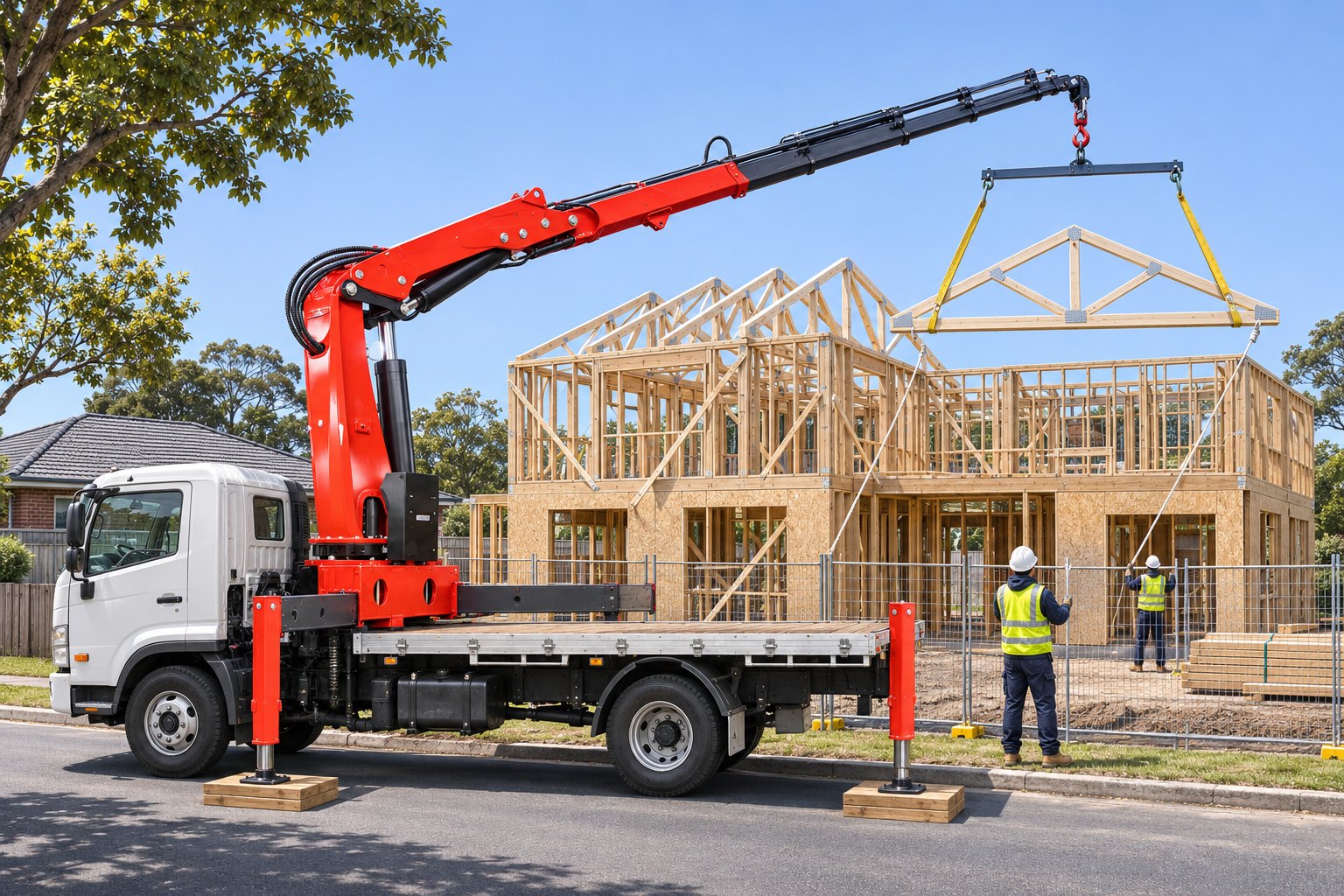

A heavy duty truck mounted crane is a loader crane in roughly the 16 to 50 ton class, fitted behind the cab of a heavy rigid truck, that lifts steel, precast concrete, machinery and other loads too heavy for a medium crane. What makes it heavy duty is not the tonnage on the boom but its lifting moment: how many ton-metres it can hold out from the column. MIAOXUE’s heavy duty knuckle boom cranes run from 33 t·m to 90 t·m, reach up to 20.3 m and weigh 4,900 kg to 10,000 kg themselves, so the truck matters as much as the crane.
We have built truck mounted cranes in Xuzhou since 2003 and export them to 124 countries and regions. This guide uses the technical drawings and load charts of our eight heavy duty knuckle boom models to show what a 16, 30, 40 or 50 ton crane really lifts at working reach, what truck it needs, and how to pick the right size before you ask for a quotation.
Key takeaways
- Judge a heavy duty crane by its lifting moment and its load chart, not by its headline tonnage. The full rating only applies about 2 m from the column, or less.
- Our heavy duty range covers 16 t to 50 t, 33 t·m to 90 t·m and a reach of 15.9 m to 20.3 m.
- At full reach, the 50 ton SQZ1000 lifts 3,230 kg and the 30 ton SQZ600 lifts 2,150 kg. The bigger crane gains most far from the truck, not close to it.
- The crane alone weighs 4.9 t to 10 t, so the truck must carry that weight within its legal axle limits and still keep payload.
- Large cranes need 45 kW to 75 kW of PTO power, 63 to 100 L/min of oil flow and an outrigger span of up to 8.6 m.
What makes a truck mounted crane heavy duty?
A truck mounted crane is heavy duty when its lifting moment is large enough to place heavy loads well away from the truck. The lifting moment is the load multiplied by the horizontal distance from the crane column. A crane rated at 80 t·m can, in principle, hold 8,000 kg at 10 m or 4,000 kg at 20 m, before the load chart’s own limits apply.
The tonnage in a model name, such as 40 ton, is the maximum capacity, and it applies only very close to the column. Dividing each heavy model’s maximum moment by its rated capacity gives a radius between 1.8 m and 2.2 m, which means the headline figure describes a lift beside the column, whereas most practical jobs take place 5 m to 15 m away. That is why two cranes with the same tonnage can be very different machines, and why our guide on how to read a crane load chart is the best place to start.
In our range, the boundary between medium and heavy duty sits at approximately 16 t and 33 t·m: smaller cranes generally suit medium trucks, while every model above that boundary requires a heavy chassis with a reinforced subframe, wide outriggers and a substantial hydraulic supply.
Our heavy duty knuckle boom range at a glance
The table lists all eight heavy duty knuckle boom truck cranes in our current range. Every figure comes from the model’s dimension drawing and load chart, and every model slews a full 360°.
| Model | Max capacity | Max moment | Max reach | Load at max reach | Crane weight |
|---|---|---|---|---|---|
| SQZ330 | 16,000 kg | 33 t·m | 15.9 m | 1,450 kg | 4,900 kg |
| SQZ430 | 20,000 kg | 42.3 t·m | 16.6 m | 1,910 kg | 5,500 kg |
| SQZ500 | 25,000 kg | 53.9 t·m | 15.9 m | 2,840 kg | 6,300 kg |
| SQZ560 | 28,000 kg | 57.3 t·m | 15.9 m | 3,050 kg | 6,100 kg |
| SQZ600 | 30,000 kg | 63.3 t·m | 20.3 m | 2,150 kg | 7,500 kg |
| SQZ700 | 34,000 kg | 70.1 t·m | 20.3 m | 2,500 kg | 8,500 kg |
| SQZ800 | 40,000 kg | 80 t·m | 20.3 m | 2,800 kg | 9,000 kg |
| SQZ1000 | 50,000 kg | 90 t·m | 20.3 m | 3,230 kg | 10,000 kg |
Two characteristics stand out: the 16 t to 28 t models reach approximately 16 m, while the 30 t to 50 t models reach 20.3 m, and the crane’s own weight roughly doubles across the range, from 4,900 kg to 10,000 kg. The 20 t to 30 t models are compared in depth in our 25 ton knuckle boom crane guide, so this article focuses on the range as a whole and on the largest cranes.

How much does a 30, 40 or 50 ton truck crane lift at real reach?
A 40 ton truck crane lifts about 14,500 kg at 4.4 m, 5,790 kg at 11.4 m and 2,800 kg at 20.3 m. That is the SQZ800 load chart. The table puts the four largest models side by side at three working distances.
| Model | Near the truck | Mid reach | Full reach, 20.3 m |
|---|---|---|---|
| SQZ600, 30 t | 12,840 kg at 4.4 m | 4,170 kg at 11.4 m | 2,150 kg |
| SQZ700, 34 t | 14,360 kg at 4.4 m | 4,800 kg at 11.4 m | 2,500 kg |
| SQZ800, 40 t | 14,500 kg at 4.4 m | 5,790 kg at 11.4 m | 2,800 kg |
| SQZ1000, 50 t | 16,700 kg at 4.6 m | 7,300 kg at 10 m | 3,230 kg |
Three lessons come out of these load charts:
- Near the truck, the 34 t and 40 t are almost equal. At 4.4 m the SQZ800 lifts only 140 kg more than the SQZ700. The 40 t pays off further out, where it lifts about 1,000 kg more at 11.4 m.
- The 50 t gains less than its name suggests at full reach. Its rating is 1.67 times that of the 30 t SQZ600, but at 20.3 m it lifts 1.5 times as much: 3,230 kg against 2,150 kg.
- Reach matters more than tonnage for many jobs. A 28 t SQZ560 lifts 3,050 kg at 15.9 m but cannot reach 20 m. If your loads must go that far, you need a 30 t or larger model.
Therefore, begin with your heaviest regular load and the horizontal distance it must travel from the crane column, and then select the smallest model whose load chart covers that combination with a comfortable safety margin, rather than starting from the advertised tonnage.
What truck does a heavy duty truck mounted crane need?
A heavy duty crane requires a heavy rigid truck that can carry the crane’s considerable dead weight within legal axle limits, power its hydraulic pump continuously and withstand the concentrated forces transmitted through the outriggers. MIAOXUE exports the crane itself; you choose the truck, and our engineers check that the crane, subframe and hydraulic installation suit that particular chassis. The truck mounting and export page lists the chassis brands our cranes are commonly fitted to.
Weight and axle limits
Because the crane is installed directly behind the cab, most of its weight is transferred to the front axle and the first rear axle, and the applicable road regulations then determine how much capacity remains available for the load bed. In the European Union, Annex I of Directive 96/53/EC sets 26 tonnes for a three-axle motor vehicle with twin tyres and air suspension on the driving axle, and 32 tonnes for a four-axle vehicle with two steering axles that meets the same conditions. On US Interstate highways, 23 CFR 658.17 sets 80,000 pounds gross, 20,000 pounds on one axle and 34,000 pounds on a tandem.
Comparing our crane weights with those limits is revealing. A 9,000 kg SQZ800 consumes more than a third of a 26 t three-axle limit before the truck body, fuel and payload are considered, and a 10,000 kg SQZ1000 weighs approximately 22,000 pounds on its own, which exceeds the federal single-axle limit, so its weight must be distributed across several axles. It is one reason the largest cranes are often fitted to four-axle trucks. Regulations differ considerably between jurisdictions, so verify the applicable limits with your local truck dealer or vehicle registration authority.
Hydraulic power
The technical drawings specify the recommended power and hydraulic supply for each individual model:
- SQZ330 and SQZ430: 45 kW, 63 L/min at 33 MPa, with a 200 L or 240 L oil tank.
- SQZ500: 50 kW, 70 L/min at 33 MPa, 240 L tank.
- SQZ560 and SQZ600: 65 kW, 80 L/min at 35 MPa, 260 L tank.
- SQZ700: 75 kW, 90 L/min at 35 MPa, 300 L tank.
- SQZ800 and SQZ1000: 75 kW, 100 L/min at 35 MPa, 300 L tank.
The truck’s power take-off and hydraulic pump must deliver that flow at a reasonable engine speed, otherwise the crane operates slowly and the oil overheats during continuous work. Our guide to the hydraulic crane for truck explains PTO, pump and oil choices in more detail.
Subframe and mounting space
Stowed, the 30 t to 40 t models fold to 2,550 mm wide and 2,450 mm high and take about 1,650 mm of chassis length behind the cab, while the 50 t SQZ1000 needs about 1,900 mm. The crane must be installed on a subframe dimensioned for its full lifting moment, and the installation should follow both the MIAOXUE drawing and the truck manufacturer’s body-building regulations. Our truck mounted crane installation guide covers the steps.

Outriggers and ground: the limit people forget
A heavy duty crane is only as stable as the ground beneath its outriggers, which is why site preparation deserves as much attention as the crane specification. Our drawings show an outrigger span of 2,324 to 5,924 mm on the SQZ330, up to 7,400 mm on the 25 t and 28 t models, and 2,250 to 8,600 mm on the 30 t to 50 t models. The wider span provides the stability that the larger moment demands, although it also requires considerably more room on a congested construction site.
In US construction work, 29 CFR 1926.1402 says equipment must not be assembled or used unless ground conditions are “firm, drained, and graded”, with supporting materials if needed, so that the maker’s requirements for support and level are met. Outrigger pads distribute the concentrated load across a larger area, and heavier cranes generally require correspondingly larger pads. Our guide to crane outriggers and ground bearing pressure shows how to size them.
Heavy duty knuckle boom or a large telescopic crane?
Both configurations are available in heavy capacities, and the appropriate choice depends on the application. A knuckle boom folds into a compact package behind the cab, preserves the load bed and can reach over walls and into buildings because the outer boom articulates, whereas a telescopic boom is a straight boom suited to long, unobstructed lifts with a hook. For a side-by-side view, read our knuckle boom vs telescopic boom truck crane comparison.
For delivery operations, where the truck transports its own steel, masonry or precast components and unloads them at the destination, most buyers in the heavy category specify a knuckle boom, which is the configuration this guide examines.
Controls and attachments on large cranes
Our heavy duty cranes can be run from manual levers, a high seat on the column or a wireless remote. On a large crane the high seat or the remote is common, because the operator needs an unobstructed view of a load that may be positioned 15 m or more from the column, and every crane is equipped with a load moment limiter. Attachments such as a hydraulic gripper, a clamshell bucket, a winch, an auger, a man basket or a grapple can be quoted on request, and our guide to knuckle boom crane attachments explains each one.
Regardless of the control arrangement, the load chart must always remain available with the crane. Under 29 CFR 1926.1417, the rated capacities (load charts), operating instructions and operator’s manual “must be readily available in the cab at all times for use by the operator”.
How to choose a heavy duty truck crane in five steps
- List your heaviest regular loads and their distances. Measure horizontally from the intended position of the crane column, not from the side of the truck.
- Check the load chart, not the tonnage. Identify the smallest model that lifts each load at its distance with an appropriate margin, and request the complete chart for every candidate.
- Check the reach you need. If any load goes beyond about 16 m, look at the 30 t to 50 t models with 20.3 m reach.
- Match the truck. Confirm the permissible axle loads, the PTO and pump output, the subframe design and the available installation space behind the cab with your truck dealer and with our engineers.
- Plan the site. Ensure there is sufficient room for the full outrigger span, with firm ground or adequately sized pads beneath each outrigger.
Example scenario (an illustration, not a customer record): a buyer delivers 2,500 kg steel bundles that must be placed 20 m from the truck. The 28 t SQZ560 cannot reach 20 m, and the 30 t SQZ600 lifts only 2,150 kg at 20.3 m, which is insufficient. The 34 t SQZ700 lifts exactly 2,500 kg at that distance, leaving no margin, so the 40 t SQZ800, rated at 2,800 kg there, is the sensible specification.
Our guide to buying a truck mounted crane from China covers the rest of the order: documents, testing and shipping.
Frequently asked questions
What is the biggest truck mounted crane MIAOXUE makes?
The SQZ1000 knuckle boom crane, which is rated at 50,000 kg and 90 t·m, reaches 20.3 m horizontally and lifts 3,230 kg at that maximum radius. The crane itself weighs 10,000 kg.
Does a 40 ton truck crane lift 40 tons at any reach?
No. The 40,000 kg rating of the SQZ800 applies only immediately beside the column; its load chart specifies 14,500 kg at 4.4 m, 6,500 kg at 9.4 m and 2,800 kg at the maximum 20.3 m radius.
How heavy is a heavy duty truck mounted crane?
Our heavy duty knuckle boom cranes weigh 4,900 kg for the 16 t SQZ330, 7,500 kg for the 30 t SQZ600 and 10,000 kg for the 50 t SQZ1000, and that weight is deducted directly from the truck’s legally permitted payload.
Which truck can carry a heavy duty crane?
We export the crane, not the truck. Send us your truck model and chassis details, and we will check the fit, the subframe and the PTO. In most countries the crane is fitted to a locally registered truck, following our drawing and installation guidance, with remote support from our team.
Are heavy duty cranes tested before they ship?
Yes. Every crane is mounted on our test bay and run through lifting, slewing and outrigger functions under load before packing. You can ask for a test video of your own crane, or send an inspection company of your choice. The quality and testing page shows how.
How we compiled this guide
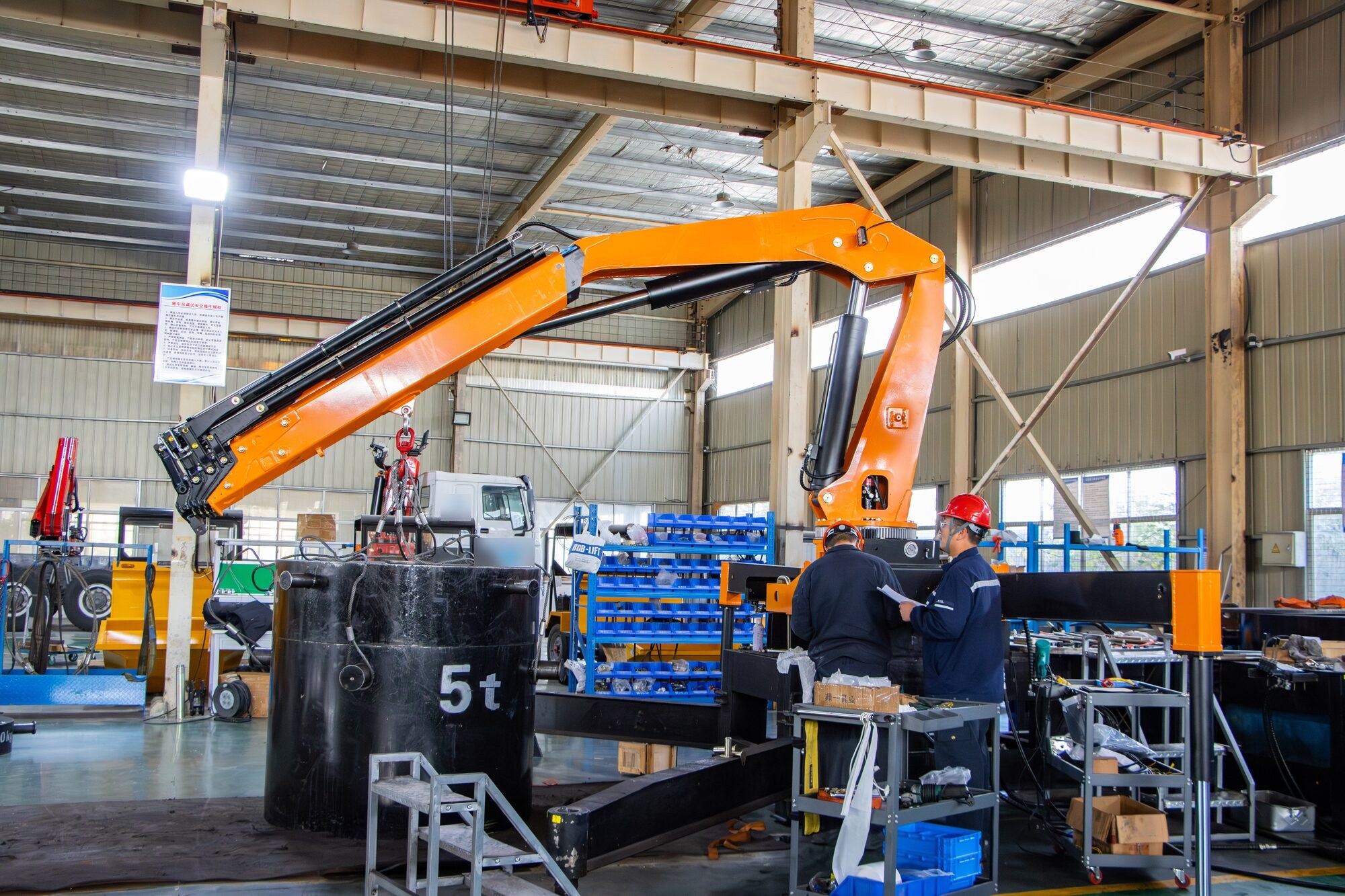
All crane figures come from the MIAOXUE technical department’s dimension drawings and load charts for the SQZ330, SQZ430, SQZ500, SQZ560, SQZ600, SQZ700, SQZ800 and SQZ1000, as they stood in November 2026. The ratio of moment to capacity is our own calculation from those drawings. Mounting sizes, controls and attachments come from our live product pages. The road weight limits and safety rules are quoted from the official texts linked above. The photos show real cranes in our Xuzhou workshop. The guide was reviewed by Achord Chan, Product Operations Director, in November 2026. It does not replace the crane’s manual, your truck maker’s body-building rules or the law where you work.
Get the right heavy duty crane for your truck
Tell us your heaviest loads, the operating radius you require and the truck you intend to use, and we will recommend a suitable model and provide its technical drawing and complete load chart. Every crane carries a 12-month warranty on the whole machine, common spare parts are dispatched within 48 hours, and our service team replies within 12 hours. Browse all our knuckle boom truck cranes, or contact us for a quotation.