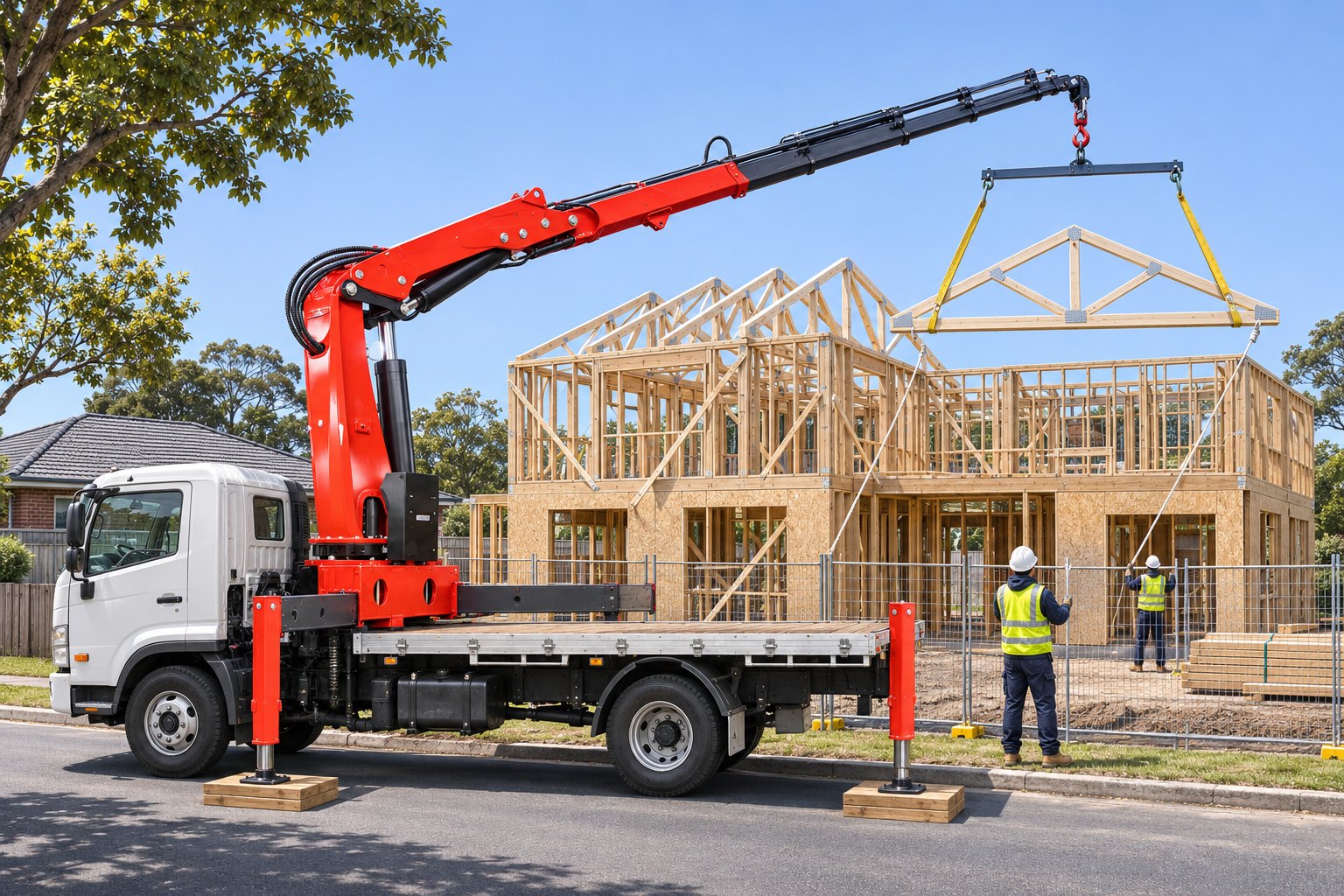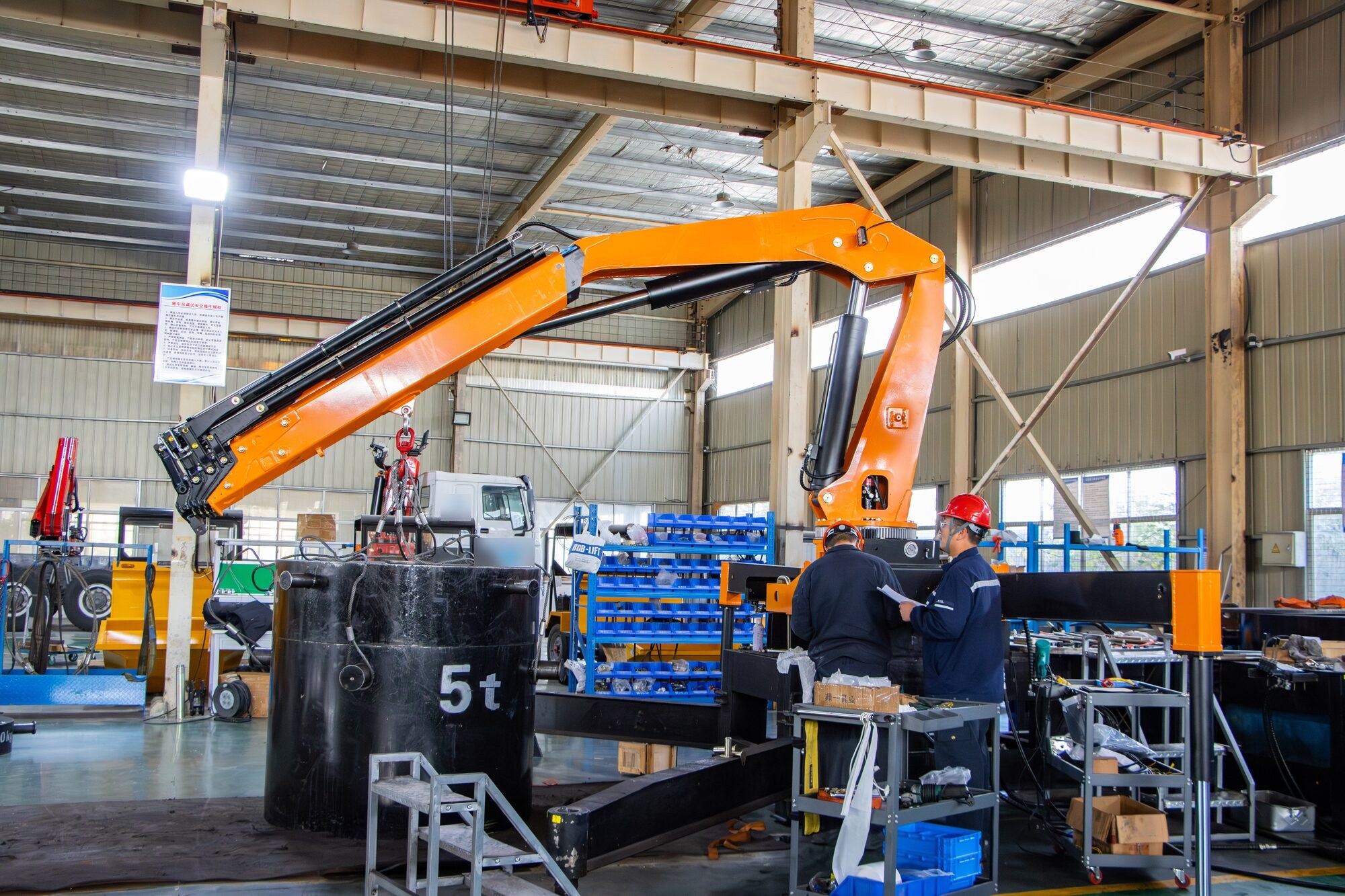

A crane boom is the principal structural arm of a crane, carrying the load outwards from the slewing column and upwards to the required height. On a hydraulic truck mounted crane or marine crane, the boom is a fabricated steel structure consisting of several sections, operated by hydraulic cylinders. Its geometry determines the working radius, the lifting height and the permissible load at every position.
We have manufactured truck mounted cranes in Xuzhou since 2003, and buyers regularly ask us what the individual boom components do and what the codes in our model designations mean. This guide explains the principal boom types, the difference between a boom and a jib, the function of the sections and cylinders, and the relationship between boom length, working radius and lifting height. Every product specification comes from the technical drawings of our cranes.
Key takeaways
- The boom determines the crane’s outreach and lifting height. On truck mounted and marine cranes it is either telescopic (a straight boom of nested sections) or knuckle (an articulated boom that folds at a hinge).
- A jib is a separate, lighter arm attached to the boom tip. The “+1” in some of our model designations indicates a manual extension of this kind.
- In our model designations, A3 to A6 indicates the number of boom sections. On our 12 t knuckle boom cranes, each additional section adds approximately 2 m of outreach.
- Three categories of hydraulic cylinder operate the boom: a lift cylinder raises it, a folding cylinder articulates a knuckle boom, and extension cylinders telescope the sections.
- A crane lifts the most close to the column and the least at maximum outreach. Our 12 t SQ12ZA6 is rated for 12,000 kg at 2.25 m but only 1,000 kg at 14.5 m.
What is a crane boom and what does it do?
The United States construction crane regulation provides a precise definition. Under 29 CFR 1926.1401, a boom is “an inclined spar, strut, or other long structural member which supports the upper hoisting tackle on a crane or derrick”. The same rule notes that the length and angle of the boom can usually be changed “to achieve increased height or height and reach when lifting loads”.
On a truck mounted crane, the boom is mounted on top of the column, which rotates on the base, while the base is attached to the truck chassis together with the outriggers. The components below the boom provide stability and rotation; the boom itself provides the outreach. For the terminology of the remaining components, consult our guide to truck mounted crane parts.
The boom performs three functions. It establishes the working radius, meaning the horizontal distance the hook can travel; it establishes the lifting height; and it transmits the load, together with its own considerable weight, back to the column. That third function explains why a longer boom is rated for a smaller load at its tip, as the chart further below demonstrates.
What types of crane boom are there?
The rule groups booms into five categories: “hydraulically extendible, cantilevered type, latticed section, cable supported type or articulating type.” For truck mounted and marine cranes, only the first and the last are relevant in practice.
Telescopic boom
A telescopic boom is one straight boom made of sections that slide inside each other. Wikipedia’s crane article describes it as “a number of tubes fitted one inside the other”, with a hydraulic cylinder that extends or retracts them. The hook is suspended on a wire rope from a winch, so a telescopic crane always lifts on the rope, and in our range it provides the greatest outreach for a given capacity class. Our guide on what a telescopic boom crane is covers how the sections telescope.
Knuckle boom (articulating boom)
A knuckle boom folds at a hinge, like a finger. The rule calls this an articulating crane, one “whose boom consists of a series of folding, pin connected structural members, typically manipulated to extend or retract by power from hydraulic cylinders”. It consists of an inner boom pinned to the column and an outer boom connected to it at the knuckle, and the outer boom accommodates the telescopic extensions. In the transport position the complete boom folds into a compact package, so it occupies very little of the vehicle’s loading area. Read more in our guide to what a knuckle boom crane is.

A third category, the lattice boom, is fabricated from welded steel members arranged as a truss and is typical of crawler and large mobile cranes; we do not manufacture it. If you are choosing between the two hydraulic types for a truck, our knuckle boom vs telescopic boom comparison sets them side by side.
Boom and jib: what is the difference?
The boom is the principal arm, whereas a jib is a shorter, lighter arm attached to the boom tip to provide additional reach or height for lighter loads. The two terms are frequently confused, which is why searches such as “jib boom” and “boom and jib of crane” are so common. On a tower crane the terminology differs: the rule says that if the main horizontal structure is fixed “it is referred to as a jib; if it is moveable up and down, it is referred to as a boom”.
On large mobile cranes, the jib is usually a fly jib that is stored alongside the boom and pinned into position when required, as explained in our article on what a fly jib is. On our smaller knuckle boom cranes, the same principle appears as a manual extension, indicated by “+1” in the model designation, which the operator extends by hand to gain additional reach for light loads.
The technical drawings quantify the effect. Our 8 t SQ8ZA6 reaches 14.68 m, where it is rated for 850 kg, while the SQ8ZA6+1 with the manual extension reaches 16.8 m and is rated for 650 kg at that radius. The boom tip at the steepest charted angle rises from approximately 17 m to approximately 19 m. In other words, the extension adds roughly 2 m of outreach in exchange for 200 kg of capacity at the end of the boom.
What do boom sections A3 to A6 mean?
Our model designations identify both the boom type and the number of sections. In SQ12ZA6, “12” is the 12 t class, “Z” means a knuckle boom (S would mean telescopic), and “A6” means six boom sections. A “T” indicates the marine version and a “J” a winch, so the SQ10ZA6TJ is a 10 t knuckle boom marine crane with a six-section boom and a hydraulic winch.
Additional sections make the boom longer when it is fully extended, and the load charts illustrate this consistently. On every chart we examined, the table contains one close-in rating plus one rating for each boom section. The 12 t SQ12ZA4 has four ratings between 4.7 m and 10.15 m, the SQ12ZA5 adds a fifth at 12.2 m, and the SQ12ZA6 adds a sixth at 14.5 m. Each additional section therefore contributes approximately 2 m of outreach in this capacity class.

The additional sections involve a compromise. According to their drawings, the SQ12ZA4 weighs 4,480 kg, the SQ12ZA5 4,600 kg and the SQ12ZA6 4,800 kg. At approximately 10 m, the four-section crane is rated for 2,100 kg, whereas the five-section and six-section versions are rated for 1,850 kg, because the longer booms must also support more of their own structural weight at the same radius.
Telescopic models follow identical logic: the three-section SQ3.2SA3 reaches 8.3 m, whereas the five-section SQ12SA5 reaches 19.35 m. Its drawing dimensions the boom from 5,773 mm with the sections in to 19,350 mm with them all out.
Which crane boom cylinder does what?
Every movement of a hydraulic crane boom is produced by a hydraulic cylinder: pressurised oil from the pump acts on a piston, and the piston rod moves the corresponding boom component. Because manufacturers use different terminology for the same component, the table lists the most common alternative names.
| Cylinder | Also called | Where it sits | What it does |
|---|---|---|---|
| Lift cylinder (knuckle boom) | Inner boom cylinder, main cylinder | Between the column and the inner boom | Raises and lowers the inner boom |
| Folding cylinder (knuckle boom) | Outer boom cylinder, knuckle cylinder | Along the inner boom, working through the link at the knuckle | Folds the outer boom up and down |
| Luffing cylinder (telescopic boom) | Lift cylinder, boom cylinder | Between the column and the underside of the boom | Sets the boom angle |
| Extension cylinders (both types) | Telescopic cylinders | Inside or along the boom sections | Push the sections out and pull them back in |
Summary compiled by MIAOXUE from our crane drawings, November 2026. Slewing is performed by a hydraulic motor and gearbox rather than a boom cylinder, and the outriggers have separate cylinders.
When people refer to “the crane boom cylinder”, they usually mean the lift or luffing cylinder, because it is the largest and carries the greatest force. On a knuckle boom, the folding cylinder is similarly important, because it supports the outer boom and the load at maximum outreach. Our telescopic boom guide explains how sections are extended one after another or together.
The hydraulic flow and pressure required by these cylinders are specified on each drawing; the SQ12ZA6, for example, requires 55 L/min at 28 MPa. Our guide to the hydraulic crane for a truck explains how that is matched to the truck’s power take-off.
How do boom length, working radius and lifting height differ?
These three dimensions are closely related, but they are not interchangeable, and confusing them is a common source of specification errors.
- Boom length is the length of the boom structure itself, from its pivot pin to its tip, and it changes as the sections extend or retract.
- Working radius is the horizontal distance from the slewing centre to the hook, and it is the dimension used on the load chart.
- Lifting height is the vertical distance the boom tip or hook can reach above the ground or the crane base.
The boom angle connects all three. A long boom raised steeply provides considerable height but a short radius, whereas the same boom lowered to horizontal provides the maximum radius but limited height. Our article on crane boom angle explains the geometry in detail. Because the boom pivots above the base, the tip can rise higher than the maximum radius: the SQ12SA5 reaches 19.35 m, while its boom tip at 75° is at approximately 21 m on the chart.
The maximum radius is never the position at which a crane lifts the most. A crane is limited by its lifting moment, the product of load and radius, and the SQ12ZA6 drawing specifies a rated moment of 27 t·m. At 2.25 m the crane is rated for 12,000 kg, and 12,000 kg multiplied by 2.25 m equals exactly 27 t·m. At 14.5 m it is rated for 1,000 kg, which corresponds to only 14.5 t·m. Much of the rest goes into holding up the boom’s own weight, far out from the column. Our article on the lifting moment of a crane explains the idea in more detail.

The chart also reveals a difference between the two boom types. At comparable radii, the telescopic SQ12SA5 is rated higher than the knuckle models and reaches considerably further, while the knuckle models fold into a compact package and position loads precisely close to the vehicle. Always confirm the value for your actual radius on the official load chart. Our guide on how to read a crane load chart shows how.
Crane boom specifications for 14 MIAOXUE models
The table summarises the boom specifications of representative knuckle boom and telescopic truck mounted cranes and marine cranes, taken from each model’s dimensions drawing and load chart.
| Model | Type | Boom sections | Max working radius | Boom tip height* | Max load close in | Load at max radius |
|---|---|---|---|---|---|---|
| SQ2ZA4 | Knuckle, truck | 4 | 7.54 m | ≈ 9.3 m | 2,000 kg at 2.1 m | 300 kg |
| SQ5ZA4 | Knuckle, truck | 4 | 9.9 m | ≈ 12 m | 5,000 kg at 2.1 m | 700 kg |
| SQ8ZA6 | Knuckle, truck | 6 | 14.68 m | ≈ 17 m | 8,000 kg at 2.0 m | 850 kg |
| SQ12ZA4 | Knuckle, truck | 4 | 10.15 m | ≈ 12.4 m | 12,000 kg at 2.25 m | 2,100 kg |
| SQ12ZA5 | Knuckle, truck | 5 | 12.2 m | ≈ 14.4 m | 12,000 kg at 2.25 m | 1,500 kg |
| SQ12ZA6 | Knuckle, truck | 6 | 14.5 m | ≈ 16.5 m | 12,000 kg at 2.25 m | 1,000 kg |
| SQ3.2SA3 | Telescopic, truck | 3 | 8.3 m | ≈ 10 m | 3,200 kg at 2.2 m | 550 kg |
| SQ6.3SA4 | Telescopic, truck | 4 | 12.6 m | ≈ 14.5 m | 6,300 kg at 2.5 m | 600 kg |
| SQ12SA5 | Telescopic, truck | 5 | 19.35 m | ≈ 21 m | 12,000 kg at 2.5 m | 600 kg |
| SQ20SA5 | Telescopic, truck | 5 | 22.0 m | ≈ 23.5 m | 20,000 kg at 2.5 m | 1,500 kg |
| SQ10ZA6TJ | Knuckle, marine, winch | 6 | 14.68 m | ≈ 17 m | 10,000 kg at 2.0 m | 1,150 kg |
| SQ12ZA5T | Knuckle, marine | 5 | 12.0 m | ≈ 14 m | 12,000 kg at 2.25 m | 1,500 kg |
| SQ5SA4T | Telescopic, marine | 4 | 11.79 m | ≈ 13.5 m | 5,000 kg at 2.5 m | 600 kg |
| SQ16SA5T | Telescopic, marine | 5 | 22.3 m | ≈ 24 m | 16,000 kg at 2.5 m | 1,050 kg |
Source: MIAOXUE technical drawings, November 2026. *Boom tip height is read from the curve on each load chart with the boom at its steepest charted angle (75° to 84°), so it is approximate. The hook hangs below the tip, so the hook height is lower.
Two patterns are evident. First, within the same capacity class, the telescopic cranes reach further: the 12 t SQ12SA5 reaches 19.35 m, compared with 14.5 m for the six-section SQ12ZA6. Second, the permissible load at maximum outreach is a small part of the rated capacity on every model, between one twentieth and less than one fifth. Browse the full ranges of knuckle boom truck mounted cranes, telescopic boom truck mounted cranes and marine cranes for every drawing.
How should a crane boom be inspected?
The boom carries every load the crane lifts, together with its own weight, so it requires regular inspection. In the United States, 29 CFR 1926.1412 requires a visual check by a competent person before each shift, including hydraulic lines “for deterioration or leakage”. At least every 12 months, a qualified person must inspect the structure “including the boom” for members that are “deformed, cracked, or significantly corroded”, loose bolts and cracked welds.
The same annual list covers the boom cylinders. It names “drifting caused by fluid leaking across the piston”, leaking rod seals, and rods with “scores, nicks, or dents”. It also lists slider pads, the wear pads between telescopic sections, “for excessive wear or cracks”. In the UK, regulation 9 of LOLER 1998 requires lifting equipment to be thoroughly examined at least every 12 months, unless an examination scheme sets other intervals.
In daily operation, three habits protect the boom. Keep the extension sections clean and lubricated as the operating manual specifies, investigate immediately if the boom gradually sinks without any control movement, and never apply side loading by dragging a load laterally. For the full daily, monthly and annual routine, use our truck mounted crane inspection checklist.
How do you choose the boom type, length and sections?
- Start with the radius. Measure the furthest position the hook must reach from where the crane will be positioned.
- Check the permissible load at that radius, not the maximum rated capacity, and include the hook and slings in the load.
- Select the boom type. A knuckle boom suits loading close to the vehicle and compact transport dimensions, whereas a telescopic boom suits long outreach and lifting on the rope.
- Choose the number of sections. Specify enough sections for the required outreach, but no more, because additional sections increase weight and reduce capacity at intermediate radii.
- Decide on a winch. A knuckle boom lifts directly at the tip unless a winch is specified. See our crane winch guide.
Example scenario (an illustration, not a customer record): a building materials supplier needs to deliver 1,200 kg pallets of concrete blocks at distances of up to 12 m from the vehicle. The SQ12ZA4 reaches only 10.15 m, so it is unsuitable. The SQ12ZA5 is rated for 1,500 kg at 12.2 m, which accommodates the pallet together with its lifting accessories and leaves a reasonable margin. The SQ12ZA6 would also reach, but it weighs an additional 200 kg and provides outreach the supplier does not require.
Frequently asked questions
What is the boom on a crane?
The boom is the principal structural arm that carries the load outwards and upwards from the crane’s column. On truck mounted and marine cranes it is a hydraulically operated steel boom, either telescopic or articulated.
What is the difference between a boom and a jib?
The boom is the principal arm, while a jib is a lighter arm attached to the boom tip to provide additional reach or height for lighter loads. On our smaller cranes, the “+1” manual extension performs this function.
What does the boom cylinder do on a crane?
The main boom cylinder raises and lowers the boom. A knuckle boom additionally has a folding cylinder that operates the outer boom, and both boom types have extension cylinders that telescope the sections.
How long is a crane boom?
It depends on the model and configuration. Across the 14 cranes in our specification table, the maximum working radius ranges from 7.54 m on the 2 t SQ2ZA4 to 22.3 m on the 16 t SQ16SA5T telescopic marine crane.
Does a longer boom lift less?
Yes, at its tip. The lifting moment, load multiplied by radius, is limited, and the boom’s own weight consumes part of it. Our SQ12ZA6 is rated for 12,000 kg at 2.25 m but 1,000 kg at 14.5 m.
How we compiled this guide
We compiled every product figure from the current MIAOXUE technical drawings (dimensions drawing and load chart) of the SQ2ZA4, SQ5ZA4, SQ8ZA6, SQ8ZA6+1, SQ12ZA4, SQ12ZA5, SQ12ZA6, SQ3.2SA3, SQ6.3SA4, SQ12SA5, SQ20SA5, SQ10ZA6TJ, SQ12ZA5T, SQ5SA4T and SQ16SA5T. Boom tip heights were read from the chart curves. The definitions and inspection items are quoted from the official eCFR text of 29 CFR 1926.1401 and 1926.1412, the LOLER text on legislation.gov.uk and Wikipedia’s crane article, as they stood in November 2026. The photos show cranes in our Xuzhou factory. Achord Chan, Product Operations Director, reviewed the guide. It does not replace your crane manual or the rules where you work.
Get the boom drawing for your crane
Tell us the load, the radius and the lifting height you require, and whether the crane will be installed on a truck or a vessel. We will recommend a suitable boom type and number of sections, and send the corresponding dimensions drawing and load chart. Every crane carries a 12-month warranty on the whole machine, common spare parts leave the factory within 48 hours, and our service team answers within 12 hours. Contact us for a quotation.