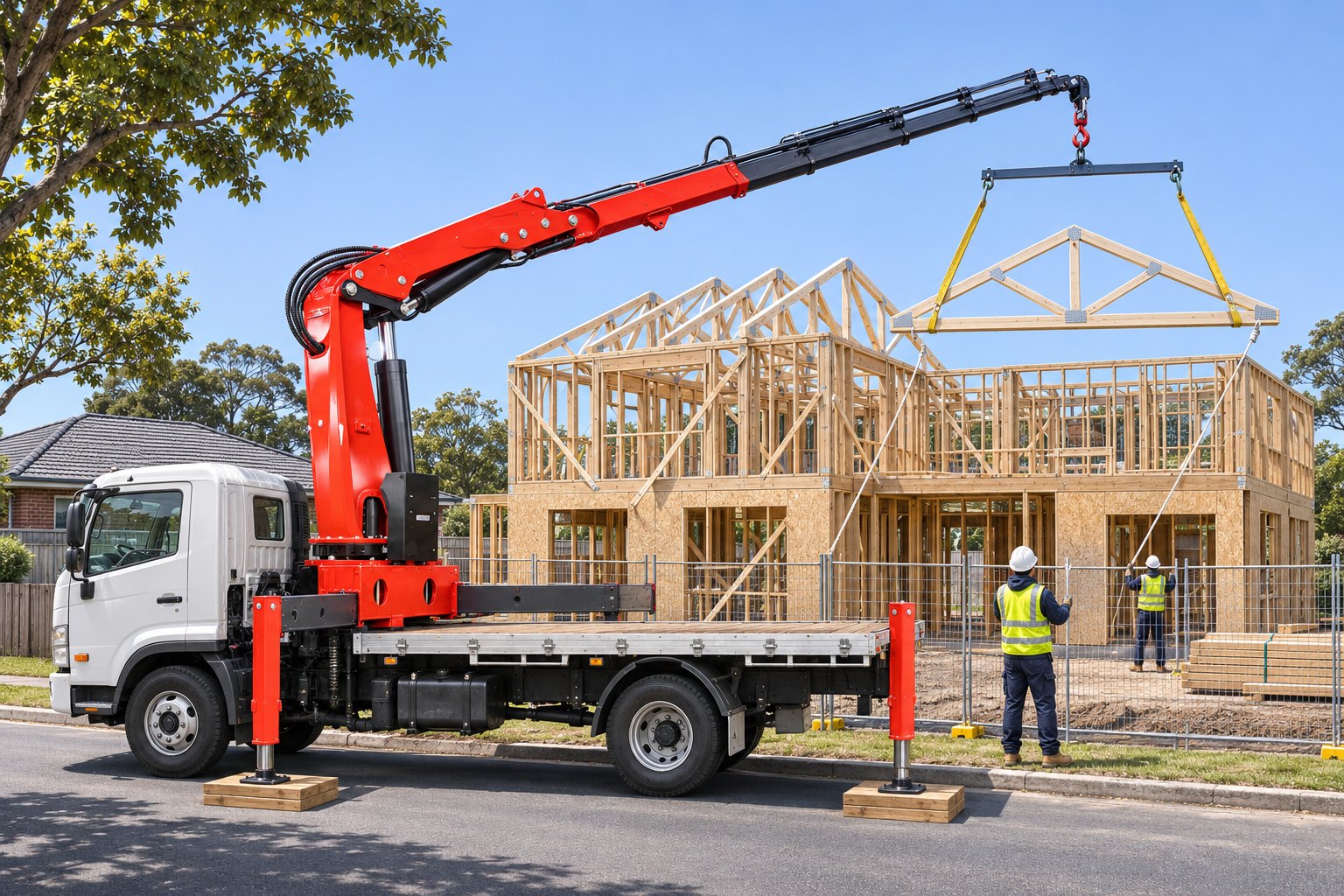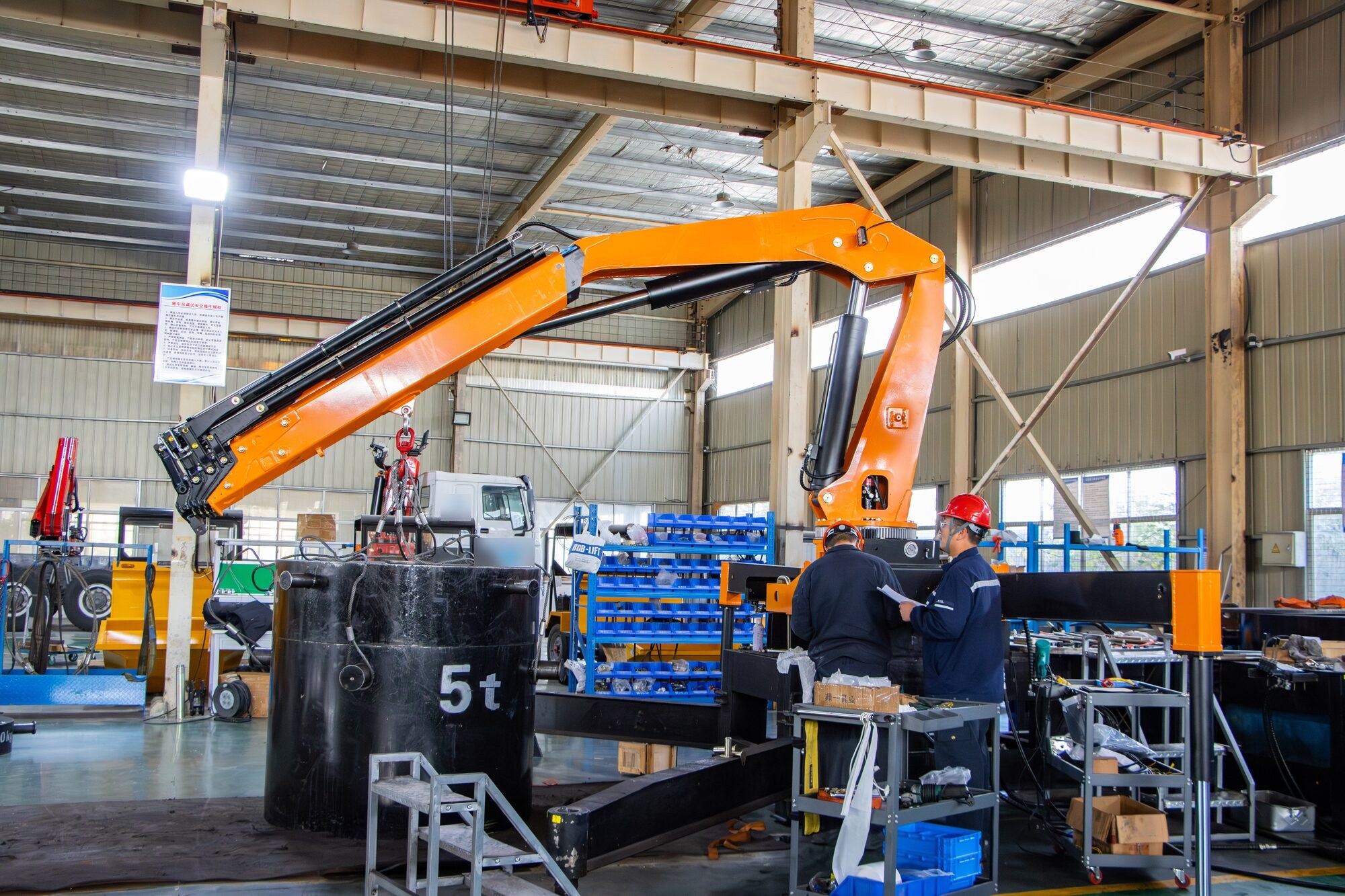

Slewing is the rotation of a crane’s column and boom around a vertical axis, so the hook can move from one side of the truck to the other. On a truck mounted crane, the slewing drive is either a toothed rack pushed by hydraulic cylinders or a hydraulic motor that turns a large slewing ring. MIAOXUE’s knuckle boom cranes up to 5 t slew 330° to 400°, and our cranes from 6.3 t to 50 t, plus all our telescopic boom cranes, are rated at 360° on their technical drawings.
We have built truck mounted cranes in Xuzhou since 2003. This guide uses our own drawings and workshop photos to explain how a slewing drive works, what the rotation angle on a spec sheet really tells you, and which checks keep the slewing system safe and tight for years.
Key takeaways
- Slewing means turning the whole crane above its base. It is one of the three main motions, with lifting and boom extension.
- Small knuckle boom cranes usually slew with a rack and pinion. Larger cranes use a slewing ring driven by a hydraulic motor and gearbox.
- Our drawings list 330° for the 1.6 t SQ1ZA3+1, 370° to 400° for 2 t to 5 t knuckle cranes, and 360° from 6.3 t to 50 t.
- An angle above 360° means the crane can pass the full circle and overlap a little, but it still has end stops.
- US rules require barriers or markings around the swing zone and a slewing speed that keeps the load under control.
What does slewing mean on a truck mounted crane?
A truck mounted crane has three principal motions: the boom is raised and lowered, the boom is extended and retracted, and the complete crane rotates on its base. That last motion is called slewing, swinging or rotation, and manufacturers, standards and specification sheets use all three terms interchangeably.
Slewing is what allows a single crane to load the truck bed, reach the pavement on the right and then deposit the load on the left. The base remains bolted to the truck’s chassis frame while everything above it rotates, including the column, the booms, the hook and the suspended load. On a knuckle boom crane, the operator frequently stands beside the base, so the control levers are located at the side of the vehicle. Our article on what a knuckle boom crane is shows where the column, base and booms sit.
The slewing system therefore performs two separate functions: it must rotate the crane smoothly under load, and it must hold the crane stationary when the operator releases the lever, even with the boom extended sideways and the vehicle standing slightly out of level.
The two slewing drives: rack and pinion or slewing ring
Truck mounted cranes use two principal designs to rotate the column, and you can usually identify which one a particular crane uses simply by examining its base.
Rack and pinion with hydraulic cylinders
In this design, a gear called a pinion is mounted at the foot of the column, and a straight toothed bar, the rack, runs horizontally across the base and engages with the pinion. Hydraulic cylinders at each end push the rack in one direction or the other, and the pinion converts that linear movement into rotation of the column. From the outside, you will see a long horizontal housing with a hydraulic cylinder on each side of the column.
Because the rack has a fixed length, the column can only rotate a limited distance before the rack reaches the end of its stroke, which is why these cranes have a rated angle such as 370° or 400° rather than unlimited rotation. The arrangement is compact and mechanically simple, and it is particularly suitable for small and medium-sized cranes.

Slewing ring with a hydraulic motor and gearbox
Larger cranes are mounted on a slewing ring, also known as a slewing bearing, which is a large-diameter ring bearing with gear teeth machined into one of its races. The column is bolted to one race and the base to the other, while a hydraulic motor with a reduction gearbox drives a small pinion that engages with the ring’s teeth. From the outside, you will see a wide bolted ring beneath the column and a vertical hydraulic motor positioned beside it.
A slewing ring simultaneously carries the weight of the column, the load and the tipping moment, and it distributes these forces over a large diameter, which is why heavier cranes depend on it. The reduction gearbox provides precise speed control and considerable holding torque. In principle, a slewing ring can rotate indefinitely; in practice, the hydraulic hoses supplying the booms must also pass from the base to the column, so the actual limit depends on the crane’s construction and should always be confirmed on the drawing.

How far does each MIAOXUE crane slew?
The following table lists the rated rotation angle of 16 of our truck mounted cranes. Every figure comes from the model’s technical drawing, the same figure printed on its product page.
| Model | Boom type | Max capacity | Rotation angle | Crane weight |
|---|---|---|---|---|
| SQ1ZA3+1 | Knuckle | 1,600 kg | 330° | 470 kg |
| SQ2ZA2 | Knuckle | 2,000 kg | 370° | 650 kg |
| SQ3.2ZA3 | Knuckle | 3,200 kg | 400° | 1,330 kg |
| SQ4ZA3 | Knuckle | 4,000 kg | 400° | 1,350 kg |
| BLZ90K4 | Knuckle | 4,600 kg | 380° | 1,600 kg |
| SQ5ZA3 | Knuckle | 5,000 kg | 400° | 2,286 kg |
| SQ6.3ZA4 | Knuckle | 6,300 kg | 360° | 2,180 kg |
| SQ8ZA5 | Knuckle | 8,000 kg | 360° | 3,250 kg |
| SQ10ZA5 | Knuckle | 10,000 kg | 360° | 3,550 kg |
| SQ12ZA4 | Knuckle | 12,000 kg | 360° | 4,480 kg |
| SQZ330 | Knuckle | 16,000 kg | 360° | 4,900 kg |
| SQZ1000 | Knuckle | 50,000 kg | 360° | 10,000 kg |
| SQ2SA3 | Telescopic | 2,000 kg | 360° | 950 kg |
| SQ5SA4 | Telescopic | 5,000 kg | 360° | 2,400 kg |
| SQ10SA5 | Telescopic | 10,000 kg | 360° | 3,950 kg |
| SQ20SA5 | Telescopic | 20,000 kg | 360° | 7,300 kg |
The pattern is consistent. Below 6.3 t, our knuckle boom cranes are rated between 330° and 400°, while from 6.3 t up to the 50 t SQZ1000, and on every telescopic model, the drawing specifies 360°. None of our truck crane drawings describes the rotation as “continuous”, so if your application requires unlimited rotation, ask us to confirm it for the exact model before you place an order.
The same logic applies to our other cranes. Our timber cranes are rated at 380°, as our timber crane guide explains. On the marine side, the drawing of the small SQ08ZA3TJ+1 lists 330°, and the BLZ90K4TJ drawing reads “360° (full rotation)”.
What the rotation angle means on the job
A crane with a limited rotation angle has mechanical end stops. Imagine the 400° SQ4ZA3 installed behind the cab: starting from the transport position, it can rotate in one direction through a complete circle and then a further 40° before it stops, and to return it must rotate in the opposite direction, because it cannot continue turning indefinitely.
That overlap is genuinely useful, because the hook can reach every position around the vehicle and the area behind the column can be approached from either direction. A 330° crane, by contrast, leaves a 30° sector that the hook cannot enter, so ask where that sector will be located once the crane is installed; ideally it should sit above the cab, where you should never swing a load anyway.
The rotation angle does not change the load the crane can lift, which depends on the working radius and on the stability of the vehicle, and stability can be lower over the front or the side than over the rear. The load chart and the stability instructions in the operator’s manual specify what applies in each working sector. Our guide on how to read a crane load chart explains how to check the load at each reach. Outrigger set-up matters just as much, and we cover it in our article on crane outriggers and ground bearing pressure.
Slewing speed and control
Slewing is the motion most likely to make a suspended load swing like a pendulum, because a load accelerated too quickly continues moving after the crane stops, imposing a lateral force on the boom and on the slewing drive. The US construction crane standard addresses this directly. Under 29 CFR 1926.1417, the “rotational speed of the equipment must be such that the load does not swing out beyond the radius at which it can be controlled”. The same section says a tag line or restraint line must be used where needed to stop a hazardous rotation of the load.
Slewing speed is determined by the hydraulic flow delivered to the slewing drive. Our drawings specify the crane’s total oil flow, for example 25 L/min for the SQ4ZA3 and 40 L/min for the SQ10ZA5, but not a slewing speed in degrees per second, so if your project specification requires that figure, request it from us before ordering. Our article on the hydraulic supply a truck crane needs explains how pump flow is matched to the crane.
Precise control matters more than maximum speed, and proportional levers or a proportional radio remote control allow the operator to start and stop the rotation gradually. We compare the options in our guide to truck crane remote control.
Slewing safety: the swing zone
When a crane slews, the rotating column and boom can strike or trap anyone standing nearby, and this hazardous area is commonly called the swing zone. US law covers it in 29 CFR 1926.1424. Where the rotating superstructure can strike or crush a worker, the employer must train staff to recognise the hazard area and mark it with “control lines, warning lines, railings or similar barriers”. If barriers are not feasible, warning signs and high-visibility markings must be used instead. The operator must also not rotate the crane while someone is known to be in an unseen part of the zone, until a pre-arranged signal confirms they are safe.
These rules apply to articulating cranes. The scope of the standard, 29 CFR 1926.1400, names “articulating cranes (such as knuckle-boom cranes)” and “commercial truck-mounted” cranes. In the UK, the LOLER regulations require every lift to be properly planned, supervised and carried out safely, and that plan should include the swing path. Rules in your country may add more.
In practice, four habits control most of the risk: keep people outside the swing zone, never swing a load over people or over an occupied cab, rotate slowly with long or light loads that catch the wind, and check the surroundings before slewing, because a column rotating close to a wall or a tree creates the classic crushing point.
Looking after the slewing system
The slewing system operates during virtually every lift, so it requires regular attention at the intervals specified in the crane’s manual. These are the points we ask owners to monitor:
- Grease. Grease the slewing ring and its gear teeth, or the rack and pinion, on schedule. Dry teeth wear fast and make the slew jerky.
- Bolts. Check that the bolts holding the slewing ring, the column and the base are tight. A loose bolt on a slewing ring is serious, so stop and call us.
- Play. Watch for new rocking or clicking in the column when the boom is loaded. Extra play means wear in the bearing or the gears.
- Leaks. Look for oil at the slewing cylinders, the motor and the hoses that cross from the base to the column.
- Drift. On a slight slope, a crane that turns by itself after you release the lever has a problem in its holding valve or brake.
Our truck mounted crane inspection checklist puts these checks into a daily, monthly and annual routine. If a part needs replacing, our guide to truck mounted crane parts shows what each part is called, so you can order the right one.
What to ask before you buy
- What is the rated rotation angle, and is it limited or continuous?
- Which slewing drive does the crane use: rack and pinion or slewing ring with a motor?
- Where are the end stops when the crane is mounted behind the cab or at the rear?
- Is the load chart the same all the way around, or is it reduced over some sectors?
- What control system is fitted: manual levers, proportional levers or a radio remote?
Example scenario (an illustration, not a customer record): a builders’ merchant delivers blocks to sites where the truck often parks with a wall on the left. A 400° knuckle crane behind the cab can reach the pavement on the right and the rear of the bed from either direction. The 40° overlap lets the operator choose the shorter swing, away from the wall.
Frequently asked questions
What is a slewing drive on a truck mounted crane?
It is the mechanism that turns the crane’s column on its base. Small cranes usually use a rack and pinion moved by hydraulic cylinders, and larger cranes use a slewing ring driven by a hydraulic motor and gearbox.
What is the difference between slewing and swinging?
There is none. Slewing, swinging and rotation all describe the crane turning around its vertical axis. US rules often say swing or rotate, and many European documents say slewing.
Can a truck mounted crane rotate 360 degrees?
Most can turn a full circle or more. Our knuckle cranes from 2 t to 5 t are rated 370° to 400°, and our cranes from 6.3 t to 50 t are rated 360°. Ask whether the rotation is continuous for your model.
What is a slewing ring on a crane?
A slewing ring is a large ring bearing with gear teeth between the base and the column. It carries the weight and the tipping force, and a motor-driven pinion turns it.
Why does my crane slew by itself?
If the truck is off level, gravity pulls the boom downhill. A healthy holding valve or brake should stop it. If the crane drifts, stop using it and have the slewing circuit checked.
How we compiled this guide
We compiled every rotation angle, capacity and weight from the MIAOXUE technical drawings of the 16 models in the table, checked against their product pages in November 2026. The descriptions of the two slewing drives are based on our own cranes, and the photos show an SQ4ZA3 and an SQ8ZA6+1 in our Xuzhou workshop. The safety rules are quoted from the official eCFR text and the HSE website. Achord Chan, Product Operations Director, reviewed the guide in November 2026. It does not replace the crane’s manual or the law where you work.
Get the drawing for the crane you need
Tell us your truck, the loads you lift and how far around the truck you need to work, and we will send the drawing and load chart for the right model, with its rotation angle confirmed. Every crane carries a 12-month warranty on the whole machine, common spare parts leave the factory within 48 hours, and our service team answers within 12 hours. Contact us for a quotation.