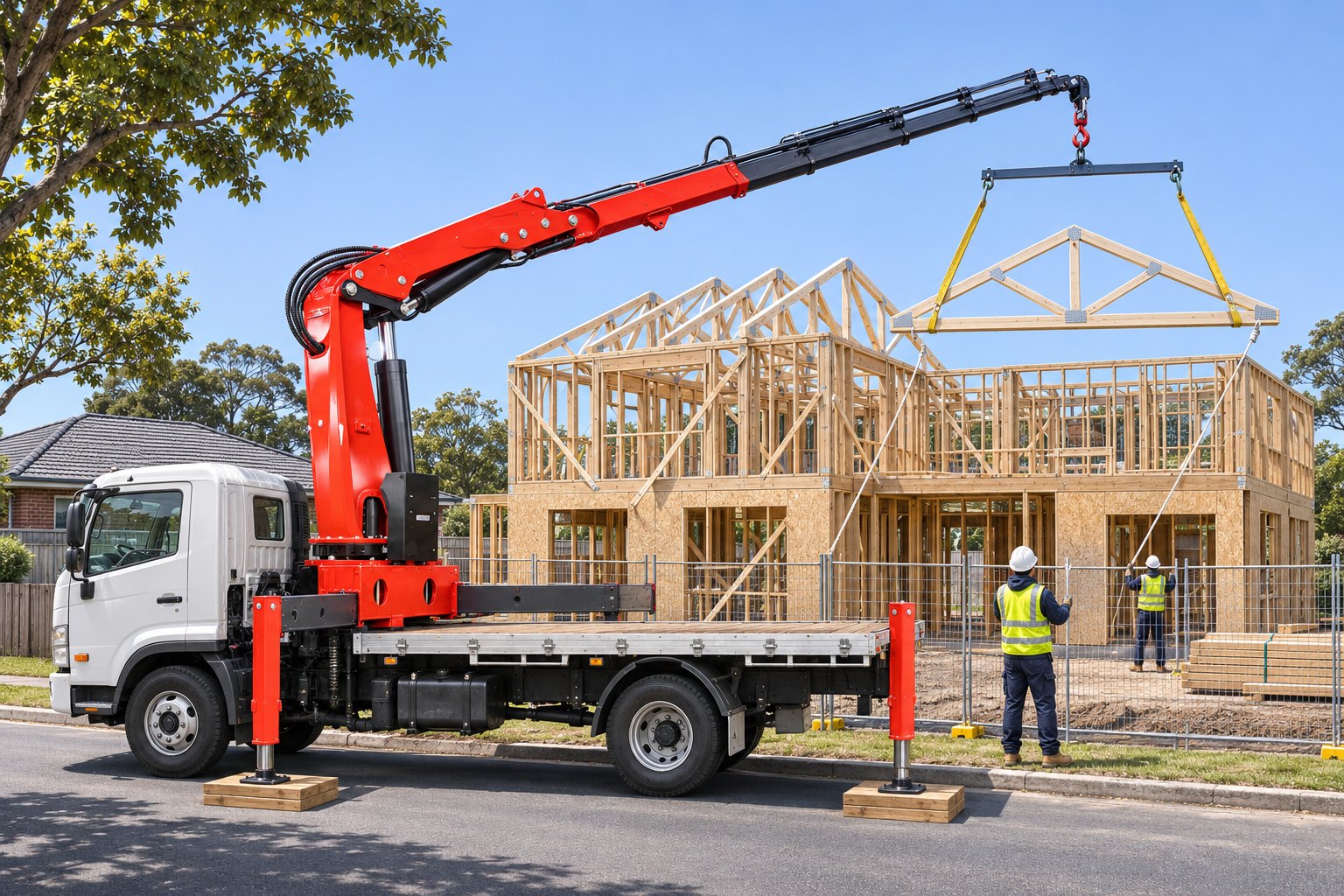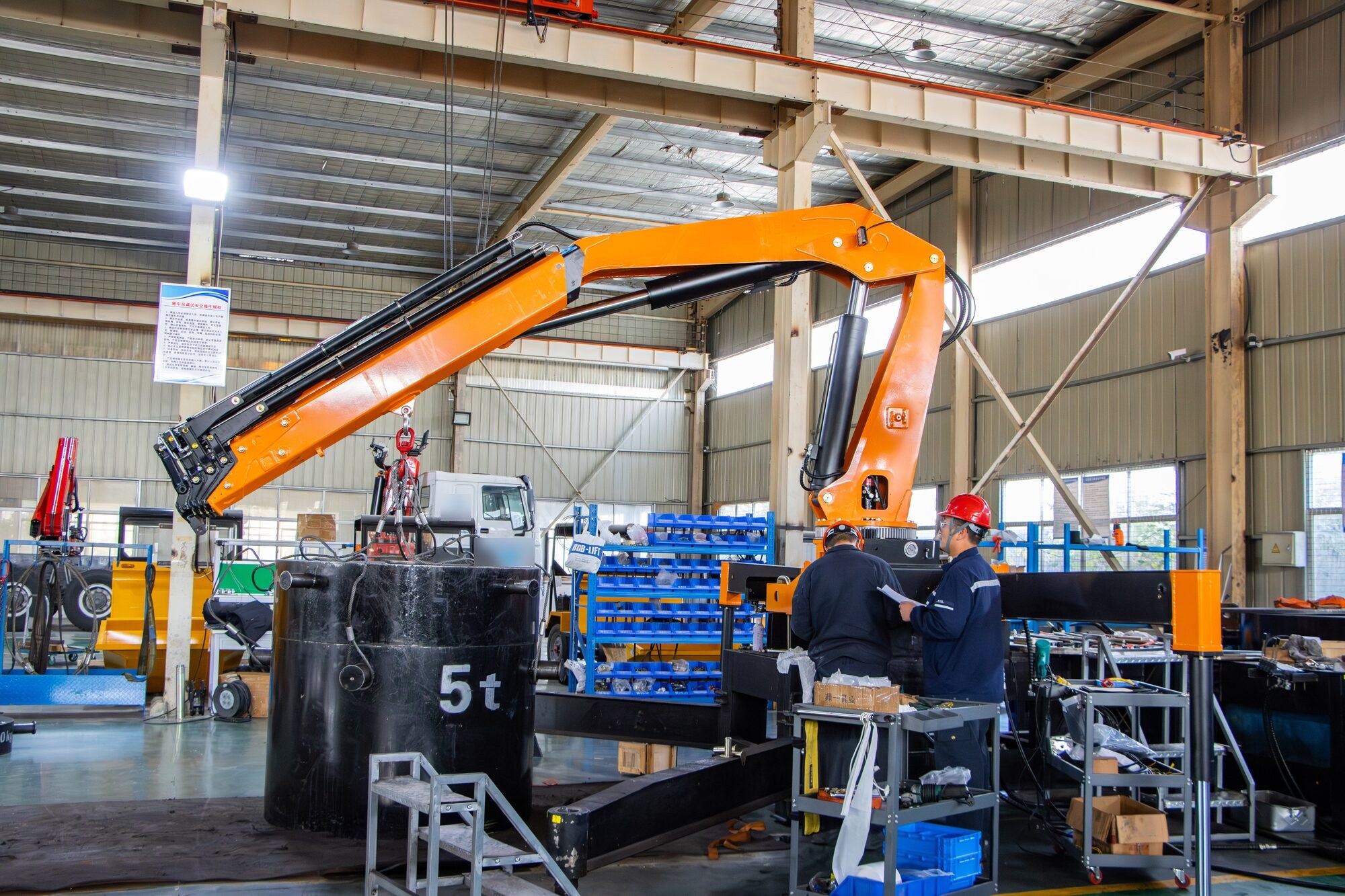
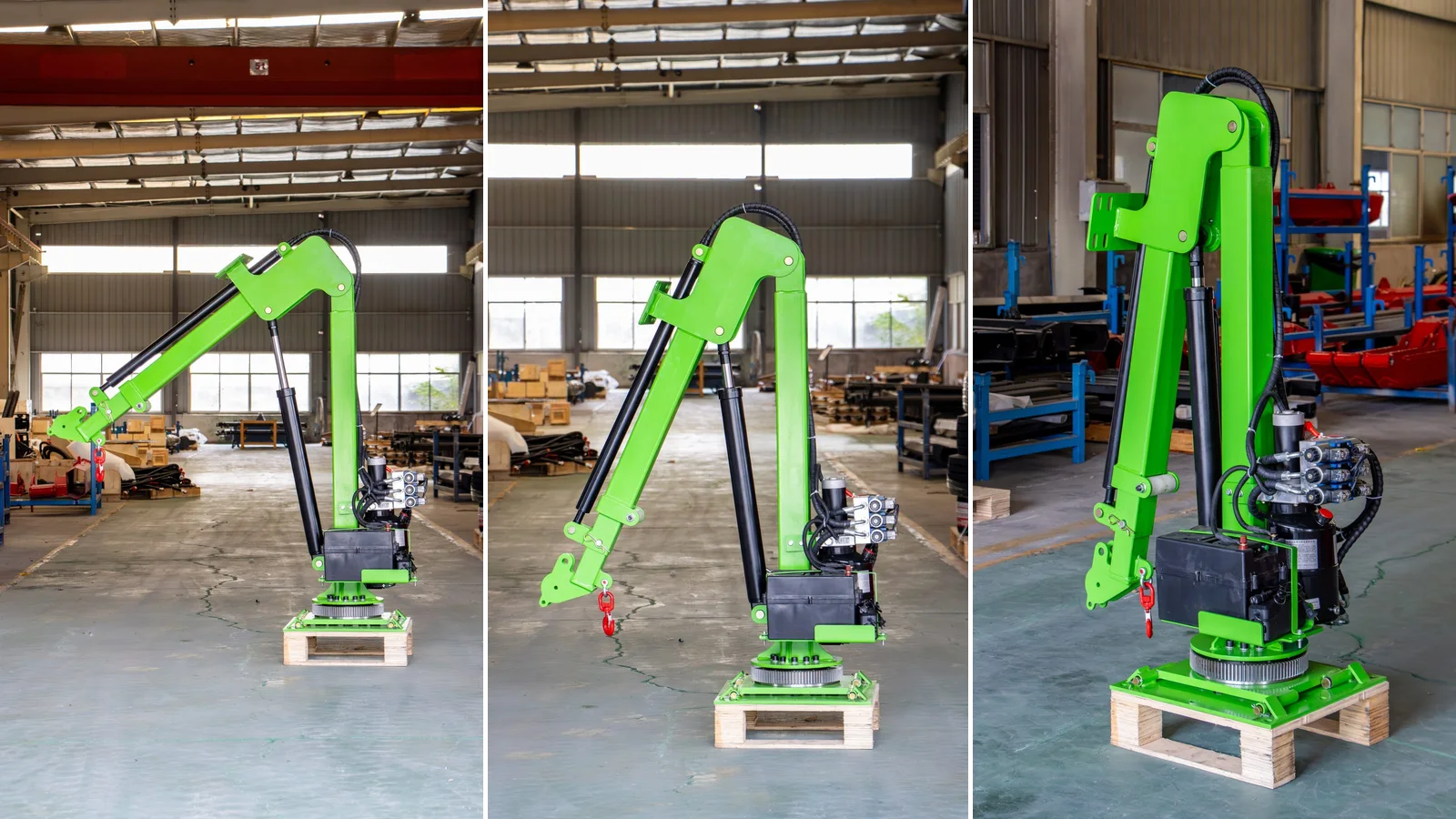
An electric truck crane is a small crane for a pickup, a light truck or a utility body that runs on the vehicle’s 12 V battery system instead of the engine’s power take-off. An electric motor drives either a wire-rope winch or, in an electric-over-hydraulic design, a compact hydraulic pump that moves the boom. Because it needs no PTO, no engine running and no hydraulic plumbing from the truck, it is the simplest way to put a crane on a vehicle that only lifts occasional loads.
MIAOXUE has manufactured truck mounted cranes in Xuzhou, China, since 2003, and in November 2026 we added two electric-hydraulic models to our range, the 1 t SQ1Z-E and the 2 t SQ2Z-E. This guide explains how electric truck cranes work, compares the two common designs, and uses the load charts, power data and mounting drawings of our two models to show how to size one for your vehicle. We supply the crane only; it bolts to the truck or trailer you already own.
Key takeaways
- Electric truck cranes come in two designs: electric winch cranes that lift on a wire rope, and electric-over-hydraulic cranes in which a 12 V motor drives a pump that luffs, extends and slews the boom.
- Our SQ1Z-E lifts 1,000 kg at 1.2 m and 200 kg at its full 2.8 m reach; the SQ2Z-E lifts 2,000 kg at 1.2 m and 500 kg at 3.1 m.
- The power units draw 1,200 W and 2,200 W from a 12 V DC supply, so they need heavy cabling, a fuse and a battery sized for the work, typically 60 Ah and 136 Ah.
- The cranes weigh 235 kg and 290 kg and bolt down with eight M12 or M18 bolts, with no welding and no changes to the truck’s engine.
- Choose by the load at the reach you need, then check the truck’s payload, the deck structure under the base and the battery.
How does an electric truck crane work?
Every crane needs a power source for its movements. A conventional hydraulic truck crane takes oil flow from a pump driven by the truck’s power take-off, which our guide to hydraulic cranes for trucks explains in detail. An electric truck crane replaces that arrangement with an electric motor, powered by direct current from a battery, so the crane can operate while the engine is switched off.
There are two common designs, and they suit different applications:
- Electric winch crane. An electric winch reels a wire rope over a sheave at the boom tip, so the motor lifts the load directly. Booms are often slewed and extended by hand. These cranes are light and popular on service trucks, but each powered movement usually needs its own motor.
- Electric-over-hydraulic crane. A 12 V motor drives a small hydraulic pump with its own oil tank. Hydraulic cylinders raise and extend the boom, and a hydraulic motor slews the column. This is the design of our SQ1Z-E and SQ2Z-E, and it gives smooth, proportional movement under load, such as when an operator sets a gearbox gently onto a bench.
Our electric models have no winch. The hook hangs from a swivel at the boom head, and the operator changes hook height by luffing and extending the boom. That keeps the crane simple and avoids wire-rope inspection, but it means the hook cannot drop far below the crane base, so check that the hook height range suits your loads.
Electric truck crane specifications
Both models share one design: a folding boom of three sections, with hydraulic luffing, a hydraulic second section, a manual third section that you pull out by hand and pin, and 360° hydraulic slewing on a toothed slewing ring. The model codes are simple to read: in SQ1Z-E, “1” is the rating in tonnes, “Z” marks the folding boom and “E” the electric drive. A final M means manual levers and R means a wireless remote.
| Specification | SQ1Z-E (1 t) | SQ2Z-E (2 t) |
|---|---|---|
| Rated load, retracted boom | 1,000 kg at 1.2 m | 2,000 kg at 1.2 m |
| Hydraulic extension | 500 kg at 2 m | 1,000 kg at 2 m |
| Manual extension, full reach | 200 kg at 2.8 m | 500 kg at 3.1 m |
| Hook height by section | 2,100 / 2,600 / 3,100 mm | 2,400 / 2,900 / 3,400 mm |
| Motor and supply | 1,200 W, 12 V DC | 2,200 W, 12 V DC |
| Typical battery | 12 V 60 Ah | 12 V 136 Ah |
| Crane weight | 235 kg | 290 kg |
| Stowed size (L × W × H) | 750 × 520 × 1,570 mm | 850 × 620 × 1,670 mm |
| Mounting bolts | 8 × M12 on a 390 mm square | 8 × M18 on a 480 mm square |
| Slewing | 360° | 360° |
Both cranes are also offered on an optional base cart with side outriggers, which weighs 285 kg with the SQ1Z-E and 350 kg with the SQ2Z-E, for use on a workshop floor or a dock rather than on a vehicle.
How much can an electric truck crane lift?
The rating on an electric crane, as on any crane, applies only close to the column. As the boom extends, the permitted load falls, because the lifting moment, meaning the load multiplied by its distance from the slewing centre, has a fixed limit. The chart below plots the points from our two load charts.

Two observations matter for planning. First, the full rating is available only up to 1,200 mm from the column, which on a pickup is roughly the distance from the crane to the near side of the bed. Second, at 2,000 mm both cranes lift exactly half their rating, so a load placed at the tailgate or beside the vehicle should weigh no more than half the headline figure. Our guide on how to read a crane load chart covers the method in more detail.
Example scenario (an illustration, not a customer record): a farm workshop needs to lift a 400 kg gearbox from the ground beside a light truck and set it in the middle of the bed. If the crane sits behind the cab and the pick-up point is about 2,500 mm away, the SQ1Z-E is limited to between 500 kg and 200 kg at that radius, which is too close to the load. The SQ2Z-E still lifts 1,000 kg at 2,000 mm and 500 kg at 3,100 mm, which leaves a sensible margin for that lift.
Battery, wiring and duty cycle
Power is where electric truck cranes differ most from PTO-driven cranes. A 1,200 W motor on a 12 V supply draws roughly 100 A while the pump runs, and a 2,200 W motor draws roughly 180 A; these are simple power-divided-by-voltage estimates that ignore efficiency losses, so the real current is higher. Those currents call for short, heavy cables, a correctly rated fuse or circuit breaker close to the battery, and a battery that can deliver them without excessive voltage drop.
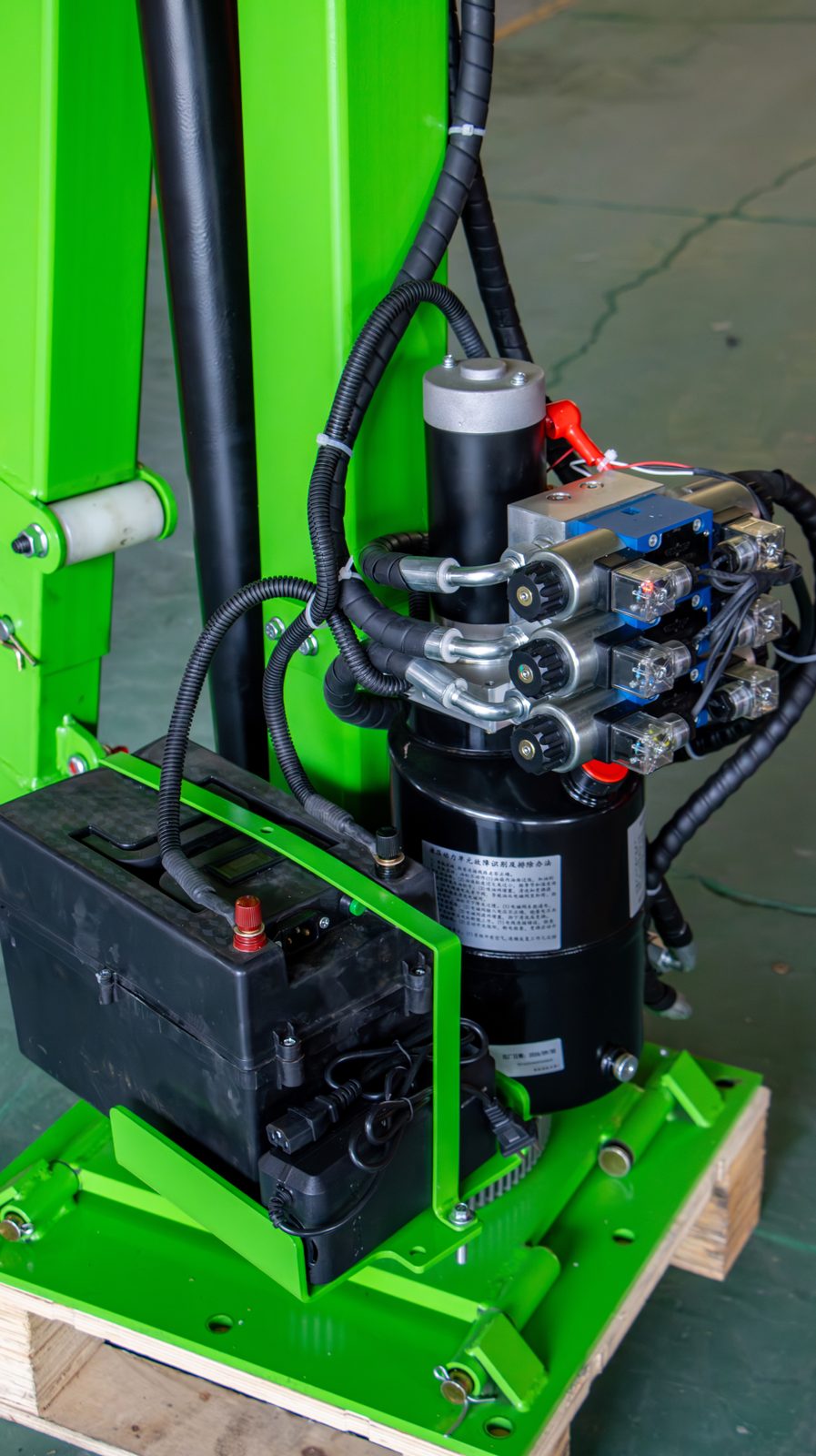
Our factory units carry their own 12 V battery in a frame beside the power unit, with a mains charger, so the crane can also work where no vehicle power is available. On a truck, the supply can also be taken from the vehicle’s electrical system, so that the alternator recharges the battery while the engine runs; we confirm the wiring arrangement with your quotation. If your vehicle runs a 24 V system, tell us when you enquire so that we can confirm the supply arrangement.
The power units are designed for intermittent operation, the stop-and-go rhythm of loading and unloading, rather than hours of continuous cycling. Long sequences of back-to-back lifts discharge the battery and heat the motor, so plan to recharge between jobs. Lead-acid batteries also release hydrogen while charging, and the UK Health and Safety Executive advises charging them in a dedicated, well-ventilated area and protecting the terminals against short circuits [1].
Wireless remote or manual levers?
Each model comes with either of two controls on the same crane, power unit and boom. The ER version uses a handheld wireless remote with a start and stop button and six motion buttons: boom up and down, extend and retract, slew left and right. Each button operates a solenoid valve, so a single operator can stand where the load is easiest to see and guide it with a free hand. The EM version uses one lever per movement on the valve bank beside the column, with no radio link to pair, charge or replace. Our article on truck crane remote controls discusses the trade-offs for larger cranes.

Mounting an electric crane on a pickup or light truck
Because the crane has its own power unit, installation is largely mechanical. The base plate bolts down with eight bolts: M12 on a 390 mm square for the SQ1Z-E and M18 on a 480 mm square for the SQ2Z-E. No welding is needed, and nothing changes on the engine or gearbox. Before you drill, check three points:
- The structure under the base. It must withstand the crane’s lifting moment, which is 1.2 t·m for the SQ1Z-E and 2.4 t·m for the SQ2Z-E at their rated loads. A thin bed floor alone is rarely enough, so add a reinforcing plate or a subframe tied into the chassis, and have the design checked by a qualified engineer.
- Payload. Subtract the crane’s weight, the reinforcement and the battery from the vehicle’s rated payload before you load any cargo.
- Stability. A light vehicle can tilt when a load swings out to the side. Lift on firm, level ground, keep loads close to the column, and consider outriggers or stabilisers for regular side lifts; our guide to crane outriggers and ground pressure explains the principles.
Typical users include repair workshops lifting engines and gearboxes, farms handling machinery parts and fertiliser, solar installers, municipal maintenance crews and small building contractors. For heavier loads or longer reach, a hydraulic crane driven by the truck’s PTO is usually the better choice; our small truck crane guide compares the options from 800 kg upward.
Rules and safe use
A small crane is still a crane in law. In the United States, OSHA’s construction crane rule sets a reduced list of requirements only for equipment with a rated capacity of 2,000 lb or less [2]; at 1,000 kg, which is about 2,205 lb, and 2,000 kg, our two models sit above that line, so check which provisions apply to your work. In Great Britain, lifting equipment needs a thorough examination by a competent person at least every 6 or 12 months, depending on its use, or under an examination scheme [3]. Whatever the jurisdiction, a few habits prevent most incidents:
- Never exceed the load on the chart at your actual radius, and never side-pull or drag a load.
- Keep people out from under the boom and the load, and wear a hard hat while lifting.
- Grease the slewing ring and pivot pins regularly; outdoors, mud and grit wear the ring and the cylinder seals faster.
- Inspect hoses, pins, the hook latch and the battery cables before each shift, using our crane inspection checklist as a starting point.
Frequently asked questions
Can an electric truck crane run without the engine on?
Yes. The crane draws power from a 12 V battery, so it works with the engine switched off. On long jobs, run the engine between lifts or recharge the battery afterwards, because repeated lifting discharges it.
What is the difference between an electric and a hydraulic truck crane?
A conventional hydraulic truck crane takes oil from a pump driven by the truck’s power take-off. An electric-over-hydraulic crane carries its own motor and pump, powered by a battery. It is simpler to install but limited to smaller loads and intermittent use.
How much can a 1 ton electric crane lift at full reach?
Our SQ1Z-E lifts 1,000 kg at 1.2 m, 500 kg at 2 m and 200 kg at its full 2.8 m reach. The 2 t SQ2Z-E lifts 500 kg at its full 3.1 m reach.
What battery does an electric truck crane need?
Our models run on 12 V DC. The usual battery is 60 Ah for the 1,200 W SQ1Z-E and 136 Ah for the 2,200 W SQ2Z-E. A larger battery gives more lifts between charges.
Does an electric truck crane have a winch?
Electric winch cranes do; ours do not. On the SQ1Z-E and SQ2Z-E, the hook hangs from the boom head, and hook height ranges from 2,100 mm to 3,400 mm depending on the model and the boom section in use.
Can I fit an electric crane to my pickup?
Usually, yes, if the payload and the bed structure allow it. Send us the vehicle make, model and payload, a photo of the bed and the loads you plan to lift, and we will confirm the model and the mounting.
How we compiled this guide
We compiled the loads, radii and hook heights from the MIAOXUE load charts of the SQ1Z-E and SQ2Z-E, and the power, battery, weight, dimension and mounting data from our technical data sheets and mounting drawings, in November 2026. The current figures are simple estimates from the rated power and voltage. The photos and the video were taken at our Xuzhou factory, and the rules are summarised from the official pages linked above as they stood in November 2026. The guide was reviewed by Achord Chan, Product Operations Director. Specifications can change without notice, so ask for the current drawing before you order.
Find the right electric truck crane
Tell us where the crane will be mounted, the heaviest load and the reach you need, and whether you prefer the wireless remote or manual levers, and we will confirm the model and configuration with your quotation. Every crane carries a 12-month warranty on the whole machine, common spare parts are dispatched within 48 hours, and our service team replies within 12 hours. Browse our electric mini cranes or contact us to start.