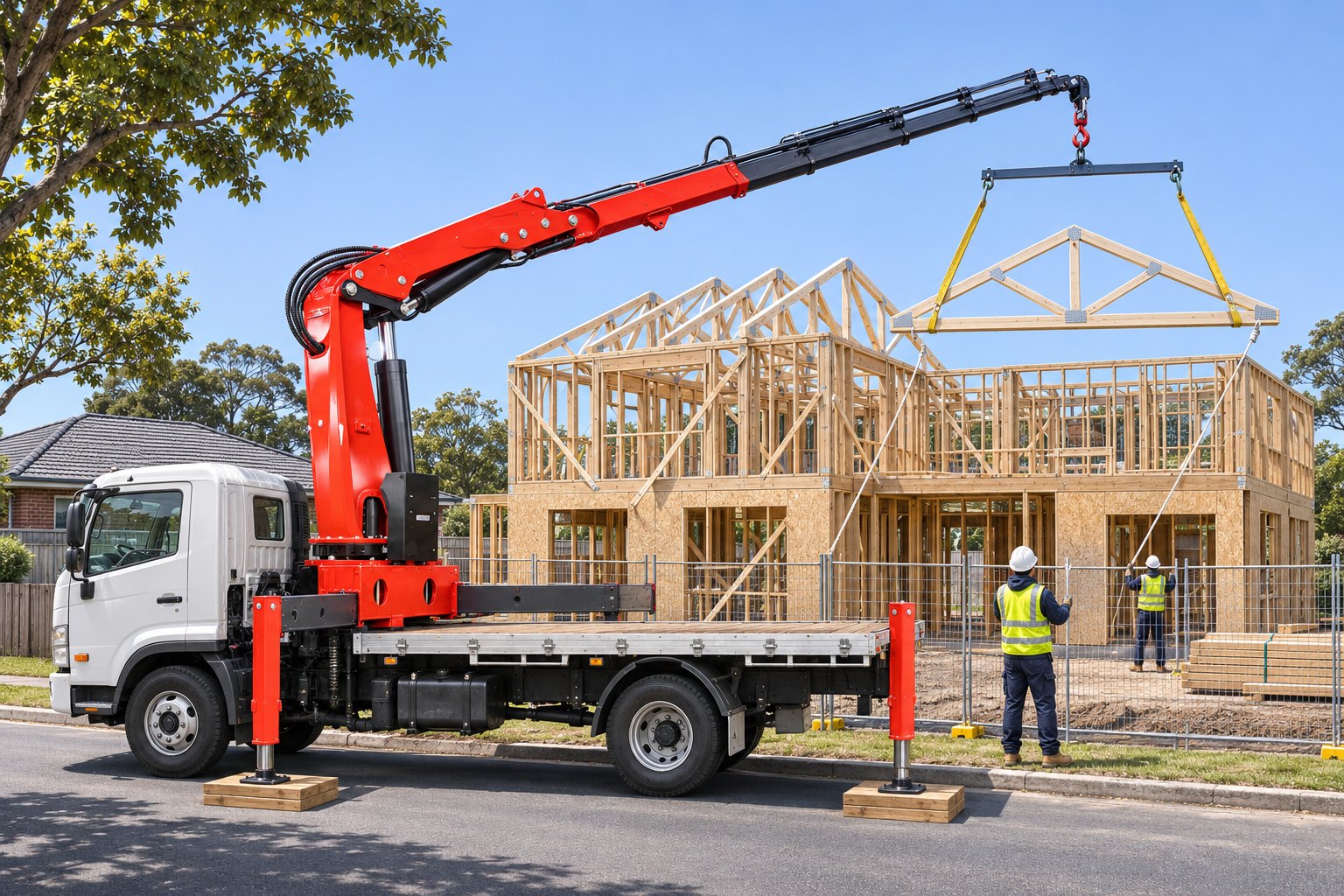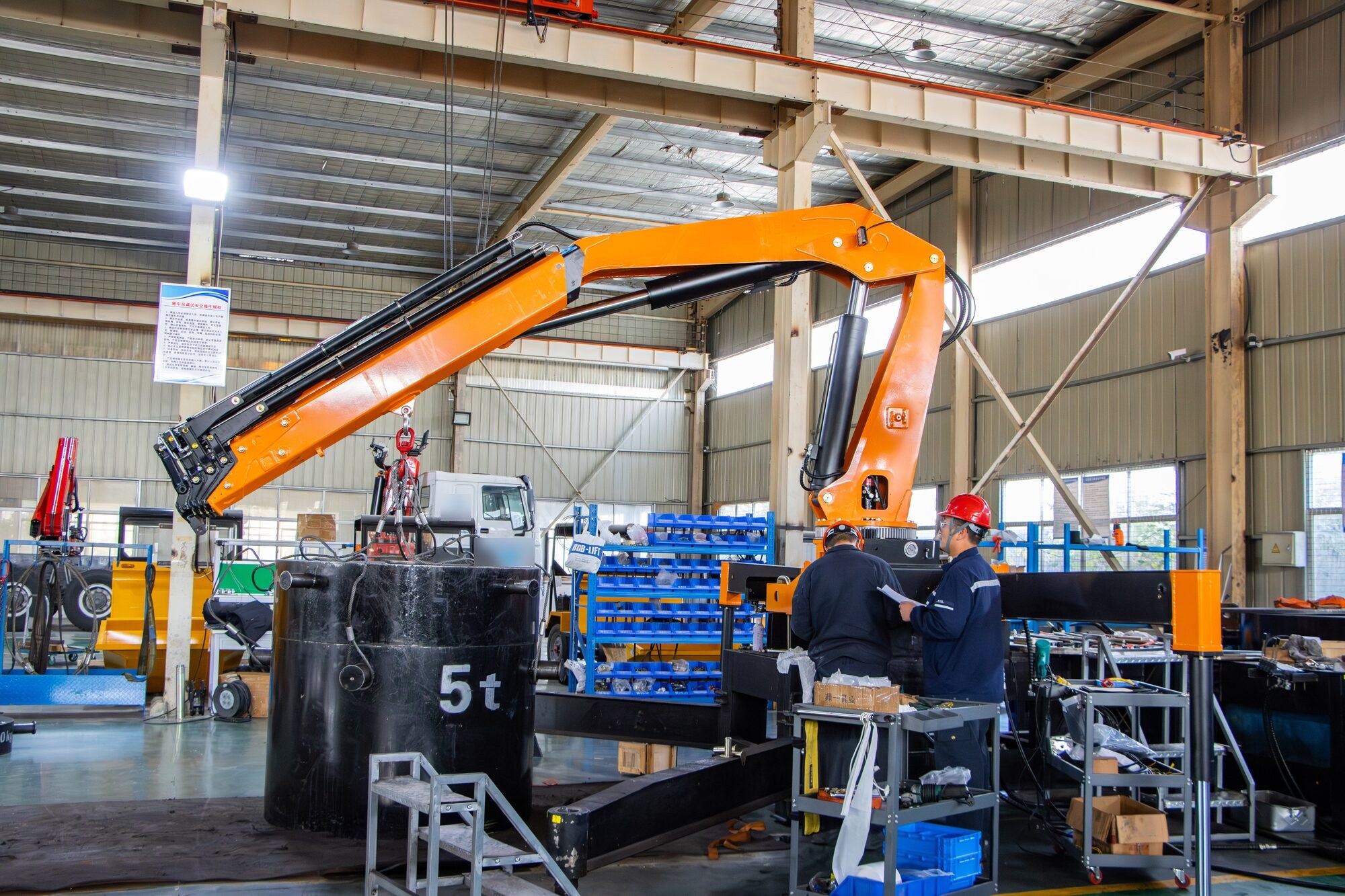

Choose a knuckle boom marine crane when deck space is limited, when loads must go down into a hold, or when the hook has to clear a bulwark or deck cargo. Choose a telescopic marine crane when the vessel has a long, open deck and most lifts run directly from the deck to the quay. Our technical drawings show how large the trade-off can be: at 20 t, the telescopic model reaches 22.0 m against 16.6 m for the knuckle boom, but it weighs 6,950 kg against 4,900 kg.
This guide is written for vessel owners, shipyards and fleet managers who have already decided to install a hydraulic crane and now have to select the boom type. We paired six of our knuckle boom and telescopic marine cranes with identical rated capacity, from 3.2 t to 20 t, and compared everything the drawings specify: maximum outreach, the load available at that outreach, crane weight, stowed dimensions, base configuration and hydraulic requirements. Every crane figure in this article comes from those drawings.
Key takeaways
- A folded knuckle boom occupies an envelope between 2.27 m and 2.81 m long in our six models, whereas a fully retracted telescopic boom still projects 3.37 m to 6.02 m from the slewing centre.
- Telescopic models reach further at every size, from 0.8 m further at 10 t to 6.4 m further at 16 t.
- Up to 10 t, the knuckle boom carries more load at its own maximum outreach; from 12 t to 20 t, the telescopic crane carries more at the same radius, for example 3,500 kg against 2,240 kg at 14.3 m in the 20 t pair.
- The 16 t and 20 t telescopic models weigh 1,300 kg and 2,050 kg more than their knuckle partners and require considerably more hydraulic flow.
- From 3.2 t to 12 t, both boom types in each pair use the same base dimensions and bolt count, so a single pedestal design can accommodate either crane.
How the two boom types work on a vessel
A knuckle boom marine crane is a hydraulic crane whose boom has an articulated joint in the middle, operating rather like an arm with an elbow. The inner boom rises from the column, the outer boom folds against it and carries the extension sections, and when work stops the complete boom folds back beside the column into a compact package. It is also known as a folding marine crane or a hydraulic folding marine crane.
A telescopic marine crane is a hydraulic crane with a single straight boom that extends in sections. One luffing cylinder raises and lowers the boom, while extension cylinders inside it push the sections outward. Because the boom cannot fold, it usually travels on a boom rest positioned along the deck. Both types are installed on a steel pedestal and slew around the column. Our knuckle boom vs telescopic boom truck crane comparison examines the same decision on a lorry; on a vessel, deck space, hold access and sea conditions change the answer.
Six pairs compared: outreach, load and weight
Rated capacity is the maximum load a crane lifts close to its column, so we paired models with identical rated capacity to keep the comparison fair. On a ship, however, rated capacity reveals very little. The load available at your actual working radius matters far more, followed closely by the additional weight the installation places on the deck.

The chart reveals three consistent patterns. First, the telescopic boom always reaches further. Second, the smaller knuckle booms retain more load at their own maximum outreach: the 3.2 t knuckle model lifts 680 kg at 7.7 m, whereas the 3.2 t telescopic lifts 200 kg at 10.5 m. Third, the advantage changes hands as capacity increases, because from 12 t upwards the telescopic crane exceeds the knuckle boom’s end-of-reach load even at a longer radius; the 20 t telescopic lifts 2,200 kg at 18.3 m, compared with 1,910 kg at 16.6 m for the 20 t knuckle boom.
Maximum outreach does not tell the complete story, so we also compared both load charts at matching radii, using the nearest available points where the charts do not share an identical distance:
- 3.2 t: knuckle 910 kg at 5.9 m; telescopic 800 kg at 5.7 m.
- 10 t: knuckle 2,280 kg at 8.51 m; telescopic 2,200 kg at 9.0 m, which is practically equal.
- 12 t: knuckle 1,400 kg at 12.0 m; telescopic 1,850 kg at 12.6 m.
- 16 t: knuckle 2,410 kg at 9.8 m; telescopic 4,100 kg at 10.45 m.
- 20 t: knuckle 2,240 kg at 14.3 m; telescopic 3,500 kg at 14.3 m.
For heavy loads at a long radius, therefore, the larger telescopic models deliver more capacity. That capacity comes with additional weight, a longer stowed boom and a larger hydraulic supply, which the following sections examine individually. Our deck crane guide explains how to measure the outreach you need over the side before you compare load charts.
Stowed size and deck footprint
A marine crane spends most of its working life stowed, so the space it occupies when idle is frequently the deciding factor. The table compares the folded knuckle envelope with the retracted telescopic boom. For each telescopic model, the minimum radius on the drawing indicates how far the boom tip still extends from the slewing centre when every section is fully retracted.
| Rated capacity | Knuckle model: folded length × height × width | Telescopic model: retracted boom tip from slewing centre | Telescopic stowed height |
|---|---|---|---|
| 3.2 t | SQ3.2ZA3TJ: 2,271 × 1,951 × 684 mm | SQ3.2SA4T: 3.37 m | 2,200 mm |
| 5 t | SQ5ZA3TJ: 2,321 × 2,261 × 712 mm | SQ5SA4T: 3.99 m | 2,178 mm |
| 10 t | SQ10ZA6TJ: 2,454 × 2,295 × 1,219 mm | SQ10SA4T: 5.25 m | 2,549 mm |
| 12 t | SQ12ZA6T: 2,807 × 2,399 × 1,597 mm | SQ12SA4T: 5.54 m | 2,617 mm |
| 16 t | SQZ330T: 2,632 × 2,339 × 1,429 mm | SQ16SA5T: 5.95 m | 2,784 mm |
| 20 t | SQZ430T: 2,550 × 2,350 × 1,453 mm | SQ20SA5T: 6.02 m | 2,757 mm |
The difference increases with capacity. A folded 10 t knuckle boom fits within 2.45 m of deck length, while the retracted 10 t telescopic boom projects 5.25 m from the column, and the 20 t telescopic projects 6.02 m. The folded knuckle boom is also lower in five of the six pairs; only the 5 t telescopic stands lower than its knuckle partner.
On a short workboat, supply boat or landing craft, that boom length can obstruct the cargo deck or the visibility from the wheelhouse. On a long cargo deck it is often irrelevant, because the telescopic boom simply lies above the hatch or the cargo on its rest.
Hook below deck and lifting over obstacles
The articulated joint gives the hook a path that a straight boom cannot follow. The inner boom can stand steeply while the outer boom reaches over a bulwark, a deckhouse or stacked cargo and then angles downward into a hatch. That geometry makes the knuckle boom the usual choice for cargo hold operations, for lifting provisions through a deck opening and for reaching beneath a quay edge at low tide.
A telescopic boom works from above and performs best on long, unobstructed lifts, for example from the deck of a vessel lying alongside to a truck waiting on the quay. It is less practical when an obstacle stands between the column and the load. For loads positioned well below the crane base, both types use a winch, which pays out rope so that the hook descends below the boom tip. Our models with J in the code, such as the SQ10ZA6TJ, are drawn with a winch drum, and our product pages list a winch as an option for both boom types.

Crane weight, the deck and the vessel’s stability
Up to 12 t, the paired cranes weigh within 330 kg of each other: 1,236 kg against 1,250 kg at 3.2 t, and 4,350 kg against 4,050 kg at 12 t. Above that capacity the difference becomes significant. The 16 t telescopic weighs 5,800 kg, which is 1,300 kg more than the 16 t knuckle boom, and the 20 t telescopic weighs 6,950 kg, or 2,050 kg more. That weight sits high above the deck, and on a small vessel it can become a genuine stability concern.
UK maritime guidance warns that inappropriate use or failure of lifting equipment can affect a vessel’s stability and, on smaller vessels, could possibly lead to capsize [1]. The UK regulations also require lifting equipment to have adequate strength and stability for each load, with particular regard to the stress induced at its mounting point [2]. Provide the crane weight and foundation loads of both options to your naval architect at an early stage, because the lighter installation can decide the choice by itself.
The base is encouraging news for anyone still undecided. In four of our six pairs, both boom types share identical base dimensions and bolt counts: 550 × 550 mm with 16 bolts at 3.2 t, 680 × 680 mm with 24 bolts at 5 t, and circular flanges with 28 bolts at 10 t and 12 t. Two of those pairs differ by 1 mm in hole diameter, so always fabricate from the drawing of the exact model. At 16 t and 20 t the bases are different, which means the boom type must be confirmed before the pedestal is built. Our pedestal crane guide covers flanges, bolts and foundation loads in detail.
Hydraulic power each type needs
At small capacities, both types require similar oil flow: 25 L/min for both 3.2 t models, and 35 and 32 L/min at 5 t. From 10 t upwards, the telescopic models demand considerably more. The drawings specify 63 L/min and 37 kW for the 10 t telescopic, compared with 40 L/min and 30 kW for the 10 t knuckle boom; at 12 t the figures are 75 against 55 L/min, and the 20 t telescopic operates on two circuits, 80 + 63 L/min, where the 20 t knuckle boom needs 63 L/min.
Additional flow requires a larger pump on the engine power take-off or a more powerful electric hydraulic unit on deck. On a vessel with limited electrical capacity, that requirement alone can favour the knuckle boom.
Wind, waves and stowage at sea
Both cranes must be stowed and secured before the vessel gets under way, with the hook fastened so that it cannot swing. The folded knuckle boom stows close to the column, whereas the telescopic boom rests on a support along the deck, so include that rest and its lashing in the deck layout. A long boom also provides a long lever for any sideways force from rolling or wind, so ask your supplier how the boom rest is attached.
Neither boom type changes the fundamental rule at sea: load charts assume a level, stable base. MGN 332 notes that high winds or wave action can cause suspended loads to swing dangerously [1]. US construction rules for cranes on barges and other vessels go further and require the land rating to be reduced to account for list, trim, wave action and wind [3]. UK legislation requires lifting operations to stop when weather conditions deteriorate enough to affect safe use [2], and the UK safety regulator lists wind effects and derating among the considerations for planning every lift [4]. A long telescopic boom at full extension experiences these effects at the hook more than a short boom, so allow a larger margin on long lifts.
Maintenance points and cost of ownership
A knuckle boom has more moving joints: a luffing cylinder on the inner boom, a second cylinder on the outer boom, extension cylinders, and a set of link plates and pins at the knuckle. Every pin is both a lubrication point and a wear point in salt spray. A telescopic boom has fewer pins but depends on sliding wear pads between the boom sections, which need regular inspection and adjustment, and its extension cylinders are enclosed inside the boom, where water can accumulate.
Neither type is free of maintenance. MGN 332 lists regular tasks such as greasing bearings and moving parts, examining structures for corrosion and cracks, and draining trapped water from hollow structures [1]. Under the UK regulations, lifting equipment needs a thorough examination at least every 12 months, or every 6 months if it lifts people [2]. Over the operating life of the crane, the principal cost drivers are identical for both types: deck reinforcement for the weight, the power unit for the flow, and lubrication and inspection time for the joints and sections.
Which boom suits which vessel?
The table summarises what we observe across our installations and drawings. Treat it as a starting point, and then verify your own loads and radii against the load charts.
| Typical job | Usually better fit | Why |
|---|---|---|
| Provisions and stores on a short deck | Knuckle boom | Folds into a small space and clears rails and deckhouses |
| Cargo hold or hatch operations | Knuckle boom with winch | The outer boom angles downward into the opening |
| Workboat or harbour tender | Knuckle boom | Low folded height and moderate weight up to 10 t |
| Cargo vessel alongside, deck to quay | Telescopic | Long, straight reach across the quay edge |
| Heavy loads at 12 m or more | Telescopic, 12 t and above | More load at the same radius in our 12–20 t pairs |
| Work barge or pontoon | Either; verify heel and power | A long open deck suits a telescopic; stand-alone power favours lower flow |
For an unpowered barge, our barge crane guide explains how to estimate heel, and for boats under about 10 m, our boat crane guide is the better starting point. The complete model ranges are listed on our knuckle boom marine crane and telescopic marine crane pages.
Example scenario (an illustration, not a customer record): a 24 m supply boat must lift 1 t pallets from the quay into a hatch 8 m from the crane, and its aft deck is only 6 m long. The 10 t knuckle boom marine crane lifts 2,280 kg at 8.51 m and folds into 2.45 m, so it suits that deck. A 40 m cargo vessel that moves 1 t bundles 18 m across a quay needs the reach of the 16 t telescopic marine crane, which lifts 1,700 kg at 18.55 m.
Choosing between them: six steps
- Loads and radii. List the heaviest load and the most frequent load, each with its radius from the planned column position.
- Path of the hook. Mark every bulwark, deckhouse or hatch the load must pass over or into; obstacles favour the knuckle boom.
- Load at radius. Read both load charts at your working radius, not the rated capacity.
- Stowed space. Draw the folded knuckle envelope and the retracted telescopic boom on the deck plan.
- Weight and base. Send both crane weights and base drawings to your naval architect for stability and deck strength calculations.
- Power. Confirm that your power take-off or deck power unit can deliver the flow and pressure specified on the drawing.
Frequently asked questions
Is a folding marine crane the same as a knuckle boom marine crane?
Yes. Folding, foldable and knuckle boom all describe a crane whose boom bends at an articulated joint and folds back for stowage, and hydraulic folding marine crane is another name for the same machine.
Which reaches further, a knuckle boom or a telescopic marine crane?
The telescopic crane reaches further at every capacity we compared. In our pairs it reaches 0.8 m to 6.4 m further, from 15.5 m against 14.68 m at 10 t to 22.3 m against 15.9 m at 16 t.
Which lifts more at the same radius?
It depends on capacity. In our smaller pairs the knuckle boom lifts the same or more within its reach, and at 10 t the two are practically equal. From 12 t to 20 t the telescopic lifts more, for example 3,500 kg against 2,240 kg at 14.3 m in the 20 t pair.
Can I change from a knuckle boom to a telescopic crane later?
From 3.2 t to 12 t, our paired models share identical base dimensions and bolt counts, so the existing pedestal can often remain. Check the hole diameter and the foundation loads on the new drawing first, and note that at 16 t and 20 t the bases differ.
Which needs less maintenance?
Neither is maintenance free. A knuckle boom has more pins and cylinders to lubricate and inspect, while a telescopic boom has fewer pins but needs its sliding pads and inner sections examined. Rinse either crane with fresh water after operating in spray.
How we compiled this guide
Achord Chan, Product Operations Director at MIAOXUE, compiled this guide in October 2026. We took every crane figure from the technical drawings of twelve current marine models and from the load charts of the six knuckle boom models; the telescopic load tables are printed on their dimension drawings. Where two charts had no point at an identical radius, we used the nearest points and stated so. The photograph comes from a customer installation. Regulations and guidance are quoted from the UK Maritime and Coastguard Agency, UK legislation, the US Code of Federal Regulations and the UK Health and Safety Executive, each linked in the text.
Get both options drawn for your vessel
Send us your deck plan, the heaviest load with its radius, and how you intend to power the crane. We will propose a knuckle boom and a telescopic model side by side, each with its load chart, weight, base drawing and hydraulic specification, so your shipyard can compare them on paper. Contact us for a quotation.