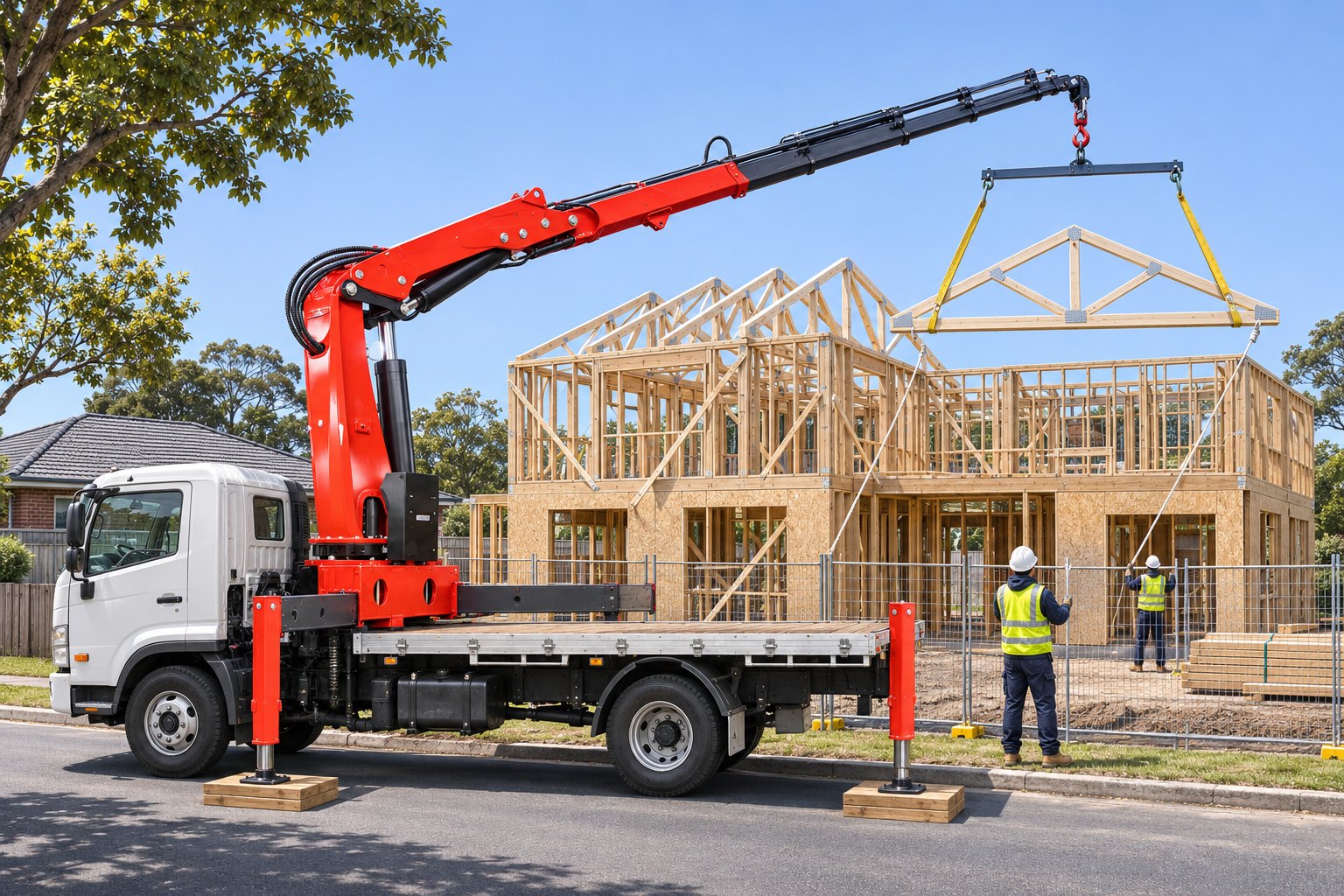

A hydraulic crane is a crane that moves its boom with pressurised oil; instead of relying on ropes, chains or gears alone, it raises, folds, extends and turns the boom hydraulically. A pump pushes oil through valves into hydraulic cylinders and motors, which convert the oil pressure into the force that moves the load. Truck mounted knuckle boom and telescopic cranes, marine deck cranes, pickup cranes and most contemporary mobile cranes all operate on this principle.
We have built hydraulic cranes in Xuzhou since 2003, and this guide explains the technology in practical terms. It covers the underlying physics, the hydraulic circuit from power source to cylinder, and the function of each cylinder and motor. It then compares the main types of hydraulic crane and sets hydraulic cranes against lattice boom and electric hoist cranes, and wherever we quote our own capacities, the figures come directly from our technical drawings rather than from brochures.
Key takeaways
- A hydraulic crane uses Pascal’s principle: pressure applied to a confined fluid acts equally everywhere, so a small pump can drive a large cylinder that produces a very large force.
- Every hydraulic crane has the same basic circuit: a power source, a pump, an oil tank, a control valve, relief and holding valves, cylinders and hydraulic motors.
- Cylinders lift, fold and extend the boom and set the outriggers, while hydraulic motors turn the slewing gear and the winch drum.
- We build truck mounted hydraulic cranes from 800 kg to 50,000 kg, marine hydraulic cranes from 800 kg to 25,000 kg, and electric-over-hydraulic mini cranes.
- Clean oil, sound hoses and a crane that holds still under load are the three things to watch in daily care.
What is a hydraulic crane?
In short, it is any crane whose principal movements are powered by hydraulic fluid. The US general industry crane rule, 29 CFR 1910.179, defines a power-operated crane as one “whose mechanism is driven by electric, air, hydraulic, or internal combustion means”. Hydraulics is therefore one of four recognised ways to power a crane, and on mobile, marine and truck mounted cranes it is by far the most common choice today.
The US construction crane rule shows how closely hydraulics and modern boom design go together. In 29 CFR 1926.1401, an articulating (knuckle boom) crane is one whose folding boom is “typically manipulated to extend or retract by power from hydraulic cylinders”. The same section describes a mobile crane as having either “a cable suspended latticed boom or hydraulic telescopic boom”.
The technology is considerably older than the truck itself, since Wikipedia’s crane article records that the industrialist William Armstrong designed a water-powered hydraulic crane in 1838. The first hydraulic truck mounted crane followed in 1947, using the truck’s engine to drive the hydraulics. Some buyers simply call these machines a “hydro crane”, which means exactly the same thing: a crane operated by hydraulic pressure.
How does a hydraulic crane work?
A hydraulic crane works because a liquid under pressure in an enclosed space pushes equally in every direction, on every wall, pipe and piston it touches. Pascal’s law is the name of this principle, described by Blaise Pascal in 1653 and explained in Wikipedia’s article on Pascal’s law. Wikipedia states it as “a change in pressure at any point in an enclosed incompressible fluid at rest is transmitted equally and undiminished to all points in all directions throughout the fluid”. Because oil barely compresses, the pressure created at the pump arrives almost unchanged at every cylinder in the circuit.
The practical consequence concerns force: force equals pressure multiplied by area, so a cylinder with a large piston turns a given pressure into a large push. Wikipedia’s example uses two pistons, one with 50 times the area of the other, so a 1 N push on the small piston lifts 50 N on the large one. There is no free energy, however, because when the small piston moves 100 cm, the large piston rises only 2 cm.
Consider, for example, a quick calculation that illustrates the scale of the forces on a crane, using illustrative figures rather than the specification of any of our cylinders. A piston 100 mm in diameter has an area of approximately 7,854 mm². At a pressure of 20 MPa, which is 20 newtons on every square millimetre, the oil pushes on it with about 157 kN, which corresponds roughly to the weight of 16 tonnes.
Why does a crane need such force to lift far smaller loads? It is because the lift cylinder is mounted close to the boom pivot while the hook hangs far out at the boom tip, so the cylinder works like a lever and must push many times harder than the load weighs. Two quantities describe the oil supply: pressure determines how hard the cylinders can push, and flow, the volume of oil delivered per minute, determines how fast they move.
The pump and its power source must deliver both quantities simultaneously, and our guide to the hydraulic crane for a truck lists the actual flow, pressure and tank figures from our drawings.
What are the parts of a hydraulic crane circuit?
Every hydraulic crane, from a pickup crane to a 50-tonne knuckle boom crane, uses the same circuit; as Wikipedia’s Pascal’s law article notes, there are hydraulic pistons “in almost all construction machines where heavy loads are involved”. Oil leaves the reservoir, gains pressure in the pump, is directed by the control valve, performs its work in a cylinder or motor, and returns to the tank. Wikipedia’s article on hydraulic machinery summarises why designers favour the system, naming “the large amount of power that can be transferred through small tubes and flexible hoses” and “the huge multiplication of forces” as its principal advantages.

- Power source. On a truck mounted crane, the engine drives the pump through a power take-off (PTO). Marine cranes typically use an engine-driven or electric power pack, compact electric cranes operate from a 12 V motor, and a forklift jib crane draws oil from the forklift.
- Oil tank. It stores the oil and gives the returning oil time to cool and to release air and contamination before the pump draws it in again.
- Pump. It converts the rotation of the drive shaft into oil flow; in Wikipedia’s words, “hydraulic pumps supply fluid to the components in the system”.
- Relief valve. It opens when pressure reaches its setting and diverts oil back to the tank, so no component can be subjected to more than its design pressure.
- Control valve. A bank of spools, moved by levers or by a wireless remote control, directs oil to the function the operator selects, at the speed corresponding to the lever position.
- Holding valves. Lock valves on the outrigger jacks and counterbalance valves on the boom cylinders trap the oil, so a cylinder stays put when the lever is released or a hose fails. Our article on the hydraulic lock valve explains both designs in considerably more detail.
- Actuators. Cylinders produce straight-line movement and hydraulic motors produce rotation, as the next section describes in detail.
- Return line and filter. Oil flows back through a filter, which removes particles before the oil re-enters the tank.
For the names and positions of these parts on an actual crane, see our guide to truck mounted crane parts.
What does each cylinder and motor do?
A hydraulic crane has one actuator for each movement the operator can control, and the terminology is straightforward. A hydraulic cylinder is a steel tube with a sliding piston and rod that pushes or pulls in a straight line, so cylinders set angles and lengths. A hydraulic motor is the rotating equivalent, which turns the crane and winds the rope; the following table lists the actuators found on our truck mounted and marine cranes, together with their individual functions.
| Actuator | What it moves | Where you find it |
|---|---|---|
| Lift (luffing) cylinder | Raises and lowers the main boom relative to the column | Every knuckle boom and telescopic crane |
| Knuckle (outer boom) cylinder | Folds and unfolds the outer boom at the knuckle joint | Knuckle boom cranes |
| Telescopic (extension) cylinders | Extend the nested boom sections and retract them again | Telescopic cranes and the extensions of knuckle booms |
| Outrigger beam and jack cylinders | Extend the outrigger beams horizontally and lower the legs onto the ground | Truck mounted cranes; marine cranes on a pedestal usually have none |
| Slewing cylinders or slewing motor | Turn the column: cylinders push a toothed rack on small cranes, while a motor turns a slewing ring on larger ones | All slewing cranes |
| Winch motor | Rotates the rope drum through a reduction gearbox to hoist or lower the hook | Telescopic cranes and knuckle cranes with a winch |
| Attachment cylinders and rotators | Operate a grab, a rotator or an auger | Cranes fitted with attachments |
Summary compiled by MIAOXUE from our crane manuals and drawings and from 29 CFR 1926.1401, November 2026.

The arrangement of these actuators is what distinguishes one crane design from another, and our guides explain each one in more depth. Read what a knuckle boom crane is for the folding boom and what a telescopic boom crane is for the straight boom. The crane boom guide covers boom geometry, the slewing guide covers rack and ring drives, and the crane winch guide covers the winch.
What types of hydraulic cranes are there?
Hydraulic cranes are classified mainly by their mounting and by the configuration of the boom. The first five types below are cranes we manufacture, with capacity ranges from our technical drawings, whereas we do not build the large mobile and crawler cranes in the final section. For every crane family, including the non-hydraulic ones, see our overview of the types of cranes.
Truck mounted knuckle boom crane
Wikipedia calls the loader crane, or knuckle boom crane, “a hydraulically powered articulated arm fitted to a truck or trailer”. Cylinders fold the boom like an arm, so it stows in a compact space behind the cab and positions loads precisely beside the vehicle. This is our principal product line, and it runs from the 800 kg SQ08ZA3, which slews through 330°, to the SQZ1000, which its drawing rates at 50,000 kg and 90 t·m with 360° slewing. Our knuckle boom vs telescopic comparison explains which applications favour each boom design.
Truck mounted telescopic crane
In a telescopic crane, according to Wikipedia, “a hydraulic cylinder or other powered mechanism extends or retracts the tubes” of one straight boom, while a hydraulic winch raises the hook on wire rope. Our telescopic truck mounted cranes start with the 2,000 kg SQ2SA3, whose three-section boom extends from 3.4 m to 8.5 m. At the top of the range, the 20,000 kg SQ20SA5 extends from 6.8 m to 22.5 m and is still rated for 1,500 kg at a 22.0 m radius. Every available model is listed among our telescopic boom truck mounted cranes.
Marine deck crane
Deck cranes on ships and boats are mostly hydraulic: Wikipedia notes that “most are diesel-hydraulic or electric-hydraulic”. Our marine cranes are the same knuckle and telescopic designs, built to stand on a pedestal on a deck or a quay. The knuckle boom models run from the 800 kg SQ08ZA3T+1 to the SQZ500T, which lifts 25,000 kg at 2.0 m and 2,000 kg at 18.0 m. The telescopic models run from the 2,000 kg SQ2SA3T to the 20,000 kg SQ20SA5T, and our marine crane sizes guide helps match an appropriate model to a particular vessel.
Pickup and electric-over-hydraulic cranes
Compact hydraulic cranes for a pickup bed, a light truck or a workshop floor frequently have no PTO at all. Instead, an electric motor drives a compact pump with its own tank, which is what buyers mean by an “electric over hydraulic crane”. Our 1 t SQ1Z-E and 2 t SQ2Z-E work this way from a 12 V supply, while our 800 kg SQ08ZA3 pickup crane can run from either a PTO-driven pump or a separate power unit. For sizing, read the guides to the small truck mounted crane and the electric truck mounted crane.

Forklift jib crane
A forklift jib crane has no pump of its own; a fixed jib that slides onto the forks has no cylinders at all, so the forklift’s mast and tilt functions provide every movement. A hydraulic fly jib, the kind we build, has its own luffing and telescopic cylinders but takes its oil from the forklift’s auxiliary hydraulic circuit. It therefore operates as a hydraulic crane only when the forklift supplies the oil, and our forklift jib crane guide explains how to check a forklift before fitting one.
Large hydraulic mobile and crawler cranes
All-terrain and rough-terrain cranes are hydraulic mobile cranes built on their own carrier, with a telescopic boom and outriggers. According to Wikipedia, modern ones “are usually single-engine machines”, and the upper works are “powered via hydraulics run through the turntable from the pump mounted on the lower”. Hydraulic crawler cranes mount a telescopic boom on crawler tracks instead of wheels, and we do not build all-terrain, rough-terrain or crawler cranes of any kind.
How does a hydraulic crane compare with lattice boom and electric hoist cranes?
The principal alternatives are rope-operated cranes with a lattice boom and electric hoist cranes travelling on a fixed runway. The US rule groups crane booms into “hydraulically extendible, cantilevered type, latticed section, cable supported type or articulating type”, and the following table sets out how the three approaches differ in everyday practice.
| Aspect | Hydraulic boom crane | Lattice boom crane (rope operated) | Electric hoist crane (overhead or jib) |
|---|---|---|---|
| How the boom moves | Cylinders control the angle and length directly | Ropes and pendants hold the boom, and a drum winds the rope to change the angle | No boom angle: a hoist runs along a bridge or arm |
| Changing reach | Folds or telescopes in seconds from the operating controls | Add or remove boom sections, which means assembly work on site | Fixed by the runway or arm length |
| Set-up | Arrives operational and sets up on outriggers or a pedestal | Often transported in parts and assembled | Permanently installed in one building or bay |
| Strengths | Compact, rapid set-up, precise proportional control, holds position under load | Long, relatively light booms for exceptionally heavy lifts and considerable heights | No hydraulic oil on board, and well suited to repetitive lifting in one location |
| Limits | Reach set by the boom sections; oil, hoses and seals need care | Time-consuming to rig and requires space to assemble the boom | Serves only the area beneath its runway |
| Built by MIAOXUE? | Yes: truck mounted, marine, pickup and forklift jib cranes | No | No |
Sources: 29 CFR 1926.1401 and 29 CFR 1910.179 definitions, Wikipedia “Crane (machine)”, compiled by MIAOXUE in November 2026.
For truck and deck operations, hydraulics usually wins, because the crane must travel folded and begin working within minutes of arriving. The 1926.1401 definitions also show what a lattice crane involves: pendants “are typically used in a latticed boom crane system” to change the boom’s suspension length, and blocking is used “to support lattice boom sections during assembly/disassembly”. A hydraulic boom avoids both steps, but it trades them for oil, hoses and seals that need regular attention.
The word “mechanical” causes some confusion in this comparison: every crane is a machine, but buyers usually mean a crane driven by ropes, drums and gears rather than by cylinders. Many hydraulic cranes are actually a combination of both principles: a telescopic crane positions its boom with cylinders but hoists the hook with a hydraulic winch, wire rope and sheaves.
How do you choose a hydraulic crane?
- Start with the load at your working radius. Determine the weight of the load including its hook and slings, and measure the horizontal distance from the crane column. Then read that point on the load chart rather than the headline capacity, as our guide on how to read a crane load chart demonstrates.
- Decide where the crane will be installed. A truck, a vessel, a pickup bed, a workshop floor or a forklift each indicates a different crane family.
- Check the available power source. A truck requires a suitable PTO and pump, a vessel requires a power pack, and a pickup or an application without a running engine suits an electric-over-hydraulic crane.
- Choose the boom configuration. Select a knuckle boom for compact stowage and precise positioning near the vehicle, or a telescopic boom for additional reach and height with a winch.
- List the required functions. Decide whether the application requires a winch, a grab, a remote control or additional boom sections. Each function adds an actuator and a valve section, and our guide to knuckle boom crane attachments lists the options.
- Specify the operating climate. The oil grade and seals are selected for the lowest and highest operating temperatures, and a saltwater environment requires a marine finish.
Example scenario (an illustration, not a customer record): a water utility wants to lift 700 kg pump units from its truck onto plinths about 4 m from the crane column with a 2,000 kg SQ2SA3 telescopic crane. The SQ2SA3 drawing rates the 6.0 m boom at 40° for 850 kg at 4.36 m, which covers the pump, the hook and a light set of slings. If some plinths sit 5.7 m away, the same boom at 0° is rated for only 550 kg, so the utility would either select a larger model or position the truck closer. This is precisely why every working radius deserves a check against the load chart before ordering.
How do you look after a hydraulic crane?
Hydraulic cranes remain reliable when three conditions are maintained: the oil is clean, the hoses are in good condition and the crane remains stationary under load. Contamination is the principal enemy of any hydraulic system, and Wikipedia’s hydraulic machinery article notes that “metal particles are continually produced by mechanical components and need to be removed along with other contaminants”, which is the filter’s job. Replace filters at the specified intervals, protect open fittings from contamination and use the oil grade specified in the crane manual.
The US inspection rule, 29 CFR 1926.1412, gives a useful list of what to look for. Every shift, check pressurised lines “for deterioration or leakage, particularly those which flex in normal operation”, and check the “hydraulic system for proper fluid level”. The annual inspection list adds the following items:
- Hoses: blistering, “abnormal deformation” and “excessive abrasion or scrubbing” of the outer cover, and leaks at joints.
- Pumps and motors: “unusual noises or vibration, low operating speed, excessive heating of the fluid, low pressure”.
- Valves: spools that stick or fail to return to neutral, and relief valves that fail to reach the correct pressure.
- Cylinders: “drifting caused by fluid leaking across the piston”, leaking rod seals and damaged or dented piston rods.
Drift is the slow, unintended movement of a loaded cylinder, such as a boom that sinks or an outrigger leg that creeps while the crane stands still, and owners notice it more than any other symptom. It points to a leaking holding valve or cylinder seal, and our hydraulic lock article shows how a technician tells them apart. Never search for a leak with your hand, because the University of Minnesota’s hydraulic safety guidance warns that “it takes only 100 psi to pierce skin”. Use a piece of cardboard and depressurise the system before any repair; the daily routine and the monthly and annual checks are set out in our truck mounted crane inspection checklist.
Frequently asked questions
What is a hydraulic crane?
It is a crane that positions its boom using pressurised hydraulic oil. A pump delivers oil through a control valve to hydraulic cylinders, which raise, fold and extend the boom, and to hydraulic motors, which slew the crane and operate the winch.
How does a hydraulic crane lift such heavy loads?
Pascal’s principle means oil pressure acts equally on every surface it touches, so force grows with piston area. A cylinder with a large piston turns the pump’s pressure into a push of many tonnes, which is enough to raise the boom and the load despite the lever geometry working against the cylinder.
What is a hydro crane?
“Hydro crane” is an informal name for a hydraulic crane, particularly a hydraulic mobile crane or a truck mounted crane; it describes the crane’s power system rather than a separate category of crane.
What is the difference between a hydraulic crane and a mechanical crane?
A hydraulic crane sets its boom angle and length with cylinders, so it folds or telescopes from the controls. A mechanical, rope-operated crane holds its boom on ropes and changes the angle by winding a drum, and a lattice boom changes length by adding sections.
Can a hydraulic crane hold a load if the engine stops?
Yes, provided its holding valves are functioning correctly. Lock valves on the outrigger jacks and counterbalance valves on the boom cylinders trap the oil, so the cylinders remain stationary when the pump stops, the lever returns to neutral or a hose fails.
How we compiled this guide
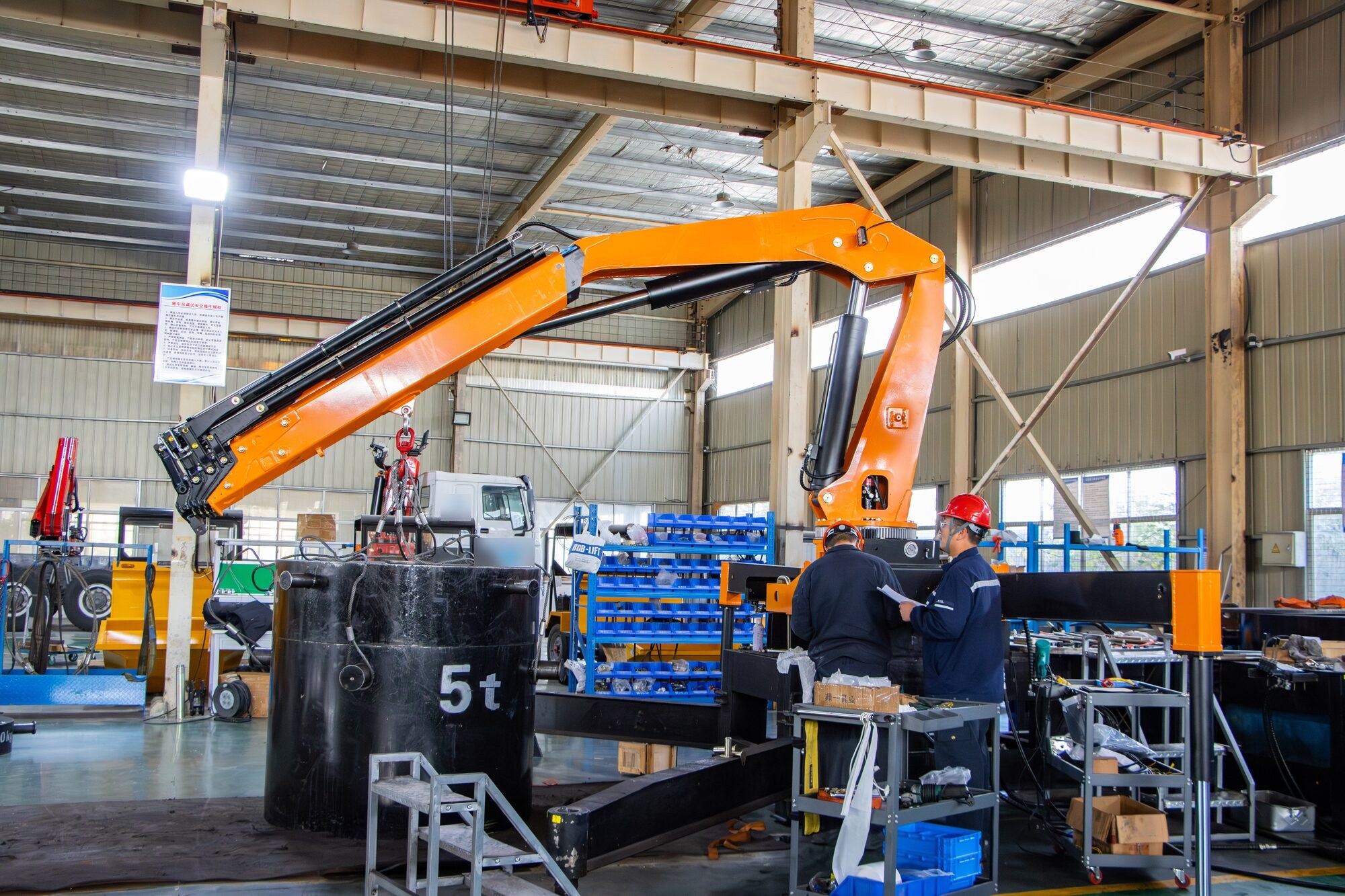
We compiled the physics and history from Wikipedia’s articles on Pascal’s law, hydraulic machinery and cranes, as they stood in November 2026. The definitions and inspection items come from the official eCFR text of 29 CFR 1926.1401, 1926.1412 and 1910.179, and the safety warning from the University of Minnesota. Our capacities come from the current MIAOXUE technical drawings of the SQ08ZA3, SQZ1000, SQ2SA3, SQ20SA5, SQ08ZA3T+1, SQZ500T, SQ2SA3T and SQ20SA5T. The SQ1Z-E and SQ2Z-E specifications come from our internal product records and live product pages. The photos were taken in our Xuzhou factory, and the circuit diagram is our own simplified illustration. Achord Chan, Product Operations Director, reviewed the completed guide before publication; the guide does not replace your crane manual, its hydraulic schematic or the regulations where you work.
Which hydraulic crane fits your job?
Tell us the load, the working radius and where the crane will be installed, whether on a truck, a vessel, a pickup or a forklift, together with the available power source. We will recommend a suitable hydraulic crane, send its dimensions drawing and load chart, and verify the hydraulic supply it requires. Every crane carries a 12-month warranty on the whole machine, common spare parts leave the factory within 48 hours, and our service team answers within 12 hours. Contact us for a quotation.