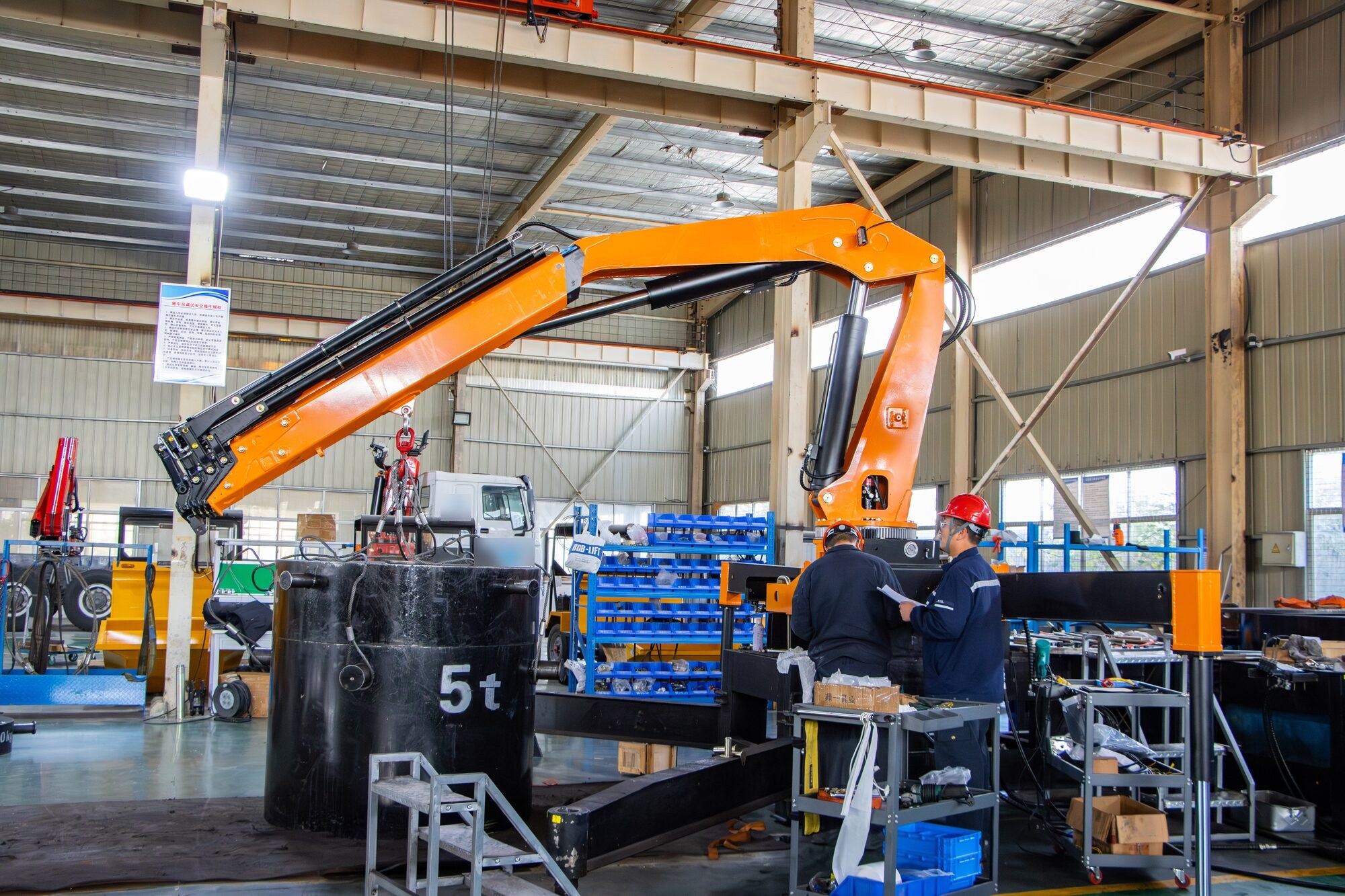
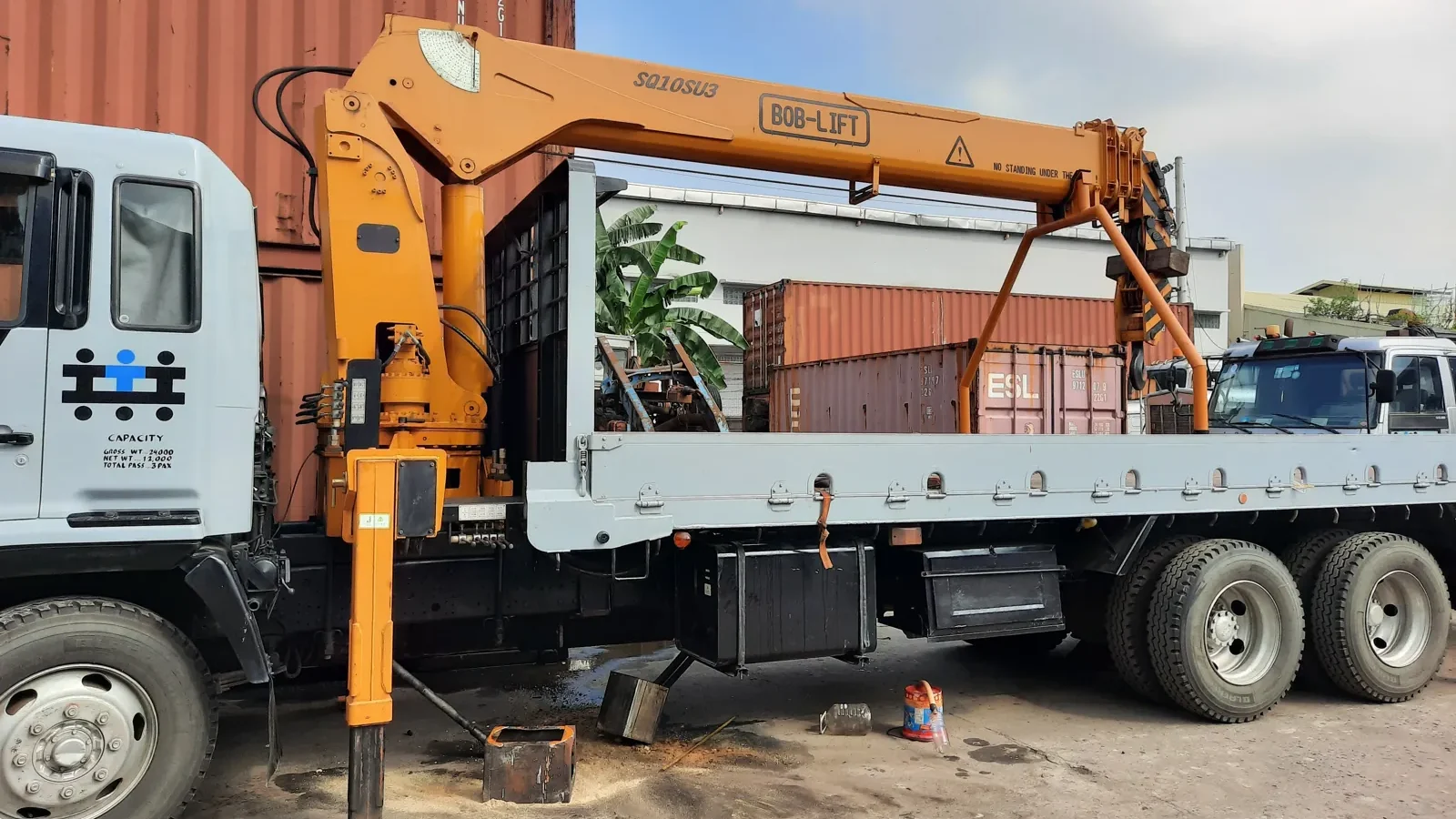
A truck mounted crane has about a dozen main parts, and they fall into four groups: the parts that hold the truck steady, the parts that turn the crane, the parts that lift, and the hydraulic system that powers them all. This guide names each part on the technical drawing of a real crane, explains what it does in plain terms, and ends with a spare parts list that tells you which items wear out and which ones are worth keeping in stock.
For this guide we compiled the technical drawings of six cranes built in our Xuzhou factory, from 2 t to 20 t, and every figure in the article comes from them, mainly from the 10 t telescopic SQ10SA4 and the 10 t knuckle boom SQ10ZA6. Achord Chan, Product Operations Director at MIAOXUE, prepared it with our engineering and after-sales teams.
Key takeaways
- The main parts of a truck mounted crane are the outriggers, base, slewing drive, slewing bearing, column, luffing cylinder, boom with its extension cylinders, boom head, hook, control valve and the hydraulic supply from the truck’s power take-off.
- A telescopic crane and a knuckle boom crane share the same lower half; they differ in the boom, which is straight on one and folds at a joint on the other.
- The hydraulic figures on the drawing tell you what the truck must supply: our SQ10SA4 needs 63 L/min of oil at 26 MPa and 37 kW, and it carries a 200 L oil tank.
- The parts that wear fastest are filters, seals, hoses and boom slide pads, so they belong on every spare parts list.
- When you order a spare part, quote the crane model and serial number from the nameplate and send a photo of the old part.
What are the main parts of a truck mounted crane?
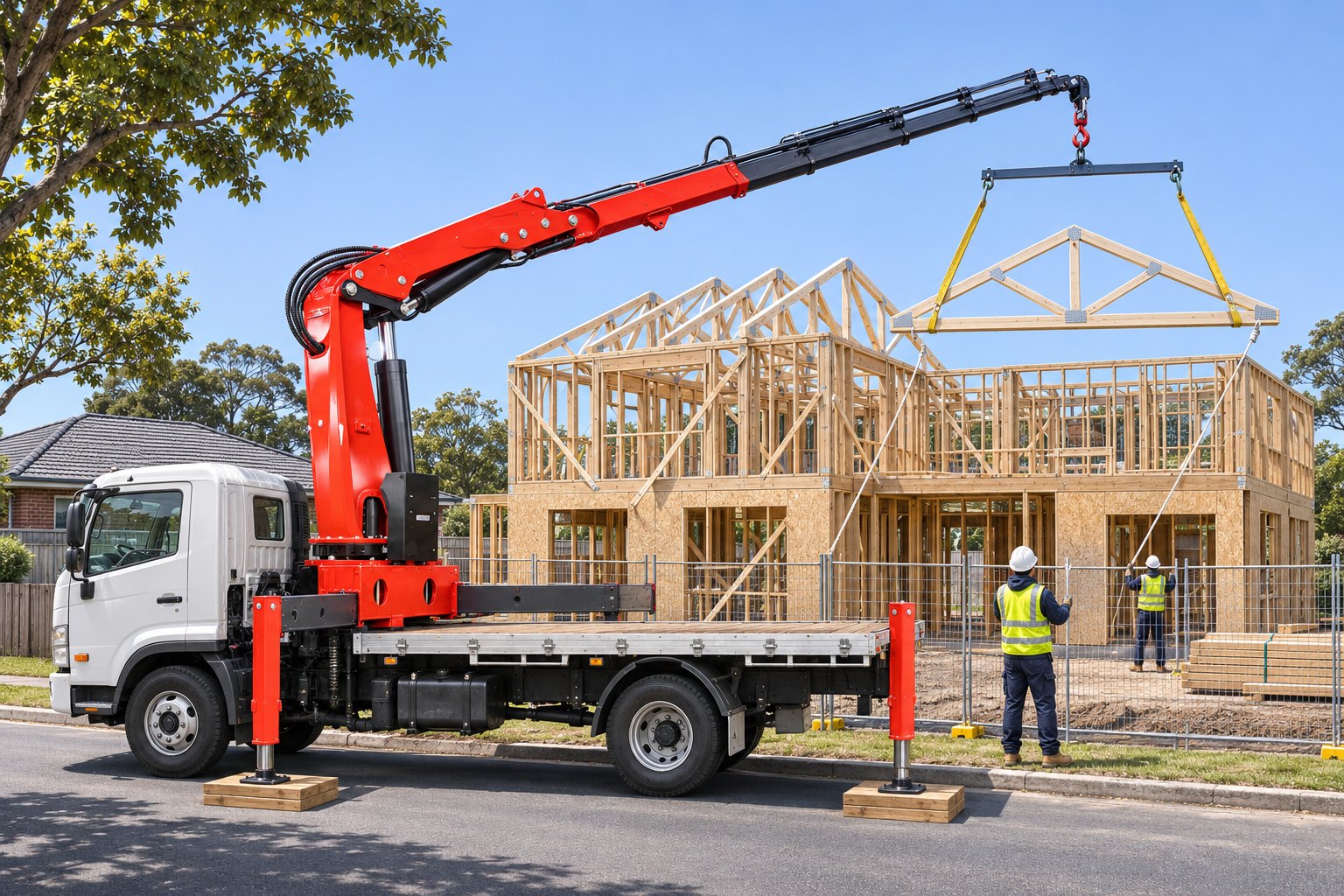
A truck mounted crane is a hydraulic crane bolted to the chassis of a truck, usually behind the cab, that lifts loads on and off the truck and around the job site. The drawing below is the side view of our 10 t telescopic SQ10SA4 from its technical drawing, with the boom fully retracted and the main parts numbered. The list under the drawing explains each part in the same order.

- Outrigger legs. Hydraulic jacks that push down onto the ground, usually onto pads, so the crane’s load goes into the ground instead of through the truck’s tyres and springs. On the SQ10SA4 the legs reach down by 736 mm to 1,286 mm.
- Base and outrigger beams. The base is the steel frame that bolts to the truck chassis and carries the whole crane. The outrigger beams slide out sideways from inside the base; on the SQ10SA4 the span across the outriggers goes from 2,290 mm to 5,990 mm, against a base width of 2,470 mm.
- Slewing drive. A hydraulic motor with a reduction gear that turns the crane. On the SQ10SA4 it turns the crane through a full 360 degrees.
- Slewing bearing. The large ring bearing between the base and the column. It carries the weight of the crane and the load while still letting the upper crane turn.
- Column. The upright steel post, sometimes called the turret or king post, that sits on the slewing bearing and carries the boom pivot at its top.
- Luffing cylinder. The large hydraulic cylinder between the column and the underside of the boom that raises and lowers the boom. It is also called the lift cylinder or derricking cylinder.
- Hydraulic hoses. The flexible lines that carry oil from the control valve to each cylinder and motor. They are routed along the column and the boom and are one of the most common parts to replace.
- Control valve. The valve bank that sends oil to each function when the operator moves a lever. Each lever works one function: slewing, luffing, telescoping, the winch, and on the base, each outrigger.
- Operator seat. A raised seat beside the control valve, often called a high seat, that lets the operator see the load from above the truck. Other cranes are worked from levers at the base or from a radio remote control.
- Telescopic boom. The straight boom made of nested box sections. The SQ10SA4 has four sections, one main boom and three hydraulic extensions, and its reach runs from 5.25 m retracted to 15.5 m fully extended.
- Boom head and sheaves. The end of the last boom section, which carries the pulleys, called sheaves, that the wire rope runs over.
- Hook block. The hook and its sheave block, hanging from the wire rope. It is where slings, chains or a lifting beam are attached.
Two important parts are not visible in this view. The hoist winch, a hydraulic motor turning a drum of wire rope, raises and lowers the hook on cranes that have one. The power take-off and the hydraulic pump sit on the truck’s gearbox, under the cab, and supply the oil that runs every other part.
Parts of a knuckle boom crane: what changes
A knuckle boom crane is a truck mounted crane whose boom folds at a hinged joint, and it uses the same lower half as a telescopic crane: outriggers, base, slewing drive, slewing bearing and column. The difference is above the column: instead of one straight boom, it has an inner boom and an outer boom joined by a hinge called the knuckle, and each boom has its own cylinder. The outer boom then carries the hydraulic extension sections. On our 10 t SQ10ZA6, the reach runs from 4,509 mm with the extensions in to 14,680 mm with them all out, and the outrigger span runs from 2,499 mm to 5,799 mm.
Because the booms fold back against the column when the crane is stowed, a knuckle boom crane occupies very little of the truck’s loading length. Our guide to what a knuckle boom crane is numbers its 12 parts on the drawing of the SQ10ZA6, in the same way as the diagram above.
| Part | Telescopic boom crane | Knuckle boom crane |
|---|---|---|
| Outriggers, base, slewing bearing, column | Same basic design | Same basic design |
| Boom | One straight boom of nested sections | Inner boom and outer boom joined at the knuckle |
| Boom cylinders | One luffing cylinder plus extension cylinders | Inner boom cylinder, outer boom cylinder plus extension cylinders |
| Lifting point | Hook on a wire rope from a winch | Hook at the boom tip; a winch is optional |
| Stowed position | Boom lies flat along the truck bed | Booms fold back against the column |
Hydraulic system parts and what they do
Almost every movement of a truck mounted crane is hydraulic, and the path of the oil is straightforward to follow: the truck’s engine drives a power take-off on the gearbox, the power take-off drives a pump, the pump draws oil from the crane’s tank, and the control valve sends that oil to whichever cylinder or motor the operator chooses. The oil then returns through a filter to the tank.
- Power take-off (PTO). A gearbox attachment that takes power from the truck engine to drive the pump. It must be matched to the flow and power figures printed on the crane’s technical drawing.
- Hydraulic pump. Turns the rotation of the PTO into oil flow, and the flow determines how quickly the crane moves.
- Oil tank and return filter. The tank holds and cools the oil, and the return filter catches the wear particles that would otherwise damage the pump and valves.
- Control valve. The valve bank that splits the oil between functions, with a relief valve that sets the maximum system pressure.
- Cylinders and motors. They turn oil pressure into force: cylinders for the booms and outriggers, motors for slewing and the winch.
- Load-holding valves. Valves fitted at the cylinders, also called counterbalance or lock valves, that hold the load in place if a hose fails or the lever is released.
The technical drawing of each crane lists the oil flow, the working pressure and the engine power it needs from the truck, and these numbers decide which PTO and pump the installer fits. Here are the figures for five of our telescopic cranes:
| Crane | Rated capacity | Oil flow | Working pressure | Recommended power | Oil tank |
|---|---|---|---|---|---|
| 2 t telescopic | 2,000 kg | 20 L/min | 16 MPa | 8 kW | 35 L |
| 5 t SQ5SA3 | 5,000 kg | 32 L/min | 20 MPa | 18 kW | 90 L |
| 10 t SQ10SA4 | 10,000 kg | 63 L/min | 26 MPa | 37 kW | 200 L |
| 16 t telescopic | 16,000 kg | 80 L/min | 30 MPa | 55 kW | 300 L |
| 20 t SQ20SA5 | 20,000 kg | 80 + 63 L/min | 25 MPa | 55 kW | 300 L |
If the PTO and pump give less flow than the drawing asks for, the crane still lifts its rated load, but every movement is slower. If they cannot reach the working pressure, the crane cannot lift its rated load at all. The installation guide explains how the chassis, PTO and subframe are matched to the crane.
Truck mounted crane parts names: a glossary
The same part often has two or three different names, depending on the manufacturer and the market, and the glossary below matches the names you will see in manuals, quotations and parts lists, so that you and your supplier are talking about the same thing.
| Part | Other names | What it does |
|---|---|---|
| Outrigger | Stabiliser, stabilizer leg, support leg | Steadies the truck while lifting |
| Base | Crane base, frame, subframe mount | Bolts the crane to the chassis |
| Slewing bearing | Slew ring, turntable bearing | Lets the crane turn under load |
| Slewing drive | Slew motor and reducer, swing drive | Turns the crane |
| Column | Turret, king post, mast | Carries the boom |
| Luffing cylinder | Lift cylinder, derrick cylinder, main boom cylinder | Raises and lowers the boom |
| Telescopic cylinder | Extension cylinder, telescoping cylinder | Pushes the boom sections out and in |
| Boom section | Telescope, extension | Adds reach |
| Knuckle | Boom joint, link | Joins the inner and outer booms of a knuckle boom crane |
| Sheave | Pulley | Guides the wire rope at the boom head and hook |
| Hoist winch | Winch, hoist | Raises and lowers the hook on a wire rope |
| Control valve | Valve bank, distributor | Sends oil to each function |
| Power take-off | PTO | Takes power from the truck engine to the pump |
Two common descriptions of these parts are wrong, and they cause confusion when buyers compare cranes. A truck mounted crane does not have an enclosed operator’s cab of its own; the operator works it from levers, a raised seat or a remote control, while an enclosed crane cab belongs to a mobile crane. And raising the boom with the luffing cylinder does not keep the hook at a constant height; it changes both the height of the hook and its distance from the crane, which is why the load chart gives a different capacity at each radius.
Which parts wear out first?
The steel structure of a crane, meaning the base, column and booms, is designed to last for the working life of the crane if it is operated within its load chart, so the parts that need regular replacement are the ones that rub, flex or filter. Most hydraulic oil leaks start at a hose, a fitting or a cylinder seal rather than in the cylinder or valve body itself, which is why these small parts head the list.
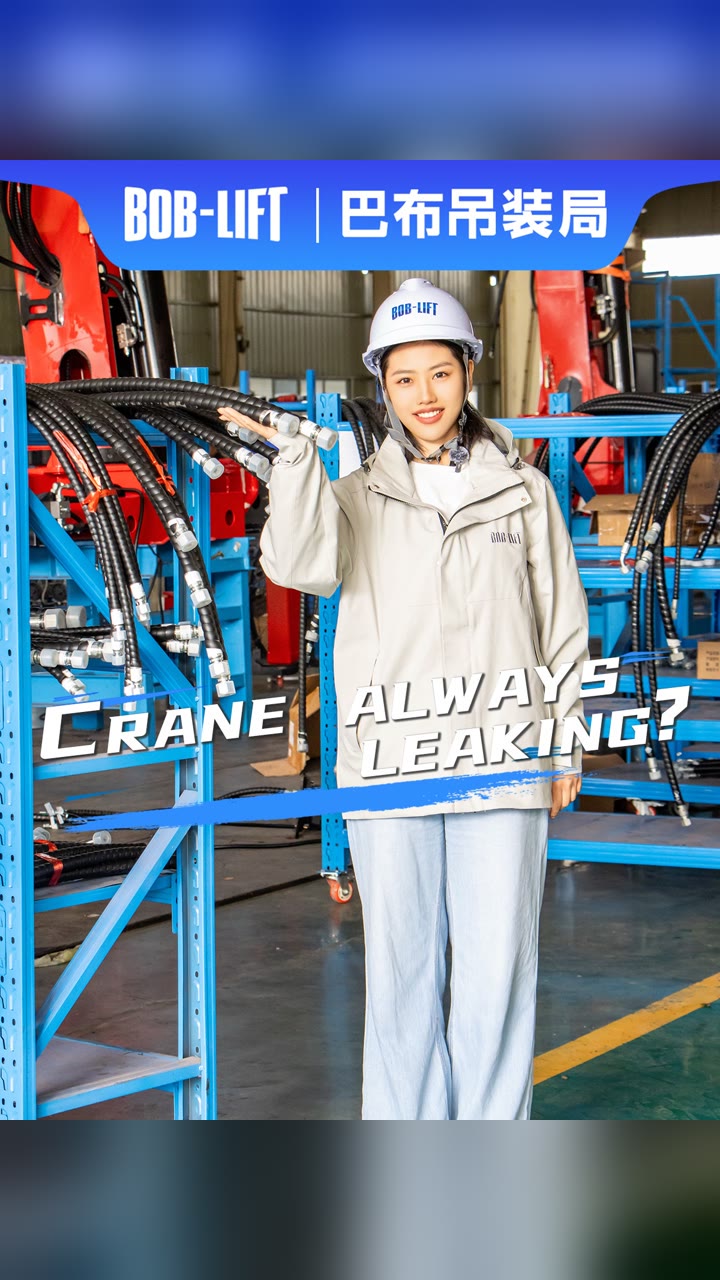
- Hydraulic hoses flex every time a boom or outrigger moves, and they rub where they pass over steel edges. During inspection, look for cracked covers, wet fittings and abraded spots.
- Cylinder seals deteriorate gradually with every stroke, and oil on a cylinder rod, or a boom that drifts down while holding a load, means that a seal kit is due.
- Filters gradually fill with contamination as they do their job, and a blocked return filter allows dirty oil to bypass it and accelerates wear on the pump and valves.
- Boom slide pads, the plastic wear pads between telescopic sections, wear thinner as the boom extends and retracts, and the boom starts to sag or knock when they are due.
- Wire rope and the hook latch on cranes with a winch wear from bending over the sheaves. For example, a rope with broken wires, kinks or crushing must be replaced immediately.
- Pins and bushes at the boom joints and cylinder ends wear when they are not greased, and the play shows up as a knock when the boom changes direction.
How often each part is checked is set by the manual and by the rules where the crane works. In the United States, OSHA 1926.1412 requires a shift inspection, a monthly inspection and an annual inspection of cranes used in construction. In the United Kingdom, LOLER requires a thorough examination of lifting equipment at least every 12 months. Our truck mounted crane inspection checklist covers the daily, monthly and annual checks part by part.
Truck mounted crane spare parts list
A crane that stands idle while waiting for a small component costs considerably more than the component itself, especially when the crane operates far from the factory. The list below is the first spare parts kit we recommend for a new crane, sorted by how soon each item is likely to be needed. The exact parts and quantities depend on the model, so ask for the parts list for your crane before you order.
| Spare part | Why you need it | Suggested stock |
|---|---|---|
| Return filter element and suction strainer | Changed at every oil service | Two of each |
| Hydraulic oil | For top-ups and the first oil change | Enough for one full tank refill |
| Seal kits for the luffing, extension and outrigger cylinders | A leaking seal can stop the crane | One kit per cylinder type |
| Hoses for the outriggers and boom | The most exposed hoses fail first | One of each length used on the boom and outriggers |
| Boom slide pads | Telescopic and extension sections only | One set |
| Wire rope and hook safety latch | Cranes with a winch only | One rope of the right length and diameter, two latches |
| Pins, bushes and grease nipples | For the boom joints and cylinder ends | One set of the most used joints |
| Control lever handles and fuses | Small parts that are easy to break or lose | A few of each |
Larger items such as the pump, the control valve, the slewing drive or a complete cylinder are rarely needed in the first years, so most buyers do not stock them; for those components, what matters is how quickly the supplier can deliver them. MIAOXUE ships common spare parts within 48 hours, answers after-sales questions within 12 hours, and covers every crane with a 12-month warranty on the whole machine.
How to order the right spare part
Most incorrect spare parts are dispatched because the supplier was given a part name but not the crane it belongs to, and cranes that look alike can use different seals, hoses and pins, while a model can also change between production years. Send these four things with every parts order and you will get the right part the first time:
- The crane model and serial number from the nameplate on the crane.
- The part name from the glossary above, or the part number from your crane’s parts manual.
- A clear photo of the old part fitted on the crane, plus one of any markings on it.
- For hoses, the length and both end fittings; for seals, the cylinder it comes from.
Frequently asked questions
What is the most important part of a truck mounted crane?
No single part works alone, but the slewing bearing and the outriggers carry the most responsibility, because the slewing bearing holds the whole upper crane and its load while the outriggers prevent the truck from tipping. Both should be inspected at every service.
What are the parts of a boom truck called?
A boom truck is a truck with a telescopic crane, so its parts are the same as in the diagram above: outriggers, base, slewing drive and bearing, column, luffing cylinder, telescopic boom with its extension cylinders, boom head, winch and hook block, all powered from the truck through a PTO and pump.
What does the luffing cylinder do on a crane?
The luffing cylinder is the hydraulic cylinder that raises and lowers the boom, and on our telescopic cranes it can lift the boom to a maximum angle of 75 degrees. Raising the boom brings the hook closer to the crane and higher, so the crane can lift more, while lowering it does the opposite.
What is a slewing bearing on a crane?
A slewing bearing is a large ring bearing with gear teeth that sits between the crane base and the column. It carries the weight of the upper crane and the load, and the slewing drive turns the crane by driving its gear teeth.
How do I know when a crane hose needs replacing?
Replace a hose if its outer cover is cracked or worn through to the reinforcement wire, if it bulges, or if oil continues to weep from the fitting after the fitting has been tightened, and never touch a leaking hose under pressure: lower the load and shut down the crane first.
Are the parts of a marine crane different?
The working parts are the same, but a marine crane is mounted on a pedestal instead of a truck base and is protected against salt water. Our article on the parts of a marine crane covers them.
Get the parts list for your crane
If you are choosing a new crane, ask for its technical drawing, load chart and recommended spare parts list together, so that you can compare suppliers on the same basis. If you already run a MIAOXUE crane, send us the model, serial number and a photo of the part. Contact us and we will reply within 12 hours.