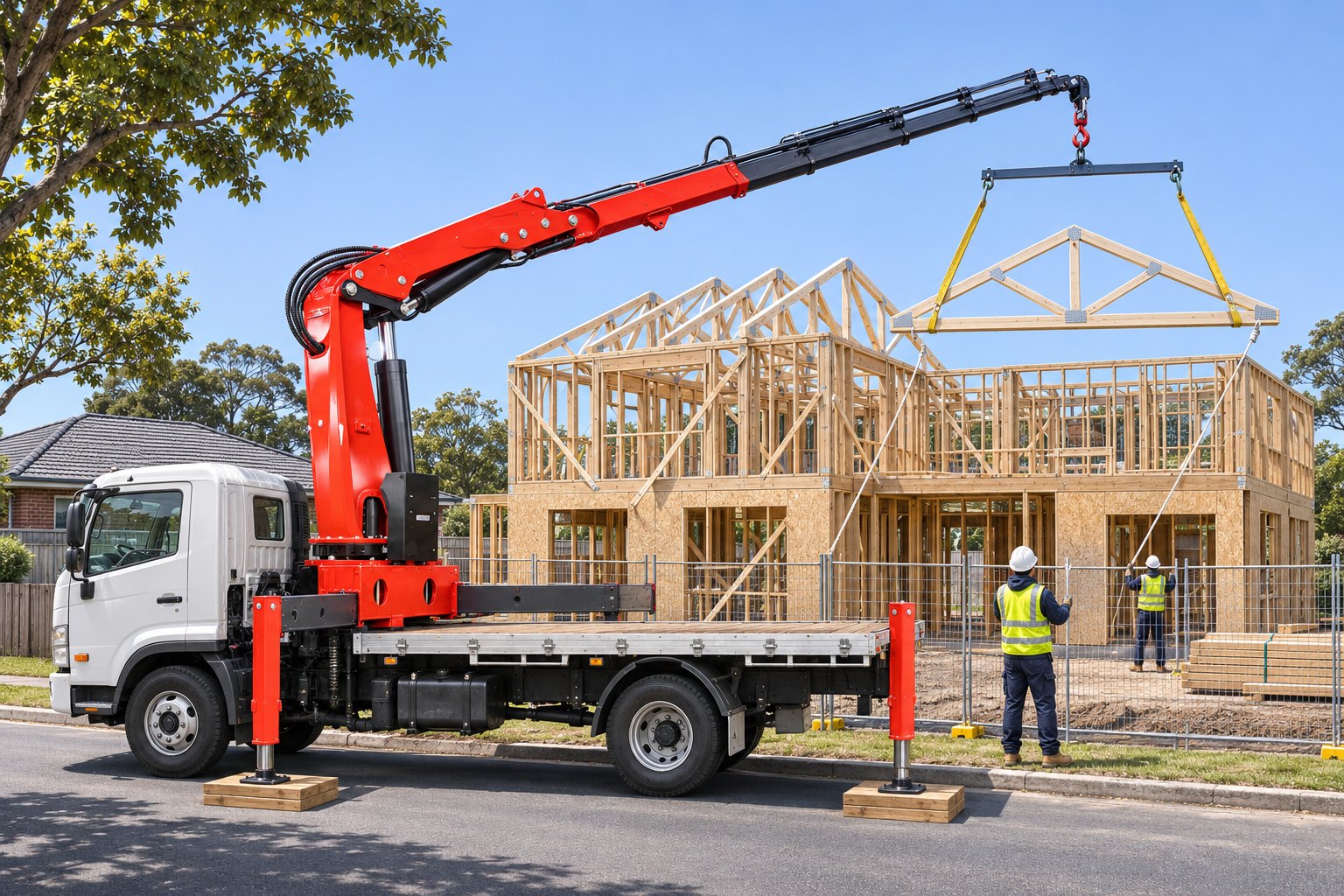

A hydraulic crane for a truck is a loader crane that runs on oil pressure made by the truck itself. The truck’s engine turns a power take-off (PTO), the PTO drives a pump, and the pump sends pressurised oil to the crane’s control valve and cylinders. Consequently, the crane can only perform as well as the hydraulic supply behind it. Before choosing a crane, establish how much oil flow and pressure it requires, and whether your truck can reliably deliver them.
MIAOXUE has built truck mounted cranes since 2003 and exports them for mounting on customers’ trucks. This guide concentrates on the hydraulic power side. It covers the PTO and pump, the oil flow, pressure and tank capacity our drawings specify for cranes from 2 t to 50 t, hydraulic oil classification, safety valves, daily inspection and the information to include in an enquiry. For frame, axle load and subframe questions, read our guide to truck mounted crane installation and chassis requirements.
Our truck mounted cranes include knuckle boom models from 1.6 to 50 t and telescopic boom models from 2 to 20 t, all supplied without the truck.
If you are new to the subject, start with our explainer on how a hydraulic crane works, which covers Pascal’s principle, the oil circuit and the job of each cylinder and motor before this guide turns to the truck side.
Key takeaways
- A truck mounted hydraulic crane takes its power from the truck engine through a PTO and a hydraulic pump, because the crane itself has no independent engine.
- Flow determines how quickly the crane moves, and pressure determines how much force the cylinders can generate.
- On eight MIAOXUE drawings from 2 t to 50 t, the crane needs 20 to 100 L/min of oil at 20 to 35 MPa, with a recommended power of 9 to 75 kW.
- The oil tank on these cranes holds 25 L to 300 L. The drawing gives the figure for each model.
- Relief valves, load-holding valves and a moment limiter protect the crane. Check the oil, hoses and safety devices before every shift.
How does a hydraulic crane on a truck get its power?
A hydraulic crane on a truck gets its power from the truck’s engine, because the crane has no motor of its own. Hydraulic oil circulates in a continuous loop, and each component in that loop has one particular job:
- Power take-off (PTO). A gear unit, usually mounted on the truck’s gearbox, that the driver engages from the cab to turn an output shaft while the truck is parked.
- Pump. Mounted directly on the PTO or driven from it by a short shaft, it converts mechanical shaft power into hydraulic oil flow.
- Oil tank. Stores the hydraulic oil, allows it to cool and settle, and supplies the pump. On our cranes the tank usually sits on the crane base.
- Control valve. The bank of levers on the crane base, or the electrically operated valve driven by a remote control, directs oil to whichever function the operator selects.
- Cylinders and motors. Cylinders lift, fold and extend the booms and push down the outriggers, for example the vertical jacks that level the truck. Hydraulic motors turn the slewing gear and any winch.
- Return line and filter. Oil returns through a filter into the tank and then begins the circuit again.
Two numbers describe the oil supply. Flow, measured in litres per minute (L/min), is the volume of oil the pump delivers each minute, and it determines the speed of each movement. Pressure, measured in megapascals (MPa), is how hard the oil pushes, and it determines the force the cylinders can produce. A crane needs both, delivered together: the correct flow at the correct pressure. Our article on truck mounted crane parts shows where the valve, tank and cylinders sit on the crane.
What oil flow and pressure does a truck mounted hydraulic crane need?
The answer depends on the crane’s size and boom type. Every MIAOXUE dimension drawing lists the hydraulic system flow, the system pressure, a recommended power and the oil tank capacity. We compiled these figures from the drawings of eight knuckle boom and telescopic models, from a 2 t crane to a 50 t crane.
| Model | Boom | Max. capacity | Max. moment | Oil flow | Pressure | Recommended power | Oil tank |
|---|---|---|---|---|---|---|---|
| SQ2ZA3 | Knuckle | 2,000 kg | 4.2 t·m | 20 L/min | 20 MPa | 9 kW | 25 L |
| SQ3.2SA3 | Telescopic | 3,200 kg | 7 t·m | 25 L/min | 20 MPa | 14 kW | 60 L |
| SQ6.3SA4 | Telescopic | 6,300 kg | 15.75 t·m | 40 L/min | 20 MPa | 22 kW | 100 L |
| SQ10ZA5 | Knuckle | 10,000 kg | 21 t·m | 40 L/min | 30 MPa | 30 kW | 160 L |
| SQ14SA4 | Telescopic | 14,000 kg | 35 t·m | 75 L/min | 26 MPa | 42 kW | 200 L |
| SQ16SA5 | Telescopic | 16,000 kg | 40 t·m | 80 L/min | 30 MPa | 55 kW | 300 L |
| SQZ430 | Knuckle | 20,000 kg | 42.3 t·m | 63 L/min | 33 MPa | 45 kW | 240 L |
| SQZ1000 | Knuckle | 50,000 kg | 90 t·m | 100 L/min | 35 MPa | 75 kW | 300 L |
Three patterns stand out from this comparison. First, flow and power rise with crane size: the 2 t SQ2ZA3 needs 20 L/min, and the 50 t SQZ1000 needs 100 L/min. Second, the larger knuckle boom cranes in this table work at higher pressure, 30 to 35 MPa, while the small telescopic cranes work at 20 MPa. Third, two cranes of a similar size can ask for quite different oil supplies. The 14 t SQ14SA4 telescopic crane needs 75 L/min at 26 MPa, while the 20 t SQZ430 knuckle boom crane needs 63 L/min at 33 MPa. Therefore, size the pump according to the drawing of the exact model, not according to the tonnage.
If you work in US units, divide litres per minute by 3.785 to get US gallons per minute, and multiply MPa by 145 to get psi. The SQZ430’s 63 L/min at 33 MPa is about 16.6 gpm at about 4,790 psi. For more on how size and boom type go together, see our guide to boom truck sizes and our knuckle boom vs telescopic boom comparison.
How do you match the PTO and pump to the crane?
Work from the crane’s drawing back to the truck. The pump must deliver the rated flow at the rated pressure, and the PTO must be able to turn the pump continuously at that load. Three calculations and checks cover the essentials.
- Power. Oil power in kW equals pressure in MPa times flow in L/min, divided by 60. For the SQZ430 that is 33 × 63 ÷ 60, or about 35 kW, while its drawing recommends 45 kW. For the SQZ1000 it is about 58 kW against a recommended 75 kW. The extra covers losses in the pump and the PTO, so use the recommended figure when you check the PTO.
- Pump size. Flow equals pump displacement times pump speed. The pump speed depends on the engine speed and the PTO ratio, so the same crane can need a different pump on a different truck.
- PTO rating. The truck maker gives each PTO a torque or power rating and a duty limit. Check them in the truck’s body builder guidelines, and ask your dealer which PTO options fit your gearbox.
Example scenario (an illustration, not a customer record): a buyer plans to fit an SQZ430 and the truck’s PTO will turn the pump at 1,200 rpm. The crane needs 63 L/min, which is 63,000 cm³ per minute. Divided by 1,200 rpm, that calls for a pump of about 52.5 cm³ per revolution, plus a small margin for the pump’s own losses. The PTO must also handle the 45 kW the drawing recommends.
What happens when the match is wrong? A pump that gives too little flow makes the crane slow, even though it can still reach its rated pressure. A pump that gives far more flow than the drawing makes the movements harder to control and heats the oil. Neither problem is obvious during a short demonstration, so check the numbers before the crane is mounted. Our installation guide covers how the PTO and pump are fitted and tested.
How big is the hydraulic oil tank on a truck crane?
On the eight drawings above, the oil tank holds 25 L on the 2 t SQ2ZA3 and 300 L on the SQ16SA5 and the SQZ1000. In general, the more flow a crane uses, the bigger its tank, because the tank gives the returning oil time to cool and allows air bubbles and contamination to settle before the pump draws it in again.
The tank size matters to the truck in two ways. The oil adds weight, so include a full tank in your payload calculation. In addition, a small tank loses its level quickly if a hose leaks, which is one more reason to check the sight glass before operating.

Which hydraulic oil should a truck crane use?
Use the oil type and grade in the crane’s operating manual. To read a hydraulic oil label, it helps to know the international system behind it. ISO 6743-4 sorts hydraulic fluids into categories. Two of them matter most here:
- HM oils are mineral oils with improved anti-wear properties. The standard lists them for general hydraulic systems with highly loaded parts.
- HV oils are HM-type oils with improved viscosity and temperature properties. The standard lists construction and marine equipment as their typical use.
An oil is named in the form “L-HV 32”. The letters give the category, and the number is the viscosity grade under ISO 3448. An HV oil keeps its viscosity more steady as the temperature changes, which is why it suits cranes that work in cold mornings and hot afternoons, or that move between climates. If your site is very cold or very hot, tell us the lowest and highest temperatures when you enquire, so the oil can be agreed before the crane is filled and tested.
What safety valves protect a hydraulic truck crane?
Three categories of protection prevent the hydraulic system from overloading the crane or releasing a suspended load.
- Pressure relief valve. It limits the system pressure to its set value, which is the pressure on the drawing. OSHA’s annual inspection list in 29 CFR 1926.1412 names “relief valves: failure to reach correct pressure” as a defect. If a crane feels weak, a technician can measure the relief pressure against the drawing.
- Load-holding valves (hydraulic locks). These valves sit on the cylinders and trap the oil inside, so a cylinder holds its position when the lever is in neutral, the pump stops or a hose fails. For outriggers, OSHA’s 29 CFR 1926.1415(a)(5) says hydraulic outrigger and stabilizer jacks “must have an integral holding device/check valve”. Our older article on hydraulic locks on truck mounted cranes explains how to tell a leaking lock from a leaking cylinder.
- Overload protection. Our product pages list a dedicated load moment limiter, also called a torque limiter. It warns the operator and stops movements that would take the crane past its load chart. Check your delivery documents for the devices fitted to your crane.
None of these protective devices replaces the load chart. Our guide on how to read a crane load chart explains what the crane may lift at each reach.
What hydraulic checks should you do every day?
OSHA’s shift inspection in 29 CFR 1926.1412(d) includes “hydraulic, and other pressurized lines for deterioration or leakage, particularly those which flex in normal operation” and the “hydraulic system for proper fluid level”. A short daily routine covers the hydraulic side:
- Oil level. With the crane stowed, the level should sit between the marks on the sight glass. Milky oil points to water, and dark oil with a burnt smell points to overheating.
- Hoses and fittings. Look for signs such as wet patches, drips under the truck, blistered covers and hoses that rub on steel, most of all the ones that flex at the boom joints.
- Cylinders. Inspect the chrome rods for oil, scratches, scoring and dents.
- PTO and warm-up. Engage the PTO according to the truck manufacturer’s instructions, and operate the crane slowly for a short period on cold mornings before lifting.
- Safety devices. Test the moment limiter using the procedure in the operating manual.
- Drift test. Hold a light load stationary for a few minutes. A boom or outrigger that gradually creeps indicates a leaking holding valve or cylinder seal.
Never feel for a leak with your hand, whatever the operating pressure. The University of Minnesota’s hydraulic safety guidance warns that “it takes only 100 psi to pierce skin”. It advises using a piece of cardboard to find a leak and depressurising the system before you work on it. Our full truck mounted crane inspection checklist has the monthly and annual checks and a hydraulic troubleshooting table.
What should you send in a hydraulic truck crane enquiry?
If you are comparing hydraulic truck cranes for sale, the hydraulic match between crane and truck deserves as much attention as capacity and reach. Send us these details and we can check the oil supply against the drawing before we quote:
- The crane you have in mind. The model, or the maximum load and the working reach you need.
- The truck. Manufacturer, model, engine and gearbox specification, or a photograph of the vehicle’s data plate.
- The PTO and pump. Whether the truck already has a PTO or a pump, and if so its ratio, torque rating and pump size.
- Other hydraulic users. Any equipment that shares the same PTO, such as a tipper body or a tail lift.
- Attachments and controls. A winch, grab, auger or basket, and whether you want a wireless remote control. Our guide to knuckle boom crane attachments lists the options.
- Climate. The lowest and highest operating temperatures on site, which determine the appropriate oil grade.
- Country of use. So that the documentation and operating manual suit the regulations where the crane will work.
We can mount the crane on your truck before shipping, or deliver the crane separately with installation guidance and remote technical support. We supply the crane only, not the truck.
Frequently asked questions
How much oil flow does a hydraulic crane for a truck need?
It depends on the model. On the eight MIAOXUE drawings in this guide, it runs from 20 L/min for the 2 t SQ2ZA3 to 100 L/min for the 50 t SQZ1000. The 20 t SQZ430 needs 63 L/min at 33 MPa.
What pressure does a truck mounted hydraulic crane work at?
Between 20 and 35 MPa on the drawings we compiled, which is approximately 2,900 to 5,080 psi. Small telescopic cranes in our table work at 20 MPa, and the large knuckle boom cranes work at 30 to 35 MPa.
Is a hydraulic boom truck the same as a truck mounted crane?
The terms overlap considerably. “Hydraulic boom truck” usually means a truck with a hydraulic crane fitted to it, often a telescopic one. A truck mounted crane, or loader crane, can have a telescopic or a knuckle boom. Both types operate on hydraulic oil supplied by a PTO and pump in exactly the same way.
What happens if the pump is too small for the crane?
The crane moves slowly, because the speed of each movement depends on flow. It may still lift its rated load, since the relief valve sets the pressure, but every lifting cycle takes longer, so match the pump to the drawing.
Which hydraulic oil is best for a truck crane in a cold climate?
Use the grade in the crane manual. Under ISO 6743-4, HV oils have improved viscosity and temperature properties and are listed for construction equipment, so they suit wide temperature swings. Tell us your site temperatures when you order.
Why does my crane boom drift down when it is stopped?
Usually because hydraulic oil leaks past a cylinder’s piston seal, or because a load-holding valve no longer seals completely. OSHA’s annual inspection lists drifting from fluid leaking across the piston as a defect. Stop lifting until a qualified technician identifies and repairs the leak.
How we compiled this guide
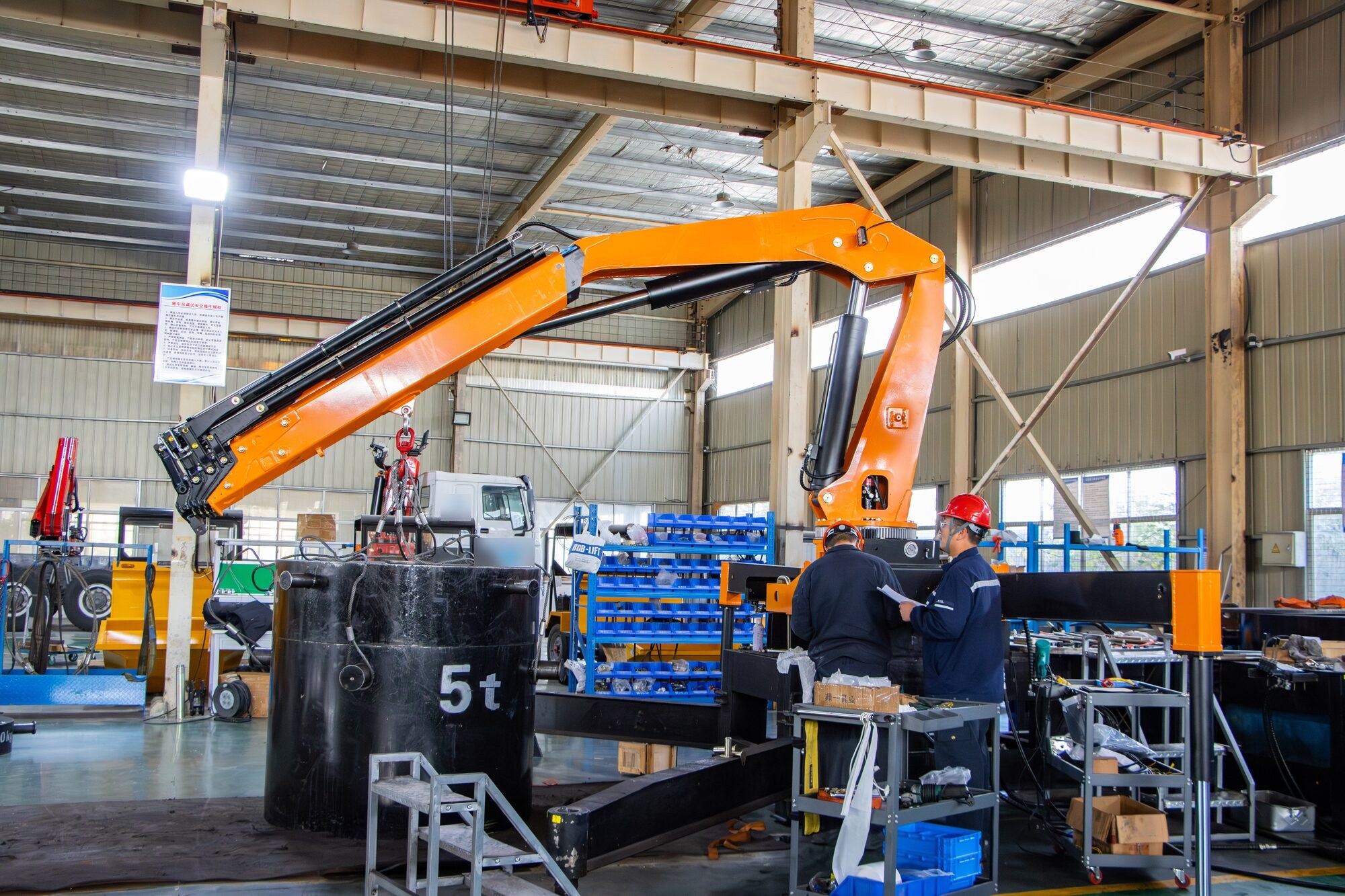
We compiled the flow, pressure, power, tank and capacity figures from the MIAOXUE technical department’s dimension drawings of the SQ2ZA3, SQ3.2SA3, SQ6.3SA4, SQ10ZA5, SQ14SA4, SQ16SA5, SQZ430 and SQZ1000, read in October 2026. The safety device details come from our live product pages. The OSHA rules, the ISO 6743-4 oil classification and the hydraulic safety advice are summarised from the official pages linked in the guide. The photo shows a real crane at our Xuzhou factory. The guide was reviewed by Achord Chan, Product Operations Director, in October 2026. It does not replace the crane’s operating manual, the truck maker’s PTO instructions or the rules where you work.
Get the hydraulic figures for your crane
Tell us the crane you need and the truck you have, and we will send the drawing with its flow, pressure and power figures and check them against your PTO. Every crane carries a 12-month warranty on the whole machine, including the hydraulic system. You can read more about us on the About us page. Browse our knuckle boom truck cranes and telescopic boom truck cranes, see the SQZ430 20 ton knuckle boom crane, or contact us to start.