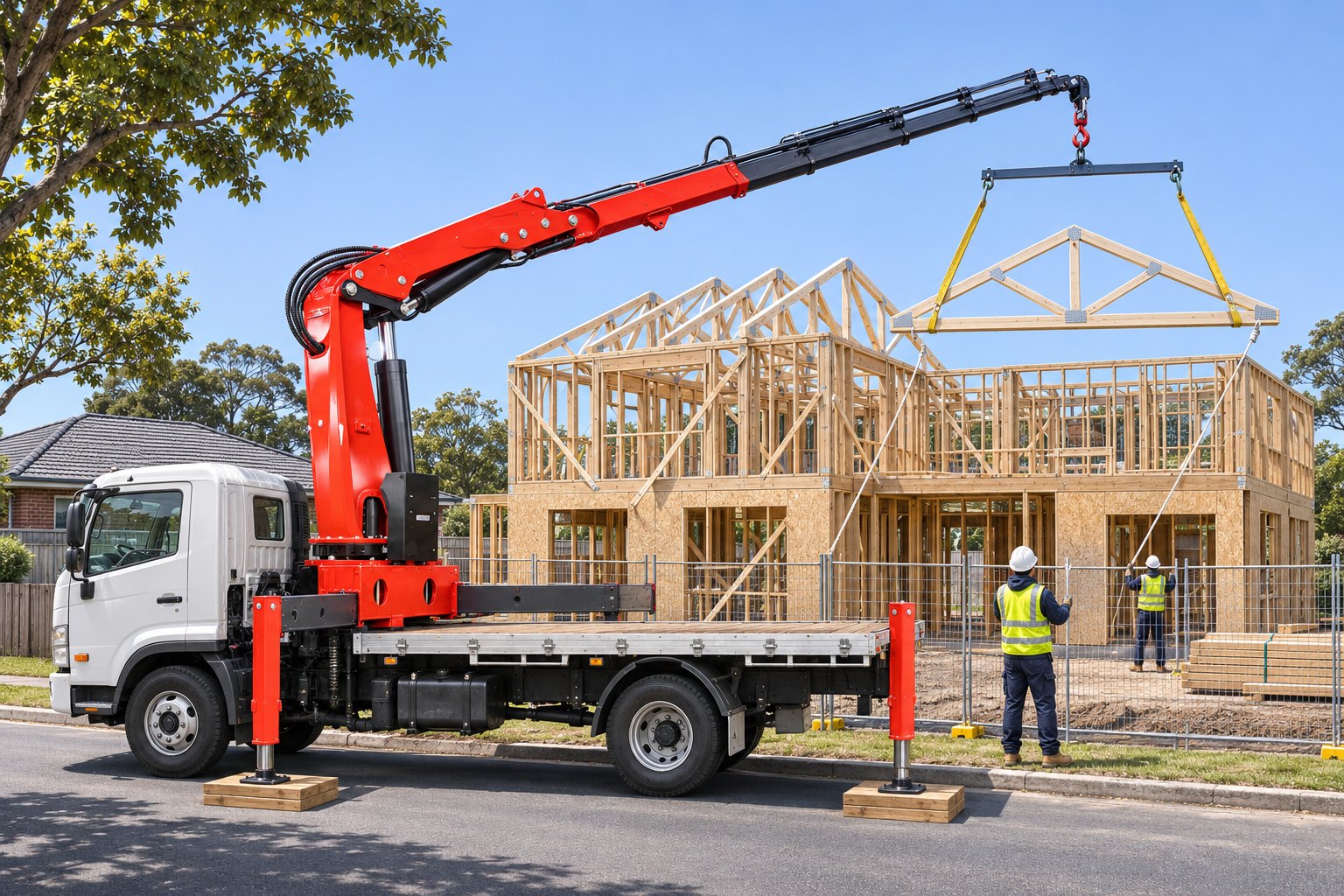

To lift a forklift with a crane, find its true weight on the data plate or in its manual and attach only to the lifting points that the forklift manufacturer specifies. Rig it with rated slings and a spreader bar so nothing bears on the overhead guard. Then check that the forklift plus all the rigging is within the crane’s load chart at the largest radius of the lift, and make a short trial lift before you lift it properly. Lifting a forklift with a crane is a planned lift in which a whole forklift truck is hoisted on the crane hook, for example onto a truck bed, a mezzanine or a vessel.
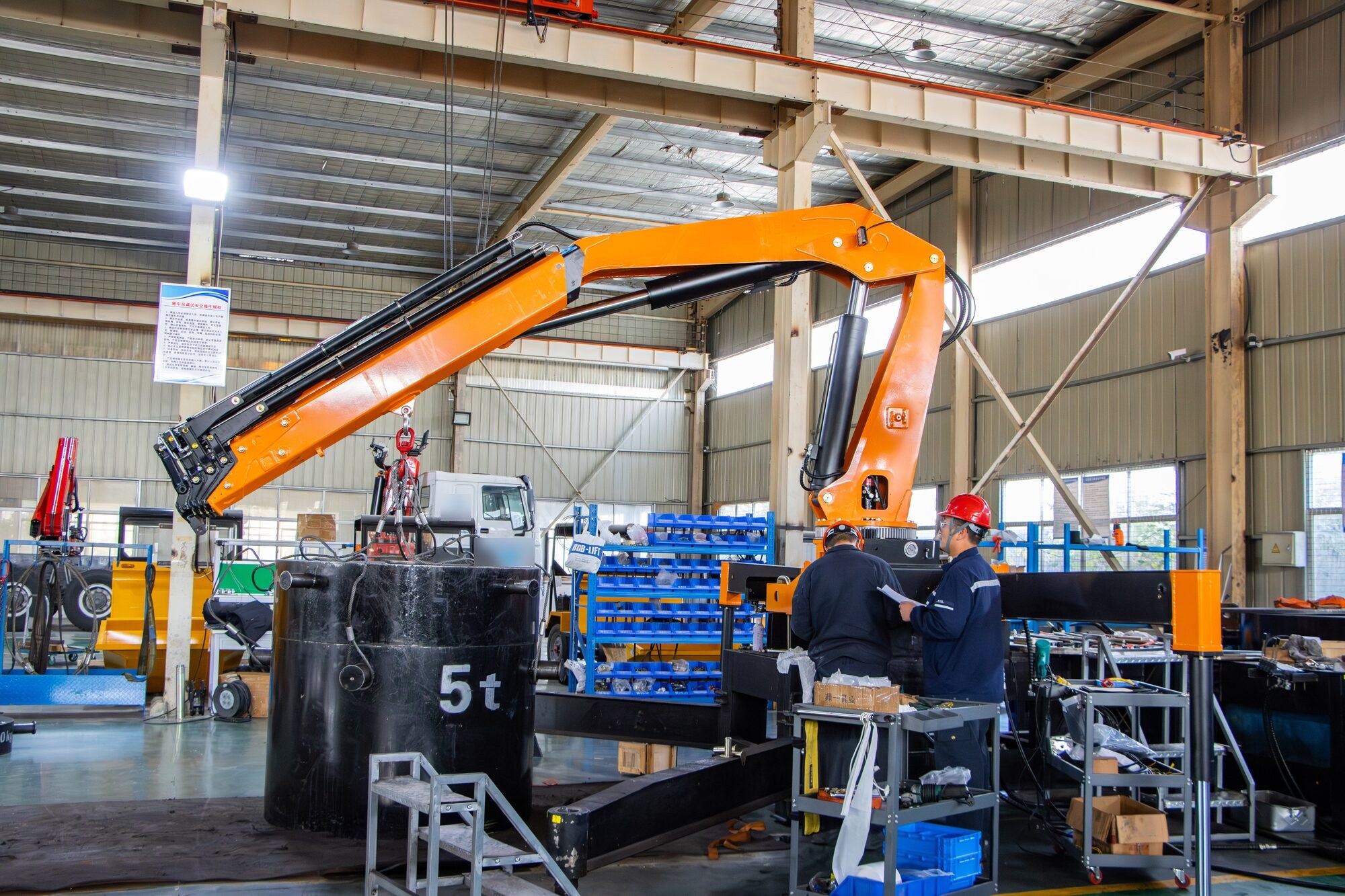
We have built truck mounted cranes in Xuzhou since 2003, and many of our customers load their own machines with them. This guide covers the weight, the lifting points, the centre of gravity, the rigging and the crane size check, and it ends with a step-by-step sequence. It does not replace the forklift manufacturer’s lifting procedure, which always comes first.
Key takeaways
- Take the forklift’s weight from its data plate or manual, including the battery and any attachment, and never confuse its rated capacity with its own weight.
- Use only the lifting points and procedure in the forklift manufacturer’s manual; if the manual shows none, ask the manufacturer before you lift.
- Never lift by the overhead guard unless the manufacturer explicitly allows it, and use a spreader bar to keep the slings clear of the guard and the mast.
- The centre of gravity sits toward the counterweight, so the hook must hang above that point, not above the middle of the wheelbase.
- Size the crane on the forklift plus all rigging at the largest radius of the lift, read from the load chart, and keep everyone off and away from the forklift.
When do you need to lift a forklift with a crane?
Most forklifts drive where they need to go, but when a job leaves no ramp, dock or level route, a crane is the practical way to move the whole machine, and these are the typical cases.
- Loading a truck or trailer where there is no loading dock or ramp, for example a forklift that travels on a truck fitted with a truck mounted crane to each delivery site.
- Placing a forklift on a mezzanine, roof or plant deck where there is no lift or ramp of the right size.
- Loading a vessel or barge from a quay, or lifting a forklift off a deck at the other end.
- Lowering a forklift into a pit, basement or excavation, or lifting it back out.
- Recovering a forklift that has left a ramp or sunk into soft ground, once the situation has been made safe.
Each of these is a lifting operation in its own right and needs a plan of its own. In the UK, regulation 8 of the Lifting Operations and Lifting Equipment Regulations 1998 (LOLER) requires every lifting operation to be “properly planned by a competent person”, “appropriately supervised” and “carried out in a safe manner”. Our guide to the crane lift plan shows what a written plan contains.
Lifting a forklift is not the same job as fitting a forklift crane jib. A forklift fly jib is a crane attachment that is mounted on a forklift and turns the forklift into a small crane, while this guide is about lifting the forklift itself. If a jib attachment is what you need, see our forklift fly jib cranes, the guide to the forklift boom crane and the forklift jib crane guide.
How much does the forklift weigh?
The forklift’s own weight is on its nameplate (data plate) or in its operator’s manual, and that is the figure to use. Do not use the rated capacity printed next to it, because that is the load the forklift may carry on its forks, not what the forklift itself weighs. Wikipedia’s forklift article explains that forklifts are rated for a maximum load at a stated load centre, and that “this information is located on a nameplate provided by the manufacturer”. The US forklift rule, 29 CFR 1910.178, requires users to keep “all nameplates and markings” in place and legible.
Several things change the real weight, so check each one against the manual:
- The battery. On an electric forklift the battery is very heavy, and Wikipedia notes that “the large battery may serve as part of the counterweight”. Make sure the weight you use includes the battery that is actually fitted.
- Attachments: a side shift, fork positioner, clamp or rotator adds weight to the truck. Under 29 CFR 1910.178(a)(5), a truck with an attachment that was not factory fitted should be marked with “the approximate weight of the truck and attachment combination”.
- Fuel, ballast and accessories. Extra counterweight, a gas cylinder, a cab or tyres filled with ballast can all add weight that is not in a brochure figure.
The US crane rule makes the same point from the crane side. Under 29 CFR 1926.1417(o), the operator must confirm the load is within the crane’s rated capacity, and the weight can come “from a source recognized by the industry (such as the load’s manufacturer)”. If the plate is missing and the manual is lost, ask the manufacturer or a dealer for the weight of that serial number, or weigh the forklift on a certified weighbridge before you plan the lift.
Where are the lifting points on a forklift?
Use only the lifting points that the forklift manufacturer designates, in the way its manual describes. Many manuals include a transport or lifting section showing where the slings attach and what other gear is needed, but the points and the procedure differ from one model to the next. That is why this guide does not say where to attach, since the answer is in your forklift’s own manual.
Some parts look strong but were never designed to carry the whole truck, and the most common mistake is the overhead guard. Wikipedia describes it as “a metal roof supported by posts at each corner of the cab that helps protect the operator from any falling objects”. It is built to protect the driver, not to hang the forklift from, so do not lift by the overhead guard unless the manufacturer explicitly says you may. The same applies to the mast, the tilt cylinders, the axles and the towing pin, unless the manual names them as lifting points.
UK law puts the duty plainly, since LOLER regulation 4 requires that “every part of a load and anything attached to it and used in lifting it is of adequate strength”. A lifting point that the manufacturer has not designed for the job cannot show that, so if the manual has no lifting procedure, ask the manufacturer in writing before you lift. Do not weld lugs or drill the frame, because 29 CFR 1910.178(a)(4) forbids changes that affect capacity and safe operation “without manufacturers prior written approval”.
Where is a forklift’s centre of gravity?
An empty counterbalance forklift is heavier at the back, so its centre of gravity lies toward the counterweight rather than in the middle of the wheelbase. Wikipedia describes the counterweight as “a mass attached to the rear of the forklift truck frame” whose purpose is “to counterbalance the load being lifted”. With no load on the forks, that mass pulls the balance point rearward, and on an electric truck the battery adds to the effect because it sits in the body and can act as part of the counterweight.
For the lift, this means the crane hook must hang directly above that rear-biased point. If the hook sits above the middle of the truck instead, the forklift tilts as soon as it leaves the ground, and the slings to the lighter end go slack while the heavier end takes most of the load. The manufacturer’s lifting procedure usually allows for this, for example with sling legs of different lengths, so follow the leg lengths and attachment order it shows. Then raise the forklift only a few centimetres, check that it hangs level and that every sling is evenly tight, and lower it again to adjust if it does not.
How do you rig a forklift for a crane lift?
The usual arrangement runs from the crane hook to a spreader bar, and from the spreader bar down to the forklift’s lifting points on slings that hang close to vertical. A spreader bar is a rigid beam hung below the hook that holds the sling legs apart, so they drop straight down instead of angling inward across the overhead guard and the mast. The diagram shows the idea and the crane size check that goes with it.

Every piece of rigging must be rated for its share of the load and must carry legible markings. Under 29 CFR 1926.251, rigging must be “inspected prior to use on each shift” and must not be loaded beyond the safe working load marked by its manufacturer. The general industry sling rule, 29 CFR 1910.184, adds that slings must be “padded or protected from the sharp edges of their loads”, and that a competent person inspects them “each day before being used”.
Sling angle matters as much as sling rating, because the further a leg leans from vertical, the more tension it carries: at 60° from vertical, each leg of a two-leg sling carries the full weight of the load. Our guide to crane rigging and slings works through the leg tension arithmetic, and the crane hook guide covers the hook, its latch and the weight of the hook block.
Prepare the forklift itself before anyone attaches a sling:
- Park it on firm, level ground within the planned reach of the crane.
- Lower the forks and set the controls. For an unattended truck, 29 CFR 1910.178(m)(5) requires that the “load engaging means shall be fully lowered, controls shall be neutralized, power shall be shut off, and brakes set”. Set the mast tilt as the lifting procedure in the manual directs.
- Secure the battery and loose parts. OSHA’s forklift rule requires a reinstalled battery to be “properly positioned and secured in the truck”, and a lift calls for the same care. Remove or secure anything loose, such as tools, a gas cylinder or a removable seat cushion, as the manual directs.
- Remove the key so that nobody can start or move the truck while it is rigged and hanging.
- Check that nobody is on board. No one rides on a forklift during a crane lift, and MIAOXUE cranes never lift people.
What size crane do you need to lift a forklift?
You need a crane whose load chart covers the total load at the largest radius of the lift. The total load is the forklift’s weight plus the spreader bar, the slings and the shackles, plus the hook block if the load chart does not already allow for it. The radius is the horizontal distance from the crane’s slewing centre to the hook, so measure it at both the pick-up point and the set-down point and size the crane on the larger of the two.
Capacity falls quickly as the radius grows, and a longer boom on a telescopic crane carries less at the same radius than a shorter one. The table shows both effects with figures read from the technical drawings of two of our 12-tonne truck mounted cranes.
| Crane and boom | Working radius | Rated capacity |
|---|---|---|
| SQ12ZA4 knuckle boom (4 sections) | 2.25 m | 12,000 kg |
| SQ12ZA4 knuckle boom | 4.7 m | 5,700 kg |
| SQ12ZA4 knuckle boom | 6.45 m | 3,750 kg |
| SQ12ZA4 knuckle boom | 8.2 m | 2,750 kg |
| SQ12SA4 telescopic, 5.85 m boom at 0° | 5.5 m | 5,800 kg |
| SQ12SA4 telescopic, 9.32 m boom at 50° | 5.7 m | 4,300 kg |
| SQ12SA4 telescopic, 9.32 m boom at 0° | 9.0 m | 2,740 kg |
Source: MIAOXUE technical drawings and load charts for the SQ12ZA4 and SQ12SA4, compiled in November 2026. Both cranes have a 12,000 kg maximum capacity; the SQ12ZA4 is rated at 27 t·m and the SQ12SA4 at 33 t·m.
Example scenario (an illustration, not a customer record): a contractor wants to lift a counterbalance forklift from the ground onto the deck of the truck that carries its truck mounted crane. For this illustration we assume the forklift’s data plate shows 4,000 kg and the spreader bar, slings and shackles weigh 150 kg, a total load of 4,150 kg. These are assumed figures for the illustration, not the weight of any real forklift model. With the SQ12ZA4, the pick-up point at 4.7 m is rated for 5,700 kg, so the lift works there. If the forklift stood 6.45 m away, the rating would drop to 3,750 kg and the lift would fail the check, so the truck would have to move closer.
The same total load shows the effect of boom length on the SQ12SA4. With the 5.85 m boom at 0°, the crane is rated for 5,800 kg at 5.5 m, which leaves a comfortable margin. With the 9.32 m boom raised to 50°, it is rated for 4,300 kg at 5.7 m, so 4,150 kg would use almost the whole rating. A margin that thin leaves no room for an error in the weight, so we would choose the shorter boom or move the truck closer.
If the weight is uncertain, the US rule adds one more check. Under 29 CFR 1926.1417(o)(3)(ii), an operator using a load weighing device must verify the weight if the load “exceeds 75 percent of the maximum rated capacity at the longest radius” [1]. Every MIAOXUE crane is listed with a load moment limiter, as our article on the lifting moment of a crane explains, but a limiter is a backstop and not a substitute for the weight.
Two more checks complete the sizing: first, read the load chart for the exact boom configuration and outrigger position you will use, as our guide on how to read a crane load chart shows. Second, check that the ground can carry the outrigger loads, which our guide to crane outriggers and ground bearing pressure explains. If you are choosing between boom types, the knuckle boom vs telescopic comparison sets out where each works best.
How do you lift a forklift with a crane, step by step?
The sequence below is a general outline that sits alongside the forklift manufacturer’s lifting procedure and the crane’s operator’s manual. The US crane rule, 29 CFR 1926.1417(a), requires users to “comply with all manufacturer procedures applicable to the operational functions of equipment”, and both manuals take priority over this list.
- Plan the lift: a competent person sets out the weight, the lifting points, the rigging, the radius, the crane position, the ground and the landing spot, and who does what. The HSE guidance on planning lifting operations lists factors such as “working under suspended loads”, “overturning”, “proximity hazards” and “overload”.
- Confirm the weight from the data plate or the manual, and add every piece of rigging.
- Find the lifting points and the sling arrangement in the forklift manual.
- Set up the crane on fully extended outriggers on firm ground, as close to the forklift as the job allows, and check overhead for power lines; our crane power line safety guide covers clearances.
- Prepare the forklift: forks lowered, controls neutral, power off, brake set, key removed, battery and loose parts secured.
- Rig it with inspected, rated slings, shackles and a spreader bar, with the hook above the centre of gravity and the latch closed.
- Clear the area: under 29 CFR 1910.184, “all employees shall be kept clear of loads about to be lifted and of suspended loads”, and only the people needed to guide or receive the load may enter the fall zone.
- Make a trial lift: raise the forklift a few centimetres, stop, and check that it hangs level, that the slings are evenly loaded and that the crane and outriggers are steady.
- Lift and slew slowly, with a tagline on the forklift and one signal person in sight of the operator, using the signals in our crane hand signals guide. The sling rule also states that “shock loading is prohibited”, so avoid sudden starts and stops with the load.
- Land it gently on firm, level ground or a deck that can carry it, chock the wheels, and only then slacken and remove the rigging.
Never use the crane to drag the forklift into position: 29 CFR 1926.1417(q) states that the equipment “must not be used to drag or pull loads sideways”. If the forklift is being moved by road afterwards, secure it to the deck before the truck leaves. The operator also needs the right training, which our crane operator licence guide explains for the US, Australia and the UK.
What mistakes should you avoid when lifting a forklift?
Most problems with this kind of lift come from a handful of shortcuts, and each one is avoidable with the checks above:
- Using the rated capacity on the data plate as the forklift’s weight.
- Forgetting to add the battery, an attachment or the weight of the spreader bar, slings and shackles.
- Choking a sling around the overhead guard or the mast instead of using the designated lifting points.
- Hanging the hook above the middle of the truck instead of above its centre of gravity.
- Letting slings run over sharp edges of the frame or counterweight without any protection.
- Reading the load chart at the pick-up radius only, when the set-down point is further away.
- Leaving someone on the forklift or allowing people under it while it hangs.
Frequently asked questions
Can you lift a forklift by its overhead guard?
Only if the forklift manufacturer explicitly allows it in the operator’s manual or a written lifting instruction. The overhead guard is a protective roof for the operator, so treat it as unsuitable for lifting unless the manufacturer states otherwise, and use the designated lifting points with a spreader bar instead.
How do I find out how much my forklift weighs?
Read the truck weight on the nameplate or in the operator’s manual, not the rated capacity. Add the battery if it is not included, plus any attachment, extra ballast and all the rigging. If there is no plate or manual, ask the manufacturer or weigh the forklift on a certified scale.
Where are the lifting points on a forklift?
They are wherever the forklift manufacturer’s manual says they are, and the position differs by model. Look for a transport or lifting section in the manual; if there is none, ask the manufacturer in writing rather than choosing points yourself.
What size crane do I need to lift a forklift?
Add the forklift’s weight to the weight of the spreader bar, slings and shackles. Then find a crane whose load chart covers that total at the largest radius of the lift, whether at pick-up or at set-down, with the boom configuration you will actually use.
Is lifting a forklift the same as a forklift crane jib?
No. Lifting a forklift means hoisting the whole forklift on a crane hook. A forklift crane jib, or fly jib, is an attachment fitted to a working forklift so that the forklift itself can lift loads like a small crane.
How we compiled this guide
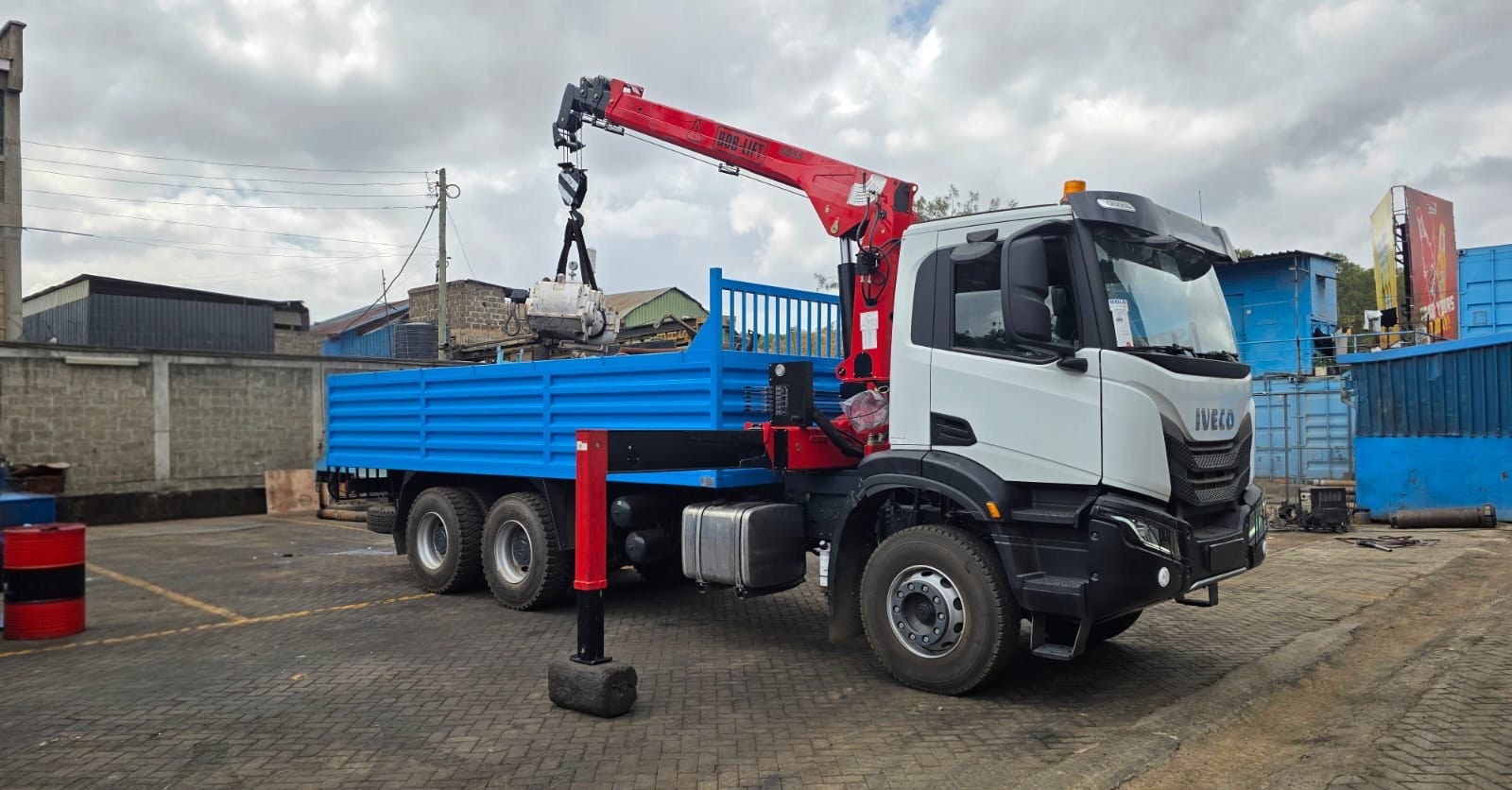
We compiled the rules from the official eCFR text of 29 CFR 1910.178, 1910.184, 1926.251 and 1926.1417, and from LOLER regulations 4 and 8 on legislation.gov.uk, as they stood in November 2026. The planning factors come from HSE’s page on planning and organising lifting operations, and the forklift layout, nameplate and counterweight details come from Wikipedia’s forklift article. The crane figures come from the current MIAOXUE technical drawings and load charts of the SQ12ZA4 and SQ12SA4, and the example uses an assumed forklift weight that is clearly marked. The rigging diagram is our own simplified illustration, and the photo was sent by a customer. Achord Chan, Product Operations Director, reviewed the guide before publication. It does not replace the forklift manufacturer’s lifting procedure, the crane’s operator’s manual or the regulations where you work.
Need a crane that can load your own forklift?
Tell us the weight of the forklift or machine you need to lift, the radius from the crane to the pick-up and set-down points, and the truck you plan to use. We will recommend a knuckle boom or telescopic boom truck mounted crane and send its dimensions drawing and load chart. Every crane carries a 12-month warranty on the whole machine, common spare parts leave the factory within 48 hours, and our service team answers within 12 hours. Contact us for a quotation and a load chart check.