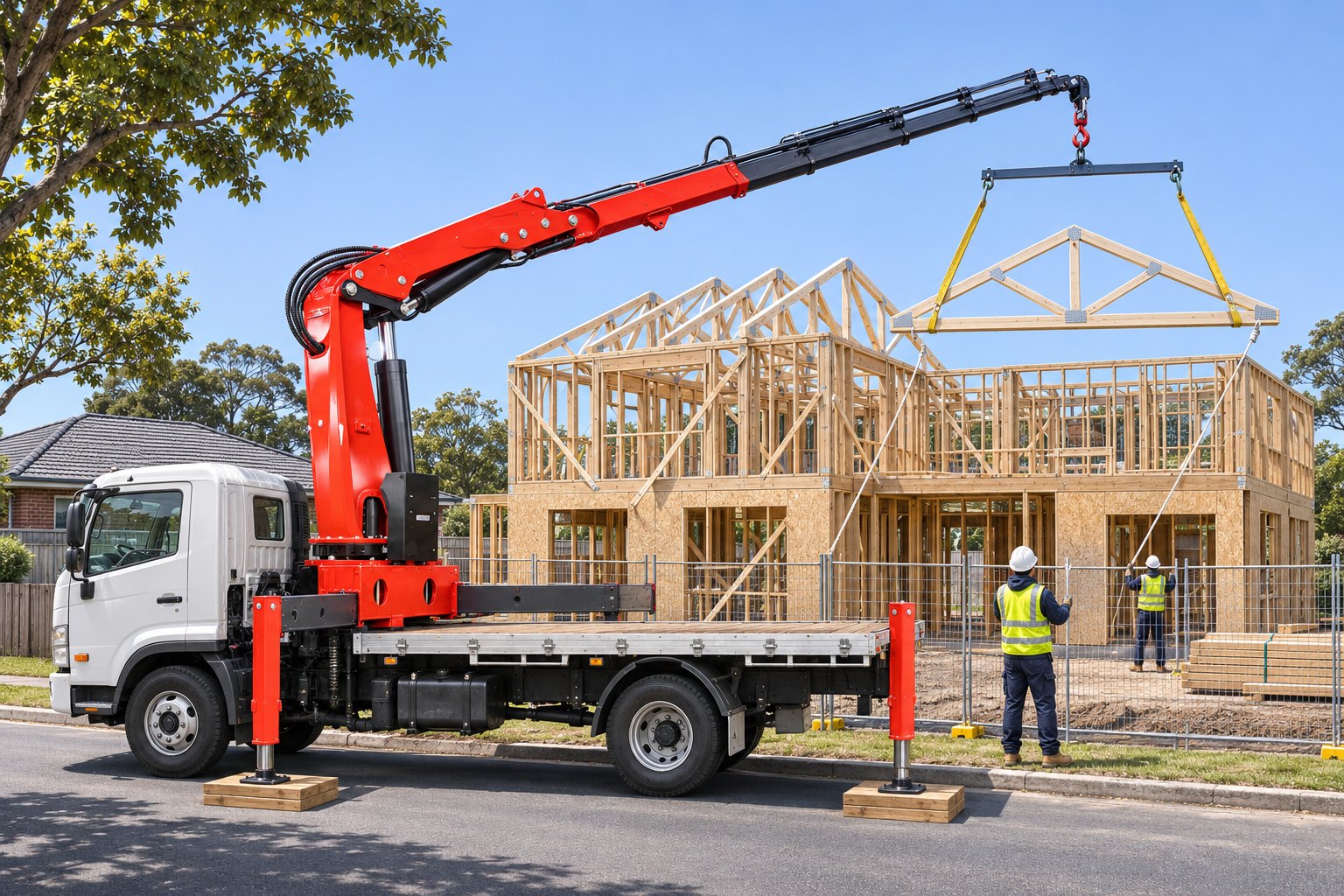

A crane lift plan is a written or agreed method for one lifting operation. It states what will be lifted and how much it weighs, which crane will lift it and where that crane will stand, the working radius and the load chart figure at that radius, how the load will be rigged, which hazards are in the work zone and who does what during the lift. A good plan is proportionate: a routine pallet delivery needs a short checklist, while a lift close to the load chart limit or a lift with two cranes needs a detailed document.
We have built truck mounted cranes in Xuzhou since 2003, and buyers often ask us what radius and capacity to plan for before they choose a crane. This guide explains when a written lift plan is required, what it should contain, and how to check a lift against a real load chart, using the chart of our 10 ton telescopic crane as a worked example. It ends with a lift plan template you can copy.
Key takeaways
- In the UK, LOLER requires every lifting operation to be properly planned by a competent person, supervised and carried out safely.
- US crane rules require a written plan from a qualified person for any lift with more than one crane, and a planning meeting before work near power lines.
- Plan with the gross load: the load plus hook block, slings and shackles, checked against the chart figure at the next larger radius.
- Check the ground, outriggers, power lines, swing area and wind before the crane arrives, not after it is set up.
- Name the operator, rigger and signal person in the plan, and brief them together before the lift.
When do you need a written lift plan?
Every lift needs a plan, but not every lift needs a long document. In Great Britain, regulation 8 of LOLER 1998 says every lifting operation must be “properly planned by a competent person”, “appropriately supervised” and “carried out in a safe manner”. The HSE page on planning and organising lifting operations adds that the degree of planning “should be proportionate to the foreseeable risks”. A single generic plan can cover a routine task, while a complex lift, such as a tandem lift with two cranes, should have a written plan from a person with specific competence.
The US construction crane standard, 29 CFR 1926 subpart CC, sets out several situations that require formal planning:
- Multiple-crane lifts: under 29 CFR 1926.1432, the plan “must be developed by a qualified person”, and a lift director must review it in a meeting with every worker involved.
- Lifting people: 29 CFR 1926.1431 requires a pre-lift meeting with the operator, the signal person and the employees to be hoisted before the trial lift at each new work location.
- Work near power lines: where any part of the crane or load could come within 20 feet of a power line, 29 CFR 1926.1408 requires a planning meeting with the operator and the other workers in the area.
Note that 1926.1400(c)(17) excludes some material deliveries by articulating (knuckle boom) truck mounted cranes from subpart CC, for example placing materials on the ground without arranging them for hoisting. The exclusion does not apply when the crane holds material in place for construction, or when it handles prefabricated components or structural steel. Even an excluded delivery still benefits from a short plan.
You will also hear the term critical lift. Subpart CC does not use one fixed definition, so many contractors set their own in company procedures, for example lifts close to the chart limit, lifts with two cranes or lifts over occupied buildings. If your site has such a rule, it decides when the full written plan is needed.
What goes into a crane lift plan?
A lift plan answers six questions: what, with which crane, from where, how rigged, near what hazards and by whom. The HSE planning page lists the factors a plan may need to cover, including working under suspended loads, visibility, attaching and securing loads, environment, location, overturning, proximity hazards, derating, lifting people, overload and pre-use checks. The table groups them into the sections of a practical plan.
| Plan section | What to record |
|---|---|
| Load | Description, weight and its source, dimensions, centre of gravity, lifting points |
| Crane | Model, boom configuration, outrigger setting, the load chart used |
| Position and radius | Set-up position, pick-up radius, set-down radius, the chart capacity at the larger radius |
| Rigging | Slings, hitch, shackles, spreader beam and their total weight |
| Ground and outriggers | Ground type, known voids or services, outrigger pads or mats |
| Hazards | Power lines, traffic, people, swing area, wind and weather, lifts over occupied areas |
| People and signals | Operator, rigger, signal person, supervisor, signal method, exclusion zone |
| Emergency | What to do if the load sticks, the weather turns or a line is contacted |
Step 1: confirm the load weight and centre of gravity
The plan starts with a weight you can trust. Under 29 CFR 1926.1417(o)(3), the operator must verify that the load is within the rated capacity, either from “a source recognized by the industry (such as the load’s manufacturer)”, from a recognised calculation such as a steel beam’s length times its known weight per foot, or by using a load weighing device as the load is raised. A guess from the delivery driver is not one of those methods.
Record where the centre of gravity sits as well. A load that hangs off-centre tilts as it leaves the ground, which changes the sling forces and can swing the load toward people. Our crane rigging guide explains how sling angle and hitch type change the force in each leg.
For a worked example of reading a loaded box’s weight and handling an off-centre centre of gravity, see our guide on how to lift a shipping container with a crane.
Step 2: set the crane position, radius and load chart figure
The working radius is the horizontal distance from the centre of slewing to the load hook, and it controls the capacity. Measure both the pick-up radius and the set-down radius from the planned set-up position, and plan with the larger one. If the radius falls between two points on the chart, use the figure at the next larger radius, because that is the lower capacity. Our guide on how to read a crane load chart covers the chart layout in detail.
Then compare the chart figure with the gross load, not the net load. The gross load is the weight of the load plus everything below the boom tip that the crane must hold: the hook or hook block, slings, shackles and any spreader beam. Our article on how to calculate crane capacity sets out the full worksheet.
The table shows the five rated points printed on the load chart of our SQ10SA4 10 ton telescopic truck mounted crane. Capacity falls quickly as the radius grows: at 12.0 m the rating is less than a sixth of the 10,000 kg maximum.
| Working radius | Rated load |
|---|---|
| 2.5 m | 10,000 kg |
| 5.0 m | 4,500 kg |
| 9.0 m | 2,200 kg |
| 12.0 m | 1,500 kg |
| 15.5 m | 1,050 kg |
Worked example: checking a lift against the load chart
Example scenario (an illustration, not a customer record): a contractor needs to set a steel frame weighing 1,250 kg, according to its fabrication drawing, on a slab. The crane can only stand on the street, so the set-down point is 10.8 m from the slewing centre. The hook and the two-leg sling with shackles are assumed to weigh 70 kg together.
- Gross load: 1,250 kg + 70 kg = 1,320 kg.
- Chart radius: 10.8 m lies between the 9.0 m and 12.0 m points, so the plan uses the 12.0 m figure of 1,500 kg.
- Check: 1,320 kg is below 1,500 kg, so the lift is within the chart, with 180 kg to spare.
- Margin: if the truck could stand 2 m closer, the radius would drop below 9.0 m, where the chart allows 2,200 kg.
- Limit: the same frame could not be placed at 15.5 m, where the rating of 1,050 kg is less than the gross load.

The chart figure is only valid for the conditions printed with it, such as outriggers fully extended and the crane level. If the site forces a shorter outrigger setting, the plan must use the chart for that setting, or a smaller lift.
Step 3: check the ground and the outriggers
A crane is only as stable as the ground under its outriggers. 29 CFR 1926.1402(b) says equipment must not be used unless the ground is “firm, drained, and graded” enough, with supporting materials if needed, to meet the manufacturer’s requirements for support and level. The plan should note the surface, any trenches, basements or buried services near the outriggers, and the pads or mats that will spread the load. Our guide to crane outriggers and ground bearing pressure includes a worked example of pad sizing.
To choose the pads or mats themselves, see our guide to crane mats and outrigger pads, which compares their types and sizes.
Step 4: list the hazards in the work zone
Walk the site and record every hazard within reach of the boom and the load:
- Power lines: treat every line as live. US rules require precautions if any part of the crane or load could come within 20 feet of a line while working up to the maximum radius. Our guide to crane power line safety explains the clearance table and the controls.
- Swing area: where the rotating crane could strike or crush a worker, 29 CFR 1926.1424 requires barriers or warning lines to mark the hazard area.
- People under the load: HSE advises that loads should not be suspended over occupied areas where it can be avoided, and that the area under a load held for a long time should be a restricted danger zone.
- Wind and weather: under 1926.1417(n), the competent person must adjust the equipment or the operation for the effect of wind, ice and snow on stability and rated capacity. Large flat loads such as panels catch the most wind.
- Traffic and the public: plan the barriers, permits and banksman needed on a street.
How wind force grows with speed, how to measure it at boom-tip height and when to stop is explained in our guide to crane wind speed limits.
Step 5: name the people and agree the signals
A lift plan should name each role, not just list job titles. The usual roles are the person who prepared the plan, the crane operator, the rigger who attaches the load, the signal person and a supervisor. US rules distinguish a competent person, who can identify hazards and has authority to correct them, from a qualified person, who has a recognised qualification or has demonstrated the ability to solve problems in the subject, as defined in 29 CFR 1926.1401.
Under 29 CFR 1926.1419(a), a signal person is required when the point of operation is not in full view of the operator, when the view in the direction of travel is blocked, or when the operator or the person handling the load decides one is needed for safety. Write the agreed method into the plan: standard hand signals, radio or both. See our crane hand signals chart for the standard method, and our crane operator license guide for the operator rules in the US, Australia and the UK.

Crane lift plan template
Copy these fields into your own form. For a routine lift, one page is enough; for a critical lift, attach the load chart page, a site sketch with the crane position and radii, and the rigging calculation.
| Field | Example entry |
|---|---|
| Job, date, location | Steel frame set-down, street side of the site |
| Load and weight source | Steel frame, 1,250 kg from the fabrication drawing |
| Rigging and its weight | Hook, two-leg sling, two shackles: 70 kg |
| Gross load | 1,320 kg |
| Crane and configuration | SQ10SA4, outriggers fully extended |
| Maximum radius and chart figure | 10.8 m, checked at 12.0 m: 1,500 kg |
| Ground and outrigger pads | Asphalt, no known voids, pads under all outriggers |
| Hazards and controls | Street traffic barriers, swing area barrier, no power line within reach |
| People | Operator, rigger, signal person, supervisor (named) |
| Signals | Standard hand signals; radio as backup |
| Stop conditions | Wind above the limit in the crane manual, load not level after test lift |
| Approved by and briefed to | Planner signature; crew briefing time |
Finish every plan with a test lift: raise the load a short distance, stop, and check balance, brakes and outrigger settlement before the full lift.
Lift plans for lorry cranes and truck mounted cranes
A lorry crane plan has a few points that a fixed crane plan does not. The truck may stop on a public street, the operator often works alone, and the set-up position is chosen on arrival. So the most useful step is to decide the set-up spot in advance: the closer the truck can park, the larger the capacity. Write down the delivery address, the parking position and the furthest set-down point when you book the delivery, and check that the radius suits the crane before the truck leaves.
Operator position matters too. With levers at the crane base, the operator stands next to the truck and may lose sight of the set-down point. A wireless remote control lets the operator walk to a point with a clear view, outside the swing area and away from the load. Note the operator position in the plan, and agree on a signal person if no position gives a full view.
Finally, plan the crane choice itself. If your typical delivery puts a 1,300 kg load at 12 m, the crane must be sized for that radius, not just for its headline tonnage. Our telescopic boom truck mounted cranes and knuckle boom truck mounted cranes all have published load charts you can use for this check.
Frequently asked questions
What is a crane lift plan?
A crane lift plan is the agreed method for one lift. It records the load weight, the crane and its set-up position, the radius and chart capacity, the rigging, the hazards in the work zone, the people and their roles, and the signals they will use.
Who should prepare a lift plan?
In the UK, a competent person must plan every lifting operation under LOLER regulation 8. In the US, a qualified person must develop the plan for any lift with more than one crane. For routine lifts, the operator or slinger may plan the lift, as long as they have the right training and experience.
Does OSHA require a lift plan for every crane lift?
No single rule demands a written plan for every lift. Subpart CC requires written planning for multiple-crane lifts, a pre-lift meeting for lifting personnel, and a planning meeting for work within 20 feet of power lines. The operator must still verify that every load is within the rated capacity.
What is a critical lift?
A critical lift is a lift that a company has decided needs extra planning and approval. The US crane standard does not give one definition, so the trigger comes from your own procedures, for example lifts near the chart limit, two-crane lifts or lifts over occupied areas.
What is the difference between a lift plan and a rigging plan?
A rigging plan covers only how the load is attached: slings, hitches, angles and hardware. A lift plan includes the rigging plan and adds the crane, its position, the load chart check, the ground, the hazards and the people. A pick plan is another common name for a lift plan.
How we compiled this guide
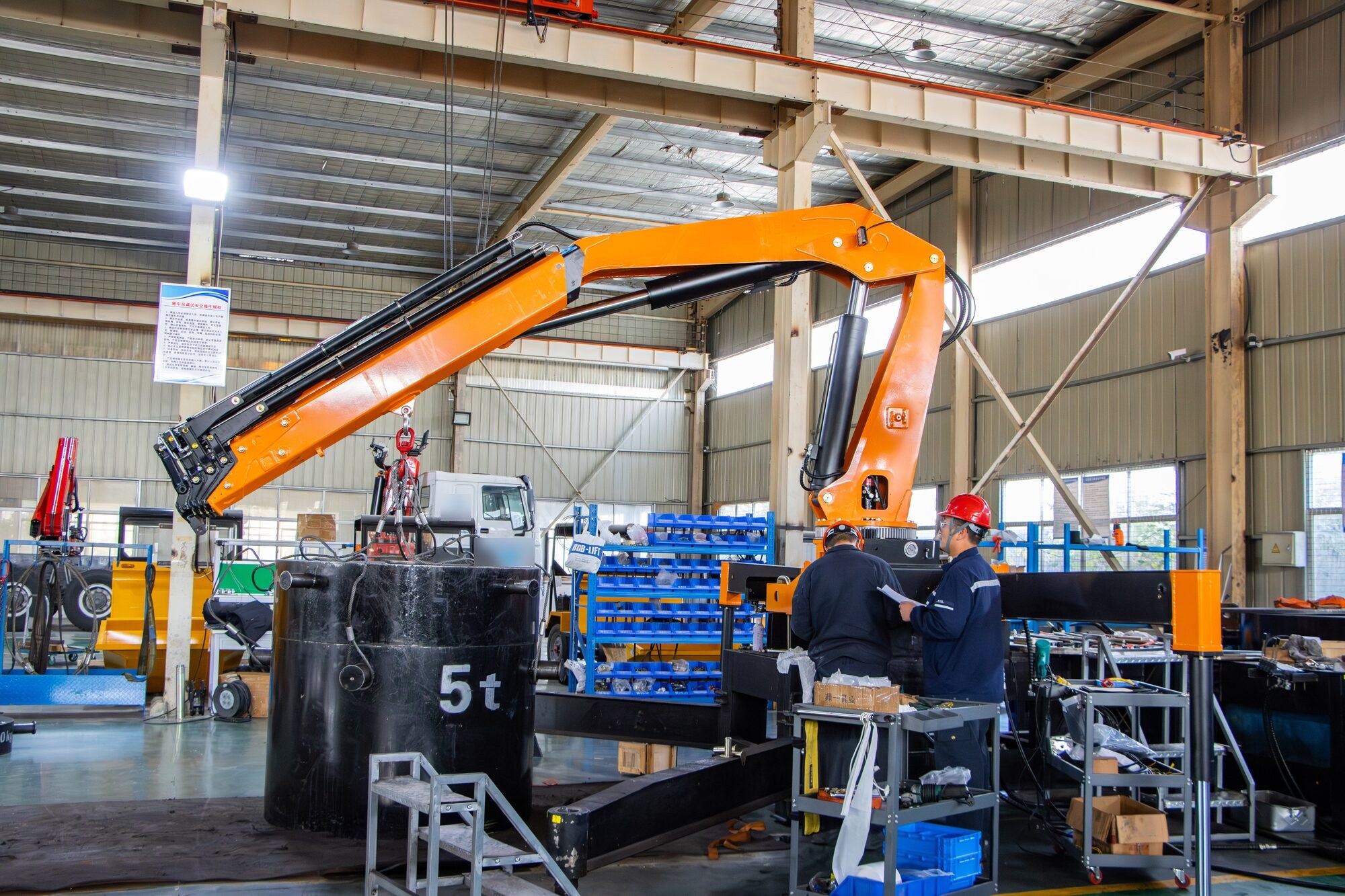
We compiled the rules from the official eCFR text of 29 CFR 1926.1400, 1926.1401, 1926.1402, 1926.1408, 1926.1417, 1926.1419, 1926.1424, 1926.1431 and 1926.1432, from LOLER regulation 8 on legislation.gov.uk and from the HSE page on planning and organising lifting operations, all read in November 2026. The SQ10SA4 figures come from its MIAOXUE load chart and dimension drawing. The worked example and the template entries are our own illustrations. The photos were taken at our Xuzhou factory. Achord Chan, Product Operations Director, reviewed the guide. It does not replace your crane manual, local regulations or a competent person’s judgement on site.
Plan your lifts with the right crane
Send us your heaviest load, the radius you need to reach and a photo of a typical site, and we will recommend a crane and send its drawing and load chart so you can check your lift plan before you buy. Every crane carries a 12-month warranty on the whole machine, common spare parts leave the factory within 48 hours, and our service team answers within 12 hours. Contact us for a quotation.