
Crane hand signals are a set of standard arm and hand movements that a signal person uses to tell a crane operator which motion to make, in which direction and when to stop. They are needed when the operator cannot see the load or the landing point, and in the US the standard set is fixed in law as the “Standard Method” in Appendix A of the construction crane rules. Riggers often call them rigging hand signals, and the posted version is known as a crane signal chart.
We have built truck mounted cranes in Xuzhou since 2003, and a clear signal is part of every lift our cranes make on a customer’s site. This guide covers the standard crane signals, when a signal person is required, voice and radio signals, what changes when the crane runs on a radio remote control, and how a signal person is qualified.
Key takeaways
- A signal person is required when the operator cannot fully see the load path or the landing point, when the view in the direction of travel is blocked, or when the operator or the load handler decides one is needed.
- In the US, hand signals must follow the Standard Method in Appendix A of 29 CFR 1926 Subpart CC, and a hand signal chart must be posted on the crane or near the lift.
- Only one person gives signals at a time, but anyone who sees a hazard may give the stop or emergency stop signal.
- Voice signals follow a fixed order: function, direction, distance or speed, then stop. Radio signals need a tested, dedicated channel and hands-free reception for the operator.
- A radio remote lets the operator walk to a spot with a clear view, but it does not remove the rules: if the load is still out of sight, a signal person is still needed.
What are crane hand signals?
Crane hand signals are one of four ways to pass instructions to a crane operator. The US construction crane standard, 29 CFR 1926.1419(b), says signals to operators “must be by hand, voice, audible, or new signals”. New signals are any other method, and they are allowed only where the employer shows they work at least as well as voice, audible or standard hand signals.
When hand signals are used, the Standard Method is the default. Non-standard hand signals are allowed only where the Standard Method is not practical, or where an operation or attachment is not covered by it. In that case the signal person, the operator and the lift director must meet before the lift and agree on each signal. The same section adds three rules that apply to every type of signal:
- One signaller. Only one person may give signals to a crane at a time.
- Stop is open to all. Anyone who becomes aware of a safety problem must alert the operator or signal person with the stop or emergency stop signal, and the operator must obey it under 1926.1417(y).
- Operator’s point of view. All directions must be given from the operator’s direction perspective, so “swing left” means the operator’s left, not the signaller’s.
When is a signal person required?
Under 1926.1419(a), a signal person must be provided in three situations. The first is when the point of operation, meaning the load travel or the area near or at load placement, is not in full view of the operator. The second is when the equipment is travelling and the view in the direction of travel is blocked. The third is when, because of site-specific safety concerns, the operator or the person handling the load decides a signal person is necessary.

On a truck mounted crane the first situation is by far the most common, because the operator usually stands at the control levers on one side of the crane base while the load is frequently delivered to the opposite side of the truck, behind a wall or onto a roof. Our crane safety tips cover planning the lift as a whole; this guide deals only with how the crew talks to the operator once the lift starts.
Crane hand signal chart: the 19 standard signals
Appendix A to Subpart CC, titled Standard Hand Signals, shows 19 signals, each with a drawing and a short description. The table below paraphrases each description; the official chart has the drawings. Under 29 CFR 1926.1422, a hand signal chart must be posted on the equipment or in a clearly visible place near the lift.
| Signal | How it is given | On a truck mounted crane |
|---|---|---|
| Stop | One arm held out level to the side, palm down, swung back and forth. | Every lift |
| Emergency stop | Both arms held out level to the sides, palms down, swung back and forth. | Every lift |
| Hoist | Upper arm out to the side, forearm and index finger pointing straight up, hand making small circles. | Raising the hook on the winch |
| Lower | Arm and index finger pointing down, hand making small circles. | Lowering the hook on the winch |
| Raise boom | Arm out level to the side, fingers closed, thumb pointing up. | Main boom up |
| Lower boom | Arm out level to the side, fingers closed, thumb pointing down. | Main boom down |
| Swing | Arm out level, index finger pointing in the direction the boom should swing. | Slewing the crane |
| Extend telescoping boom | Both hands in front at waist level, fingers closed, thumbs pointing outward. | Telescoping out |
| Retract telescoping boom | Both hands in front at waist level, fingers closed, thumbs pointing at each other. | Telescoping in |
| Raise the boom and lower the load | Arm out level, thumb up, fingers opening and closing for as long as the load should move. | Fine placing with boom and winch |
| Lower the boom and raise the load | Arm out level, thumb down, fingers opening and closing for as long as the load should move. | Fine placing with boom and winch |
| Move slowly | One hand held in front of the hand that is giving the action signal. | Final landing of the load |
| Dog everything | Hands held together at waist level. | Holding all motions |
| Use main hoist | A hand taps the top of the head, then the normal signal follows. | Cranes with two hoists only |
| Use auxiliary hoist (whipline) | Arm bent with the forearm upright, the elbow tapped with the other hand, then the normal signal follows. | Cranes with two hoists only |
| Travel / tower travel | Fingers pointing up, arm pushed out and back in the direction of travel. | Rare; check the crane manual |
| Crawler crane travel, both tracks | Fists rotate around each other in front of the body: away from the body for forward, towards it for backward. | Not used |
| Crawler crane travel, one track | Raise the fist on the side of the track to be locked, and rotate the other fist in the direction the other track should travel. | Not used |
| Trolley travel | Palm up, fingers closed, thumb pointing in the direction of motion, hand jerked sideways in that direction. | Not used |
Most truck crane operations require only nine of these signals: stop, emergency stop, hoist, lower, raise boom, lower boom, swing, extend and retract. A knuckle boom crane without a winch lifts by moving its boom sections, so the crew should agree before the lift how those folding motions will be signalled. That is exactly the case the rule covers with agreed non-standard signals. Our crane hook guide explains the difference between a boom tip hook and a hook block on a winch rope.
The UK hand signal set
Outside the United States, crews frequently operate according to a different signal chart. In Great Britain, Part IX of Schedule 1 to the Health and Safety (Safety Signs and Signals) Regulations 1996 sets the minimum requirements for hand signals. It says signals must be “precise, simple, expansive, easy to make and to understand, and clearly distinct from other such signals”. Some of its coded signals look very different from the US chart:
- Start: both arms held out level, palms facing forward.
- Stop: the right arm points upwards, palm facing forward.
- End of the operation: both hands clasped at chest height.
- Raise: the right arm points upwards, palm forward, and slowly makes a circle.
- Lower: the right arm points downwards, palm facing inwards, and slowly makes a circle.
- Danger (emergency stop): both arms point upwards, palms facing forward.
The schedule also sets specific rules for the signaller: the signalman must be able to monitor all manoeuvres visually without being endangered, and their duties must consist exclusively of directing manoeuvres and ensuring the safety of workers in the vicinity. If those conditions cannot be fulfilled, one or more additional signallers should be deployed. The signaller should also wear something distinctive and brightly coloured, such as a jacket, helmet, sleeves or armbands, so the operator can recognise them easily.
The UK stop signal looks a little like the US hoist signal, so a mixed crew must agree on one chart before the first lift. If you export a crane or hire operators from another country, write the chosen chart into the lift plan.
Voice and radio crane signals
When the signal person is positioned out of the operator’s sight, voice signals transmitted by radio are often the only practical alternative. The US rules for voice signals, 29 CFR 1926.1421, ask for three things:
- Agree first. Before work starts, the operator, signal person and lift director must agree on the voice signals. They need to meet again only if a worker is added or replaced, there is confusion, or a signal changes.
- Fixed order. Each voice signal gives the function (such as hoist or boom), then the direction, then the distance and/or speed, then the function and the stop command. For example: “Hoist, up, two metres, slow … hoist, stop.”
- Common language. The operator, signal person and lift director must be able to communicate effectively in the language used.
Radios and phones add their own rules under 29 CFR 1926.1420. The devices must be tested on site before work begins to make sure transmission is “effective, clear, and reliable”. Signals must go through a dedicated channel, with limited exceptions for several cranes coordinating on one channel and for work near railway tracks. The operator must receive signals through a hands-free system. If the link drops at any point, 1926.1419(f) says the operator must safely stop until it is re-established and a proper signal is given and understood.
Where one signal person talks to more than one crane, 1926.1419(m) requires a way to identify which crane each signal is for, such as naming the crane before every command. The UK schedule takes a similar line in Part VIII. Spoken messages must be “as short, simple and clear as possible”, and it lists code words such as start, stop, end, raise, lower and danger for an emergency stop.
Signals when a truck crane runs on a radio remote control
Many truck cranes can now be operated from a belly-box transmitter instead of the conventional control levers. On our telescopic crane pages, for example the 5 ton telescopic boom truck mounted crane, the operation modes are listed as “Control panel, top seat or wireless remote”. A remote changes where the operator stands, and that changes how often a signal person is needed.

With levers on the crane base, the operator is restricted to one position beside the truck, whereas with a remote the operator can walk to a location where the load path and the landing point are in full view, so the first trigger in 1926.1419(a) may no longer apply. But the rule is about what the operator can see, not about the type of control. If the landing point is still behind a wall or on the far side of a roof, a signal person is still required.
A remote also affects radio communication: the operator’s hands are occupied by the transmitter, and 1926.1420(c) requires hands-free reception of radio signals, which in practice means a headset or a similar hands-free device rather than a handheld walkie-talkie. Our guide to truck crane remote control explains how the remote itself works and what to specify when you order one.
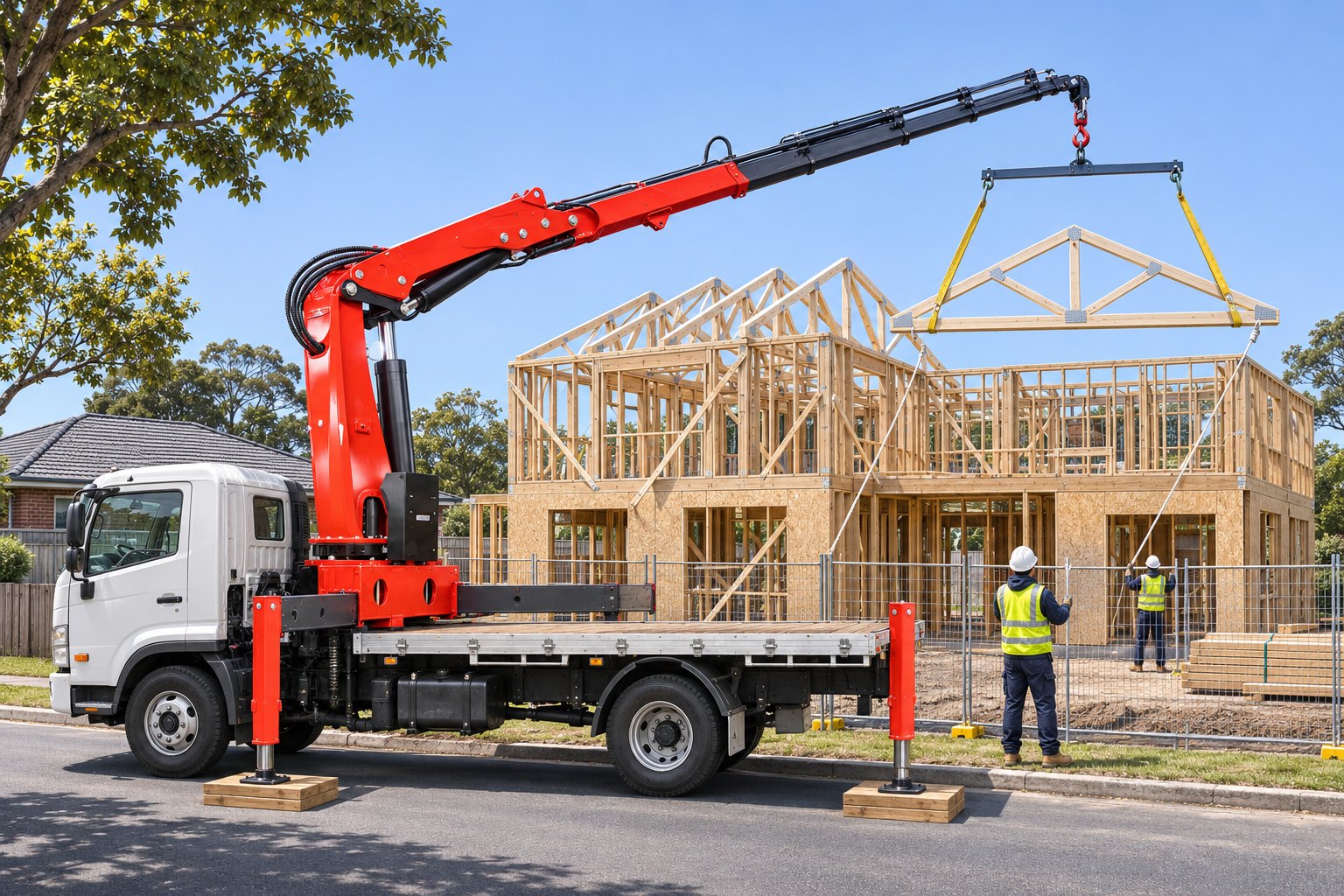
Example scenario (an illustration, not a customer record): a crew delivers roof trusses to a two-storey house with a telescopic truck crane. The operator, using the remote, walks to the corner of the plot and can see the truss lift off the bed. Once the boom swings over the ridge, the landing point is out of view. A roofer on the scaffold, wearing a hard hat and a hi-vis vest, takes over as the only signal person. He uses a dedicated radio channel and the operator wears a headset. When the radio drops for a moment, the operator stops and waits for the next clear signal.
Signal person qualification basics
In the United States, a signal person must be qualified before communicating any signals to an operator. Under 29 CFR 1926.1428, the employer can meet this in one of two ways:
- Option 1, third party: the signal person has documentation from a third-party qualified evaluator showing they meet the requirements.
- Option 2, employer’s evaluator: a qualified evaluator employed by the signal person’s employer assesses them and documents the result. This assessment is not portable, so another employer cannot rely on it.
The documentation must be available on site and must list each type of signalling the person is qualified for, such as hand signals or radio signals. To qualify, a signal person must know and understand the signals used, including the Standard Method if hand signals are used. They must be competent in using them and have a basic understanding of crane operation and limits. That includes the crane dynamics of swinging and stopping loads and boom deflection from hoisting loads. They must also know the relevant signal rules and pass both an oral or written test and a practical test. If later actions show they no longer meet the requirements, they must stop signalling until they are retrained and reassessed.
These are separate from the rules for the person at the controls. Our article on the crane operator license covers operator certification for knuckle boom and telescopic truck cranes.
Common signalling mistakes
Most signalling problems originate from a crew that did not establish the basic communication arrangements before the lift. Each mistake below breaks one of the rules quoted above:
- Two people signalling. A rigger and a supervisor both wave at the operator. Only one person may give signals at a time, except for stop.
- Directions from the wrong side. The signaller says “left” meaning their own left. Directions must come from the operator’s perspective.
- Made-up signals. Local signals invented mid-lift. Non-standard signals must be agreed before the operation by the signal person, operator and lift director.
- Mixed charts. One person uses the US chart and another the UK chart. Agree on one chart and post it.
- Carrying on after a dropout. The radio cuts out but the operator keeps moving. The operator must stop until communication is back and a proper signal is understood.
- A busy signaller. The signal person is also guiding a tag line or unhooking slings. In the UK the signaller’s duties must consist only of directing movements and keeping workers safe.
- Ignoring a stop from a bystander. Anyone may give the stop or emergency stop signal, and the operator must obey it.
Pre-lift signal checklist
Run through this short checklist at the pre-lift briefing, after the crane is set up on its outriggers and before the first hook movement:
- Can the operator see the whole load path and landing point? If not, name one signal person.
- Is the signal person qualified for the type of signals in use, with the documents on site?
- Which chart applies, and is it posted on the crane or near the lift?
- Are any non-standard signals needed, for example for knuckle boom folding motions or an attachment? Agree on them now.
- If radios are used: test them on site, set a dedicated channel and give the operator a hands-free set.
- Agree the voice signal order and the language everyone will use.
- Confirm that everyone knows the stop and emergency stop signals and that anyone may give them.
- Check that the signaller has a safe position, clear of the load, with a view of the whole lift.
Signals are only one part of a safe lift. Before signalling starts, check the radius on the crane load chart and the ground under each pad with our guide to crane outriggers and ground bearing pressure. The daily truck mounted crane inspection checklist covers the crane itself.
Frequently asked questions
How many standard crane hand signals are there?
The US Standard Method in Appendix A to 29 CFR 1926 Subpart CC shows 19 hand signals. They run from stop and emergency stop to hoist, lower, boom, swing and telescoping signals, plus signals for crawler, tower and trolley travel that truck cranes do not use.
What is the hand signal for stop on a crane?
On the US chart, stop is one arm held out level to the side, palm down, swung back and forth. Emergency stop uses both arms in the same way. On the UK chart, stop is the right arm pointing up with the palm facing forward.
Who can give crane signals?
Only one qualified signal person communicates instructions to a crane at a time. The exception is the stop or emergency stop signal, which anybody who identifies a safety problem must give and which the operator is required to obey.
Does a crane signal person need to be certified?
In the US the signal person must be qualified, either through a third-party qualified evaluator or through the employer’s own qualified evaluator. The documentation must be on site and list each type of signalling covered.
Do you need a signal person if the crane has a remote control?
Only if the operator still cannot see the load path or landing point, or another trigger in the rule applies. A remote lets the operator move to a better view, but if the landing point stays out of sight, a signal person is still required.
How we compiled this guide
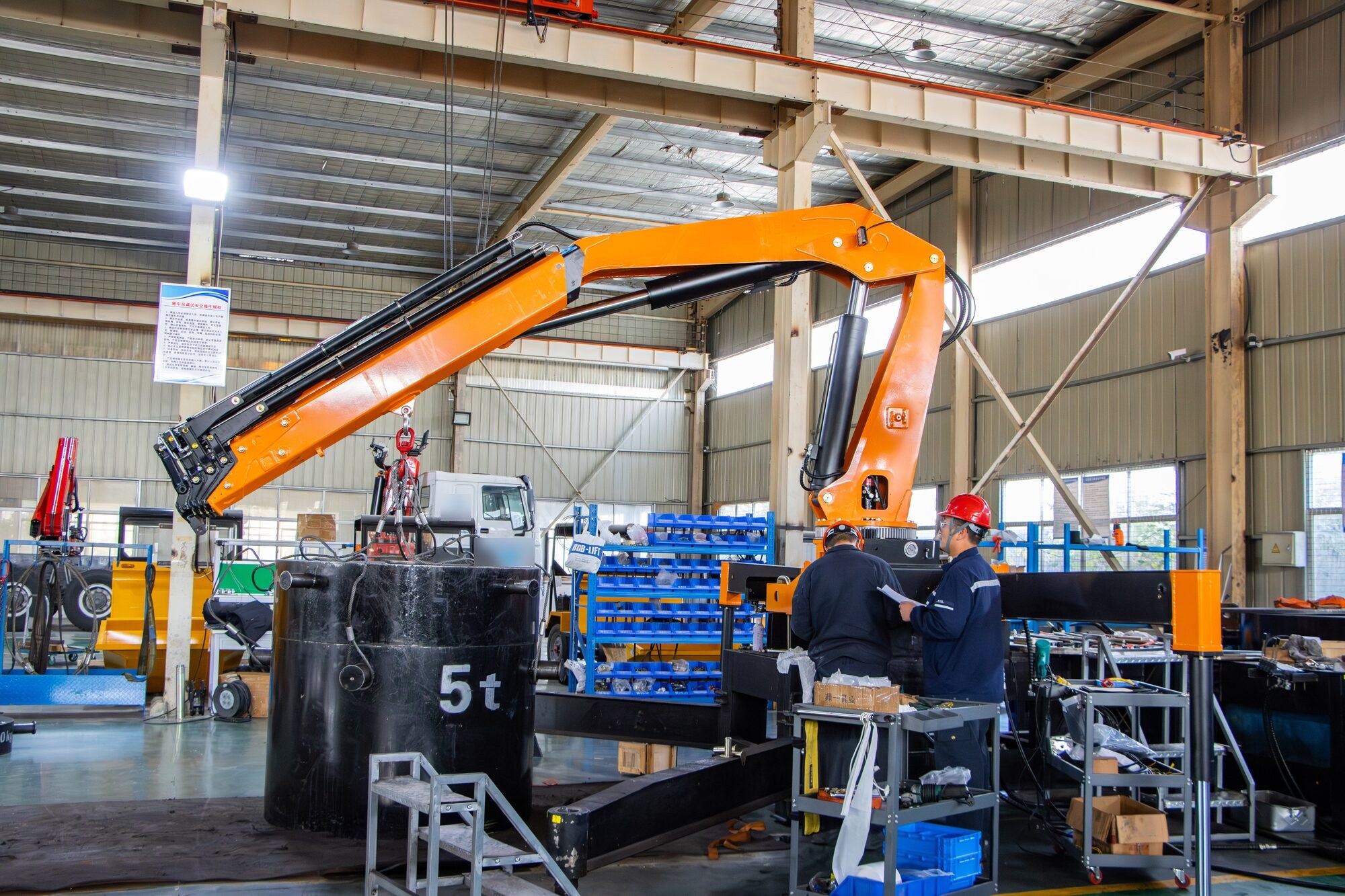
We compiled the US rules from the official eCFR text of 29 CFR 1926.1401, 1926.1419, 1926.1420, 1926.1421, 1926.1422 and 1926.1428, and the 19 signal descriptions from the drawings in Appendix A to Subpart CC. The UK hand and verbal signals come from Schedule 1 to the Health and Safety (Safety Signs and Signals) Regulations 1996 on legislation.gov.uk, as originally made. The remote control wording comes from our live product pages. The photos were taken at our Xuzhou factory. Achord Chan, Product Operations Director, reviewed the guide in November 2026. It does not replace your crane manual, your site lift plan or the law where you work.
Choose a crane that suits the way your crew signals
Tell us where your loads are usually set down and whether the operator can see them from the truck, and we will recommend a knuckle boom or telescopic truck crane with the control option that fits, whether that is levers, a top seat or a wireless remote. Every crane carries a 12-month warranty on the whole machine, common spare parts leave the factory within 48 hours, and our service team answers within 12 hours. Contact us for a quotation with the drawing and load chart.