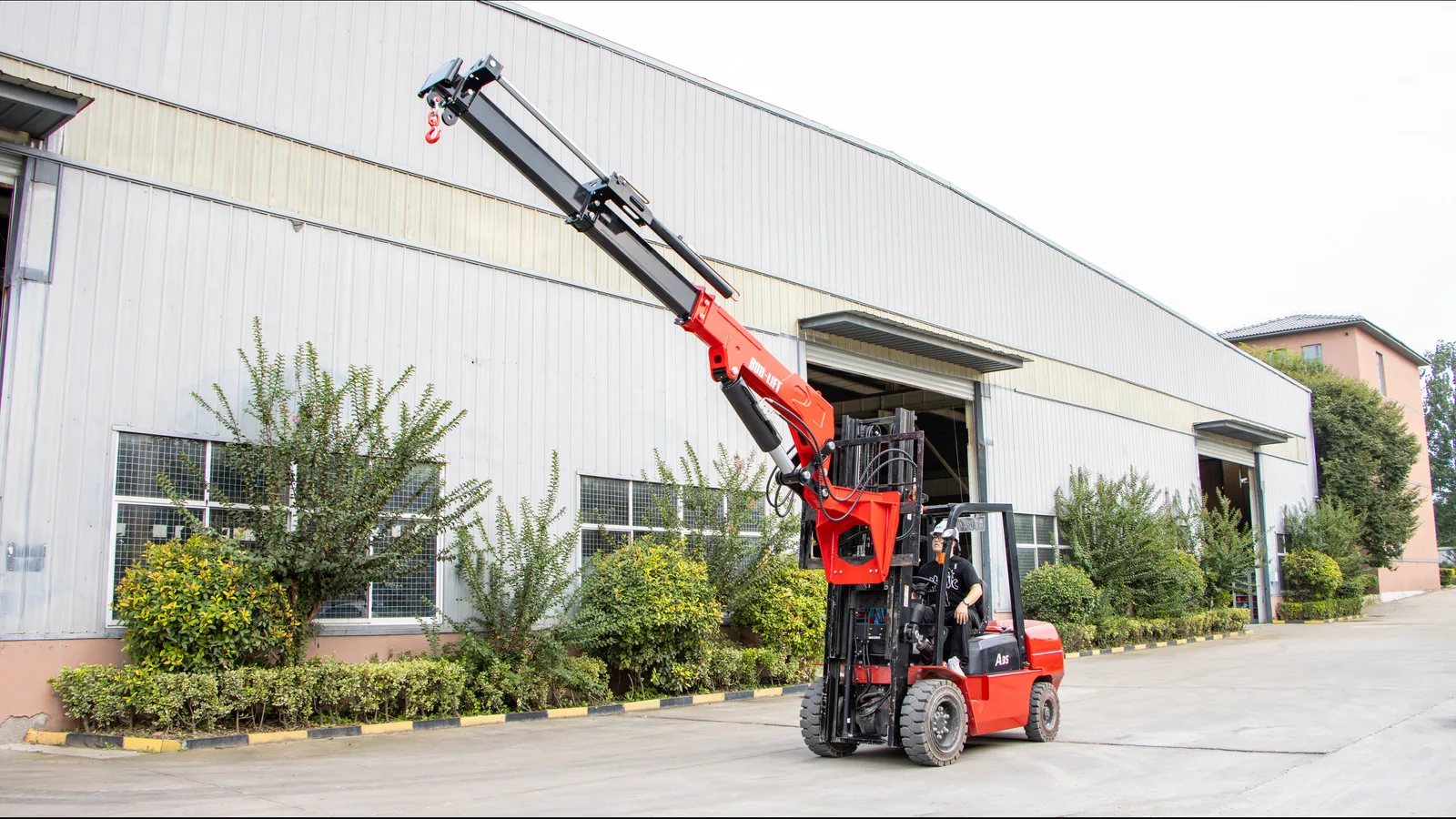
A forklift boom crane is a crane boom fitted to the front of a counterbalance forklift, so the forklift can lift a load on a hook instead of on its forks. The simplest kind is a fixed steel jib that slides onto the forks. The kind we build at MIAOXUE, often called a forklift fly jib crane, is a folding, telescopic hydraulic boom that hangs on the fork carriage and reaches out, up and down like a small crane.
MIAOXUE has built cranes in Xuzhou, China, since 2003. This guide explains how a forklift boom crane works, how it differs from a fork-mounted jib, and how to size one. Every load and reach figure comes from the technical-department load charts of our four drawn models, the CC85, CC105, CC125 and CC145.
Key takeaways
- There are two kinds of forklift boom: a fixed jib that slides onto the forks, and a hydraulic fly jib crane with folding, telescopic sections. The second reaches further and can lower a hook into a pit.
- Our four drawn models are rated from 2,300 kg to 4,900 kg close to the mast and still lift 300 kg to 500 kg at their maximum reach of 5,400 mm to 9,400 mm.
- The crane weighs 560 kg to 1,200 kg and is matched to forklifts of 3 t to 7 t, because the forklift is the crane’s counterweight.
- The forklift mast lifts the whole crane, so a taller mast adds hook height before the boom even moves.
- Size the crane by the load at the radius you need, then confirm the fit with the forklift’s make, capacity, mast and carriage.
What is a forklift boom crane?
Ask a dealer for a “forklift boom” and you may be offered two very different products. Both convert the forklift into a lifting machine with a hook, but they operate differently, carry different capacities and suit different applications.
- Fork-mounted jib (fixed boom). A steel beam with fork pockets slides over the forks and is pinned in place. The hook hangs from a fixed point, or from one of several holes along the beam. Because it has no hydraulic cylinders of its own, the forklift’s mast and tilt functions provide every movement.
- Forklift fly jib crane (hydraulic boom). A crane frame hangs on the fork carriage. The boom luffs up and down, telescopes out on hydraulic cylinders and folds back for travel. It can reach over an obstacle, through a doorway or straight down into a pit, and it typically lifts considerably more weight close to the mast.
A fixed jib is an economical tool for occasional, relatively light lifts at a single height. A fly jib crane, by comparison, is a genuine crane with a load chart for every working radius, designed for daily operation in factories, warehouses, storage yards and construction sites, such as lifting moulds, motors or steel sections. The rest of this guide concentrates on that second type. If you are still deciding between attachments, our guide to choosing a fly jib crane covers the basics.
Our forklift jib crane guide compares fork jibs and fly jibs in more depth and explains how to estimate capacity from a crane’s lifting moment.
How a forklift fly jib crane works
The crane and the forklift divide the work between them, and each component performs one specific function:
- The frame hangs on the forklift’s fork carriage, where the forks would normally sit.
- The mast lifts the whole crane, so the hook starts higher before the boom moves at all.
- The boom is built from 1,900 mm sections. Hydraulic cylinders raise it and extend all but the last section, which you pull out by hand and pin.
- The forklift drives the hanging load to where it is needed, slowly and with the load kept low, then sets it down.
For travel, the boom folds down in front of the mast, so the forklift keeps a compact profile in aisles and doorways. The video below, recorded at our factory, shows a CC85 on a counterbalance forklift as it unfolds, extends and carries the hook.
Forklift boom crane models and specifications
All four drawn models share one structural design. What changes is the number of boom sections, and consequently the reach, the crane weight and the forklift capacity required. The rated load is the maximum the crane lifts closest to the mast; at full reach it lifts considerably less, because the lifting moment, meaning the load multiplied by its horizontal distance from the mast, has a fixed limit.
| Model | Rated load | Max radius and load | Boom | Hook height (3 m / 4.5 m mast) | Crane weight | Forklift |
|---|---|---|---|---|---|---|
| CC85 | 2,300 kg at 1.7 m | 400 kg at 5.4 m | 4 × 1,900 mm (2 hydraulic + 1 manual) | 8,400 / 9,900 mm | 560 kg | 3 t / 3½ t |
| CC105 | 2,500 kg at 1.7 m | 300 kg at 6.6 m | 4 × 1,900 mm (2 hydraulic + 1 manual) | 9,500 / 11,000 mm | 650 kg | 3½ t / 4 t |
| CC125 | 3,500 kg at 2.1 m | 350 kg at 8.0 m | 5 × 1,900 mm (3 hydraulic + 1 manual) | 11,000 / 12,500 mm | 850 kg | 4 t / 6 t |
| CC145 | 4,900 kg at 2.2 m | 500 kg at 9.4 m | 6 × 1,900 mm (4 hydraulic + 1 manual) | 12,400 / 13,900 mm | 1,200 kg | 5 t / 7 t |
For more reach, we also build two 7 t models: the CC165, which lifts 750 kg at a working radius of 11 m on a 10 t forklift, and the CC200 long-reach forklift jib crane, which lifts 600 kg at a working radius of 12.6 m on a 10–12 t forklift. Both are rated 7,000 kg at a working radius of 2.8 m and are not plotted in this comparison; their load charts are on the product pages.
How much can a forklift boom crane lift at reach?
The headline rating only applies close to the mast. Every additional metre of reach reduces the permitted load, and the curves below, plotted from the points on each model’s load chart, show how quickly the capacity decreases.

Three observations stand out from the load charts. First, the CC85 and CC105 carry almost identical loads out to about five metres, so the CC105 justifies its additional 90 kg only when you regularly need reach beyond the CC85’s maximum. Second, at a radius of 5,200 mm the CC125 lifts 1,300 kg while the CC145 lifts 2,100 kg, which means that moving up one size substantially increases capacity at the same working distance. Third, every model finishes between 300 kg and 500 kg at full reach, regardless of its headline rating. Our guide on how to read a crane load chart explains the method in more detail.
Example scenario (an illustration, not a customer record): a maintenance workshop needs to lift a 1,200 kg injection mould out of a press bay, approximately three and a half metres from the nearest position where the forklift can stand. The CC85 lifts 1,300 kg at 3,200 mm but only 700 kg at 4,300 mm, so at the required distance its capacity falls below the weight of the mould, and the CC105 would be operating at its limit. The CC125, which still lifts 2,200 kg at 3,800 mm, leaves a comfortable safety margin and is designed for a 4 t forklift.
Matching the crane to your forklift
A forklift boom crane has no outriggers. The forklift itself acts as the counterweight, so the crane only operates safely on a forklift of the matching capacity. For example, fitting the CC145 to a 3 t forklift would make the forklift tip forward long before the crane reached its rated load.

Before we quote, we ask for these details about the forklift:
- Make, model and rated capacity, in tonnes, from the data plate.
- Mast: its height (3 m, 4.5 m or other) and the carriage width.
- Hydraulics: whether the forklift has an auxiliary hydraulic circuit.
- A side photo of the forklift that shows the carriage clearly.
Then tell us your heaviest load, the distance from the forklift at which it must be placed, and the highest point you need to reach. With those figures our engineers can select the model and confirm the installation. Mast height is particularly important, because the mast raises the entire crane: a four-and-a-half-metre mast provides approximately 1,500 mm more hook height than a three-metre mast on every model in the table.
Where a forklift crane works best
A forklift crane suits a facility that already operates a forklift and needs hook lifting several times a day, without the cost and scheduling of a mobile crane. Typical applications include:
- Factories and workshops: machine parts, moulds, motors and gearboxes.
- Building sites: pipes, steel sections and building materials, including lifts to a higher floor.
- Pits and basements: the hook can go straight down to lift a pump or a part out of a pit.
- Narrow spaces: aisles, bays and doorways too tight for a truck crane.
If the load has to travel on public roads, or you need more reach than our largest drawn model provides, a crane mounted on a truck is usually the more practical solution. Our forklift fly jib cranes page lists the full range, and our knuckle boom crane attachments guide covers hooks and other tools for truck cranes.
If the job is to move the forklift itself rather than fit a jib to it, our guide on how to lift a forklift with a crane covers the lifting points, rigging and crane size.
Rules and safe use
Installing a crane on a forklift changes the machine’s capacity and stability, so the regulations for both types of equipment apply. In the United States, OSHA 1910.178 says that modifications and additions which affect capacity and safe operation must not be made without the forklift manufacturer’s prior written approval, and that the user of a truck with non-factory front-end attachments must ask for it to be marked with the attachment and the approximate weight of the combination [1]. In Great Britain, lifting equipment needs a thorough examination by a competent person at least every 6 or 12 months, depending on the equipment, or under an examination scheme [2]. In the EU, the CC85 and CC105 hold a CE certificate of conformity under the Machinery Directive 2006/42/EC [3].
On site, a few consistent operating habits prevent most incidents:
- Use the crane only on a forklift of the matching capacity, and stay within the load chart at your actual radius.
- Lift with the forklift on firm, level ground. Travel slowly, with the load low and the boom retracted as far as the job allows.
- Never side-pull or drag a load, and keep people out from under the boom.
- Operators and slingers wear hard hats. Check pins, hoses and the hook latch before each shift, and use our crane inspection checklist as a starting point.
Frequently asked questions
What is the boom on a forklift?
It is a lifting arm fitted to the front of the forklift so that the machine can carry a suspended load on a hook. It can be a fixed jib that slides onto the forks, or a hydraulic fly jib crane that hangs on the fork carriage and folds, luffs and telescopes like a compact crane.
How much can a forklift boom crane lift?
Our drawn models are rated from 2,300 kg (CC85) to 4,900 kg (CC145) close to the mast. At full reach, which ranges from about five and a half to nine and a half metres, they lift between 300 kg and 500 kg. Always consult the load chart at the radius you will actually use.
What size forklift do I need for a fly jib crane?
It depends on the crane. The CC85 needs a forklift of three to three and a half tonnes, the CC105 one of three and a half to four tonnes, the CC125 one of four to six tonnes and the CC145 one of five to seven tonnes. Send us the forklift’s manufacturer, capacity and mast specification so that our engineers can confirm the compatibility.
Does a forklift boom crane reduce the forklift’s capacity?
Yes. The crane’s own weight, between 560 kg and 1,200 kg, is positioned in front of the mast, and the suspended load hangs further forward than a load on forks. That is why each crane is matched to a specific forklift class and why the truck should be marked for the attachment.
How high can a forklift boom crane lift?
With a standard three-metre mast, the maximum hook height ranges from 8,400 mm on the CC85 to 12,400 mm on the CC145. With a four-and-a-half-metre mast, each figure increases by approximately 1,500 mm, reaching 9,900 mm and 13,900 mm respectively.
Can I fit a fly jib crane to my existing forklift?
Usually, yes, provided the forklift’s capacity matches the crane. Because the crane hangs on the fork carriage, our engineers verify the carriage width, the mast and the hydraulic circuit from your details and photograph before confirming the installation in the quotation.
How we compiled this guide
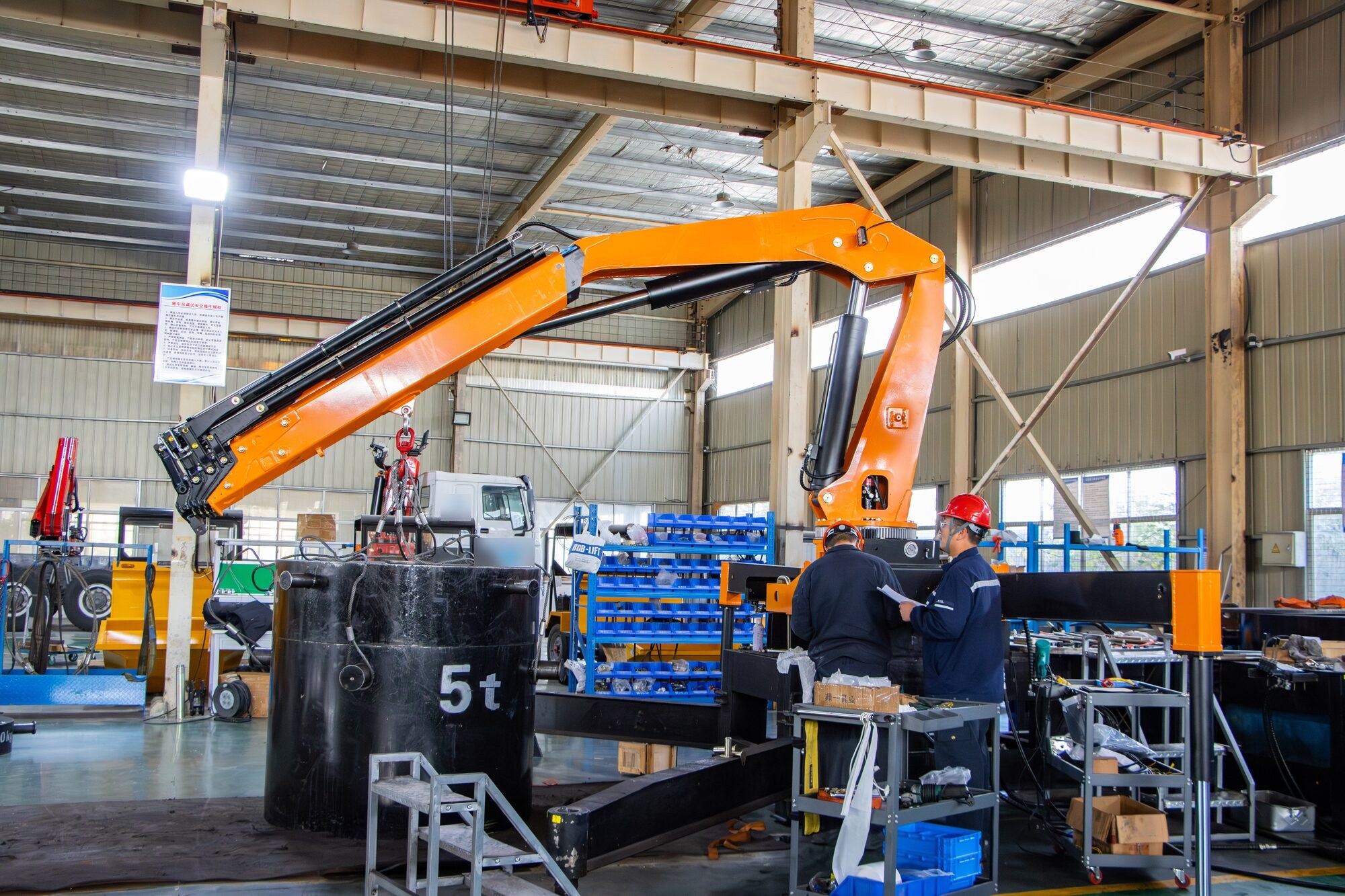
We compiled the rated loads, radii and boom sections from the MIAOXUE technical-department load-chart drawings of the CC85, CC105, CC125 and CC145, and the hook heights, crane weights and forklift classes from our product pages, in November 2026. The photos and the video were taken at our Xuzhou factory. The rules are summarised from the official pages linked above as they stood in November 2026. The guide was reviewed by Achord Chan, Product Operations Director. Specifications can change without notice, so ask for the current drawing before you order.
Get the right forklift boom crane
Tell us your forklift, your heaviest load, the radius and the height you need, and we will suggest a model with its load chart. Every crane carries a 12-month warranty on the whole machine, common spare parts are dispatched within 48 hours, and our service team replies within 12 hours. Download the forklift fly jib crane catalogue (PDF), browse the full range, or contact us to start.