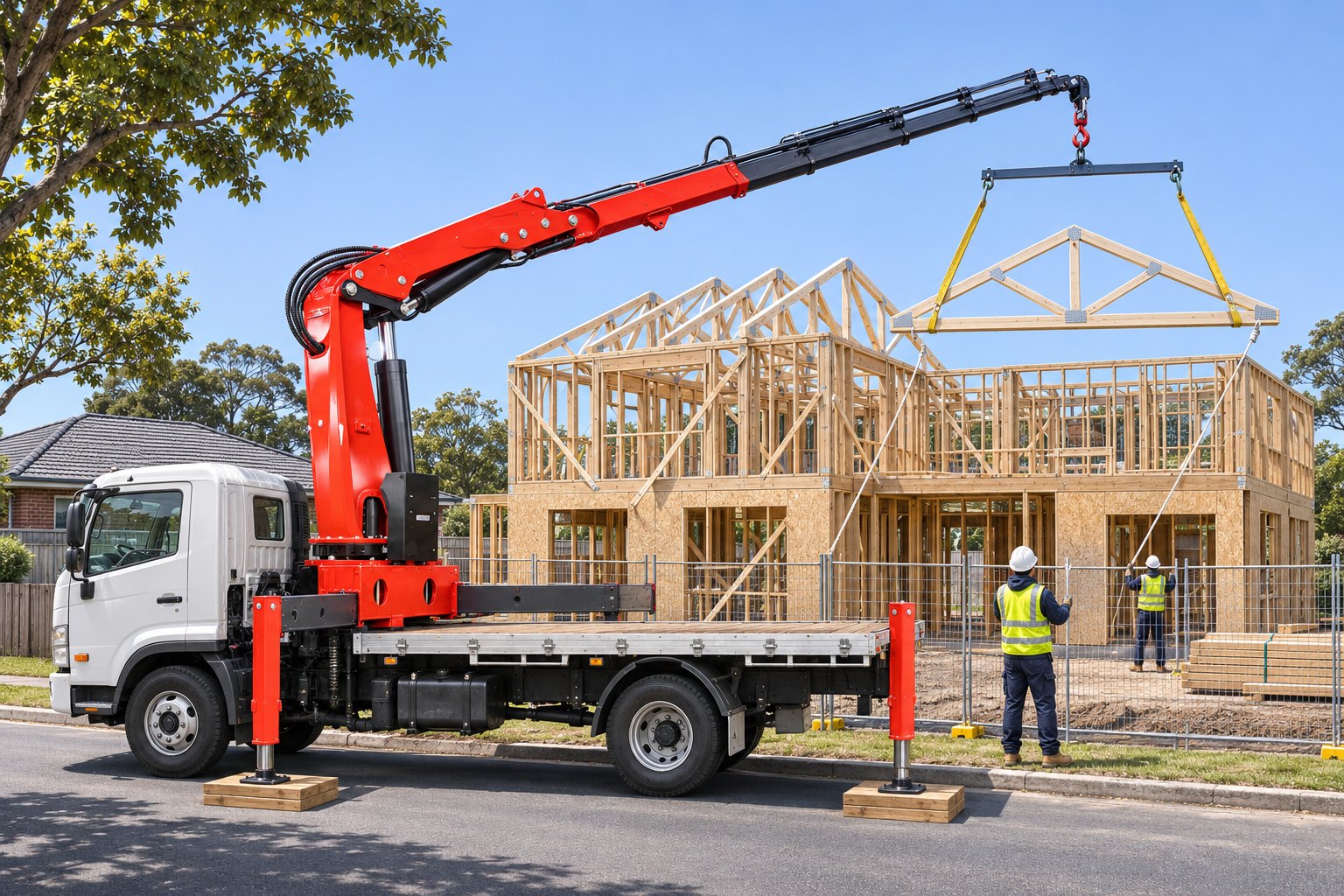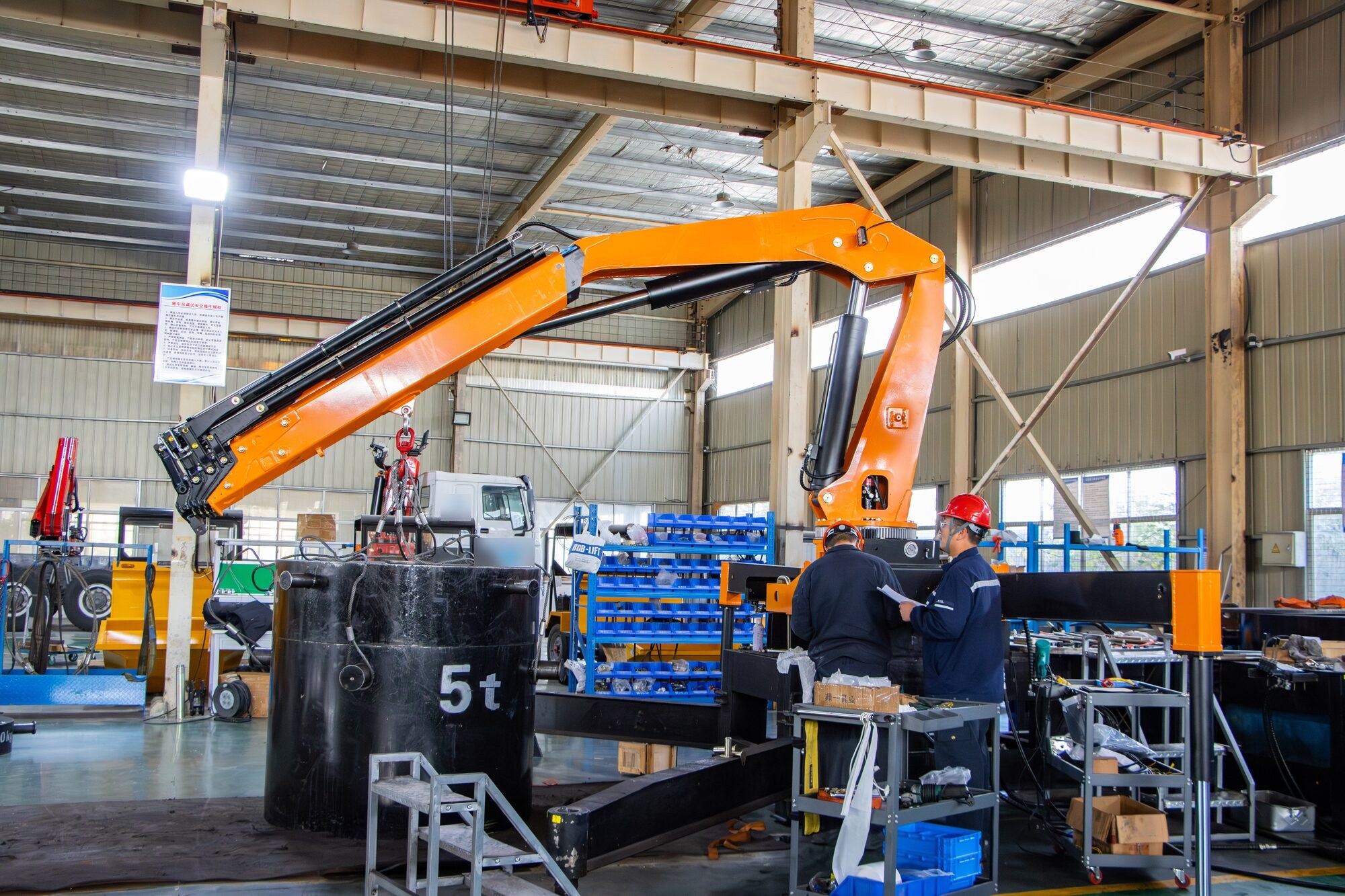
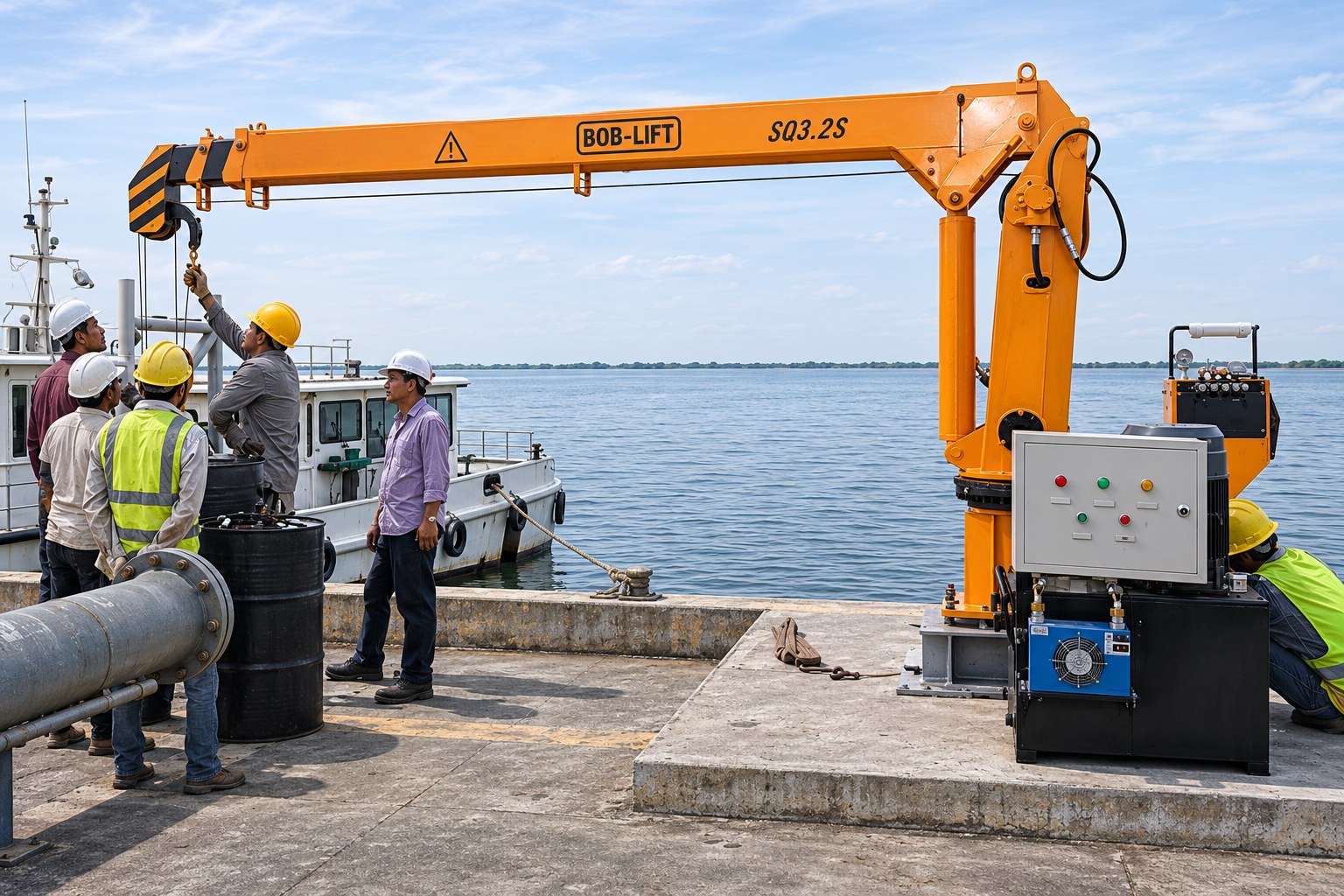
Cranes in the marine industry move cargo between ship and shore and lift stores, spare parts and hoses on board. They also haul nets and catch on fishing boats, handle buoys and moorings from workboats, build and repair ships, and make heavy lifts from floating crane vessels. Each setting uses a different crane. Container terminals use ship-to-shore gantry cranes, many cargo ships carry their own deck cranes, and fishing boats, barges and workboats mostly use compact hydraulic knuckle boom or telescopic cranes. A marine crane is a crane built to work on a vessel, barge or quay, with its own pedestal or base and protection against salt water.
We have manufactured hydraulic cranes in Xuzhou since 2003, and our marine knuckle boom and telescopic cranes work on vessels, barges and quays. This guide explains what cranes do in each part of the marine industry, which crane each job uses, what decides its size, and where our cranes fit.
Key takeaways
- Marine cranes do six main jobs: ship-to-shore cargo, cargo and stores on board, fishing gear and catch, workboat and barge work, shipbuilding and repair, and heavy lifts at sea.
- A geared ship carries its own cranes, so it can load and discharge in ports that have no shore cranes.
- Fishing boats need cranes because hauling nets, pots and catch by hand is slow and heavy; a power block hung from a boom or deck crane hauls the net.
- The size of a marine crane is decided by the load at the working radius, the deck space and power on board, and how the vessel moves, not by the headline tonnage.
- MIAOXUE marine cranes run from 0.8 t to 25 t for vessels, barges and quays in sheltered water; they have no class-society certification and are not offshore cranes.
Where do cranes work in the marine industry?
Almost everything that crosses the sea is lifted at least twice. According to UNCTAD, “around 80% of the volume of international trade in goods is carried by sea”, and the share is even higher for most developing countries [1]. Every one of those cargoes is loaded and discharged somewhere, and the vessels that carry it also need fuel, stores, repairs and maintenance.
The chart groups the main settings. The two largest crane types stay on land, while most cranes mounted on a vessel are much smaller hydraulic cranes sized for one deck and one job.

Ports and container terminals: ship-to-shore cranes
At a container terminal, cargo moves between ship and quay on a ship-to-shore crane. A ship-to-shore crane is a large dockside gantry crane that runs on rails along the quay and lifts containers with a spreader locked into the corner castings. Wikipedia’s article on the container crane states that a modern crane that lifts two 20-foot containers at once is “generally” rated at 65 tonnes. Some new cranes are rated at 120 tonnes, and the largest reach across 26 rows of containers on deck [2]. The same article notes that operations are generally halted above a wind speed of about 22 m/s.
Smaller berths use mobile harbour cranes and fixed quayside cranes, and smaller container cranes “are still used to serve barges and similar vessels at inland ports” [2]. Our article on what cranes are used at docks compares them. In the United States, 29 CFR 1917.45 requires a rating chart visible to the operator at marine terminals, and the manufacturer’s rated loads “shall not be exceeded” [3].
Ship cranes on cargo vessels
Ship cranes are the cranes for ships that cannot rely on the port. Wikipedia’s article on the bulk carrier explains that ships can be “gearless (dependent upon terminal equipment) or geared (having cranes integral to the vessel)” [4]. A geared vessel is a cargo ship with its own cranes, derricks or conveyors, which allow it “to load or discharge cargo in ports without shore-based equipment”. The same article describes a typical Handymax bulk carrier with five cargo holds and four cranes. Gearless ships avoid “the costs of installing, operating, and maintaining cranes”, but they can only trade to ports that have shore equipment.
The same logic applies on a much smaller scale. Island supply vessels, coastal general cargo ships and landing craft often call at jetties with no crane at all. For example, a hydraulic deck crane on board lifts bagged cargo, pipes, pallets and machinery between the quay and the deck. A cargo ship with a crane of this kind carries its own loading equipment to every stop. Our deck crane guide covers outreach and deck space, and the article on types of cranes used on a ship names each kind of ship crane.
Stores, spare parts and hose handling
Even a ship that never handles its own cargo needs a crane for supplies. Provisions, stores, ropes, engine spares and waste are lifted between the quay or a supply boat and the deck, often by a small provision crane.
Tankers and bunker vessels add hose handling. A tanker moored at a pier connects “with cargo hoses or marine loading arms”, according to Wikipedia’s article on the oil tanker [5], and bunkering is the supply of fuel to ships. A filled hose string is heavy and stiff, so a marine hose crane lifts it to the manifold and holds it while the crew connects it.
Why do fishing boats need cranes?
Fishing boats need cranes because nets, pots, catch and ice are too heavy and too frequent to handle by hand. A crane also keeps the crew out from under the load while the boat moves. The clearest example is the power block, which is a powered sheave used to haul in seine nets. Wikipedia’s article on seine fishing quotes the UN Food and Agriculture Organization: no single invention “has contributed more to the effectiveness of purse seine net hauling than the power block” [6].
That power block has to hang from something. The same article states that on Danish seiners “a power block, usually mounted on a boom or a slewing deck crane, hauls the seine net”. Power blocks are now usually driven by hydraulic pumps on the main or auxiliary engine. Wikipedia’s article on the fishing vessel adds that trap setters use “hydraulic or mechanical pot haulers”, and that larger lift netters carry “winches and derricks” [7]. At the quay, the same crane lifts catch boxes ashore and ice, bait and gear back on board.
Because fishing decks are small and busy, these are usually compact knuckle boom cranes that fold away when the boat is fishing. Our smallest marine knuckle boom, the SQ08ZA3T+1, lifts 800 kg at 1.337 m and 220 kg at its full 4.151 m reach, slews 330° and weighs 200 kg, according to its technical drawing. Our boat crane guide explains how to size a crane for a fishing boat.
Workboats, aquaculture, buoys and small boats
Harbour workboats and fish farm service vessels lift loads such as anchors, chain, mooring blocks, net pens and feed bags. A buoy tender is a vessel that maintains and replaces navigational buoys, according to Wikipedia’s buoy tender article, which means lifting a buoy and its chain onto the deck. These cranes often lift over the side at a fixed radius, so the load at that radius matters most.
Yachts and larger vessels also launch tenders and inflatable boats by crane. A davit crane is the usual fixed solution, while lifeboat davits are a separately regulated product. On land, a truck mounted crane can move a small boat between a trailer and the water, as our guide on how to lift a boat with a crane explains. MIAOXUE cranes never lift people.
Barges, marine construction and floating cranes
In marine construction, a crane on a barge or pontoon lifts piles, rock bags, pipes and dredging gear where no land-based crane can reach. It is sized by the load at its working radius and by how far the barge heels when it lifts over the side, as our barge crane guide explains.
At the top of the scale are floating cranes. A crane vessel, or crane barge, is a ship with a crane specialised in heavy lifts, “typically exceeding 1500 MT for modern ships”, according to Wikipedia’s crane vessel article [8]. The largest has two revolving cranes of 10,000 t each that lift 20,000 t together, and it lifted a 15,300 t topside in September 2019. Our floating crane guide explains when a pontoon crane is enough.
Ship yard cranes: shipbuilding and repair
Shipyards use the largest land-based cranes of the marine industry. Wikipedia’s article on the shipyard describes a large yard as containing “many specialised cranes, dry docks, slipways”, painting facilities and large fabrication areas [9]. Full gantry cranes straddle the building dock and move large ship sections and engines together [10]. For example, two such cranes at a Belfast shipyard span 140 m and lift up to 840 t to a height of 70 m. A gantry crane installed at a shipyard in Yantai, China, in 2008 lifts 20,000 t.
Repair yards and fitting-out quays also need lighter lifts, such as propellers, pumps, winches and pallets of spares. Fixed quay cranes and truck mounted cranes often handle these, and the pedestal crane guide covers bases and foundations for a fixed quay crane.
Offshore: a separate class of crane
Offshore platforms and offshore vessels use cranes designed for lifting in waves. Wikipedia’s article on the crane notes that standards for cranes on ships or offshore platforms are “somewhat stricter because of the dynamic load on the crane due to vessel motion” [11]. Our article on the differences between marine cranes and offshore cranes explains the gap; MIAOXUE does not build offshore cranes.
Marine crane uses at a glance
The table pairs each use with its usual crane and the factor that decides the size.
| Use | Typical crane type | What decides the size |
|---|---|---|
| Containers between ship and quay | Ship-to-shore gantry crane | Ship width (rows across), container weight, quay rails |
| General cargo at ports without shore cranes | Ship’s own deck crane (knuckle or telescopic) | Load at the radius to the quay, hatch layout, deck space |
| Stores, spares and provisions | Small provision crane | Heaviest spare part, reach over the rail |
| Hoses on tankers and bunker vessels | Hose handling crane | Filled hose weight, reach to the manifold |
| Nets, pots and catch on fishing boats | Small knuckle boom crane, power block on a boom | Gear weight, deck space, stowed height |
| Buoys, moorings and aquaculture | Deck crane on a workboat | Load over the side at a fixed radius, vessel stability |
| Piles, rock and pipes in marine construction | Barge or pontoon crane | Load at working radius, barge heel |
| Ship sections and engines in a shipyard | Full gantry crane, tower or mobile crane | Heaviest block, dock width and height |
| Very heavy lifts at sea | Floating crane vessel | Lift weight and radius, sea state |
| Tenders and small boats | Davit or small deck crane | Boat weight with equipment, launch radius |
What drives demand for marine cranes?
We have not found a marine cranes market figure from a source we can verify, so this guide quotes none. The demand drivers are clearer. Seaborne trade carries most of the world’s goods [1], geared ships keep serving ports without shore equipment [4], and fishing has relied on powered hauling since the power block arrived in the 1950s [6].
Our own marine range is built for the small and medium end of that demand. The knuckle boom models fold flat for stowage, a J in the model name marks a crane with a winch for loads below deck level, and each crane runs from a hydraulic power pack.
What these uses mean when you choose a crane for a vessel
Start from the use, not from the tonnage. Write down the heaviest load and the radius from the crane to where that load is picked up or set down. Add the deck space for the crane and its stowed boom, the power available on board, and whether the vessel is moored, at anchor or moving when the crane works. Capacity falls quickly as the radius grows, which the article on the lifting moment of a crane explains. Every MIAOXUE crane is listed with a load moment limiter.
Our knuckle boom marine cranes run from the 800 kg SQ08ZA3T+1 to the SQZ500T, which lifts 25,000 kg at 2.0 m and 2,000 kg at 18.0 m. Our telescopic boom marine cranes run from the 2,000 kg SQ2SA3T, which reaches 8.2 m with 250 kg, to the 20,000 kg SQ20SA5T, which reaches 22.0 m with 1,500 kg. All figures come from each crane’s current technical drawing. These cranes have no class-society certification, so if your vessel needs class approval, tell us before we quote.
Rules follow the flag and the place of work. On United Kingdom ships, the Merchant Shipping and Fishing Vessels (Lifting Operations and Lifting Equipment) Regulations 2006 apply. They require a competent person to inspect lifting equipment “after installation and before being put into service for the first time” [12]. Where equipment is exposed to deterioration, it must be thoroughly examined at least every 12 months, or every 6 months for accessories for lifting and equipment for lifting persons.
These guides each cover one part of the choice:
- Marine crane buying guide: the choice step by step.
- Marine crane sizes: load at full reach by model.
- How a ship crane works: the hydraulic circuit.
- Structure of marine cranes: the parts.
- Knuckle boom vs telescopic marine crane: which boom suits your deck.
Frequently asked questions
Why do we need fishing cranes?
Fishing cranes haul and carry nets, pots, catch boxes, ice and gear that are too heavy to handle safely by hand. A crane or boom also carries the power block that hauls seine nets.
What are ship cranes used for?
Ship cranes load and discharge cargo in ports without shore cranes, and lift stores, spare parts, hoses and small boats on board.
What cranes are used in shipyards?
Large shipyards use full gantry cranes that move ship sections and engines, plus tower, mobile and pedestal cranes for lighter parts.
What is a marine hose crane?
A marine hose crane lifts and holds cargo or bunker hoses at a tanker’s manifold while the crew connects them. The filled hose weight and the reach to the manifold decide its size.
Can MIAOXUE marine cranes be used offshore?
No. MIAOXUE marine cranes are built for vessels, barges and quays in sheltered water and have no class-society certification. Offshore lifts need cranes designed for lifting in waves.
How we compiled this guide
We compiled the trade share from UNCTAD’s Review of Maritime Transport page and the crane facts from eleven Wikipedia articles cited above, read in November 2026. The rules come from the official eCFR text of 29 CFR 1917.45 and regulation 12 of SI 2006/2184 on legislation.gov.uk. The MIAOXUE figures come from the current technical drawings of the SQ08ZA3T+1, SQZ500T, SQ2SA3T and SQ20SA5T. This version replaces an earlier article whose capacity figures had no source. The diagram is our own work, and Achord Chan, Product Operations Director, reviewed the guide.
Tell us what your crane will lift on the water
Send us the heaviest load, the radius you need, your vessel, barge or quay and the power on board. We will recommend a crane from our marine crane range with its technical drawing and load chart, or tell you plainly if the job needs an offshore or class-approved crane. Every crane carries a 12-month warranty on the whole machine, common spare parts leave the factory within 48 hours, and our service team answers within 12 hours. Contact us for a quotation.