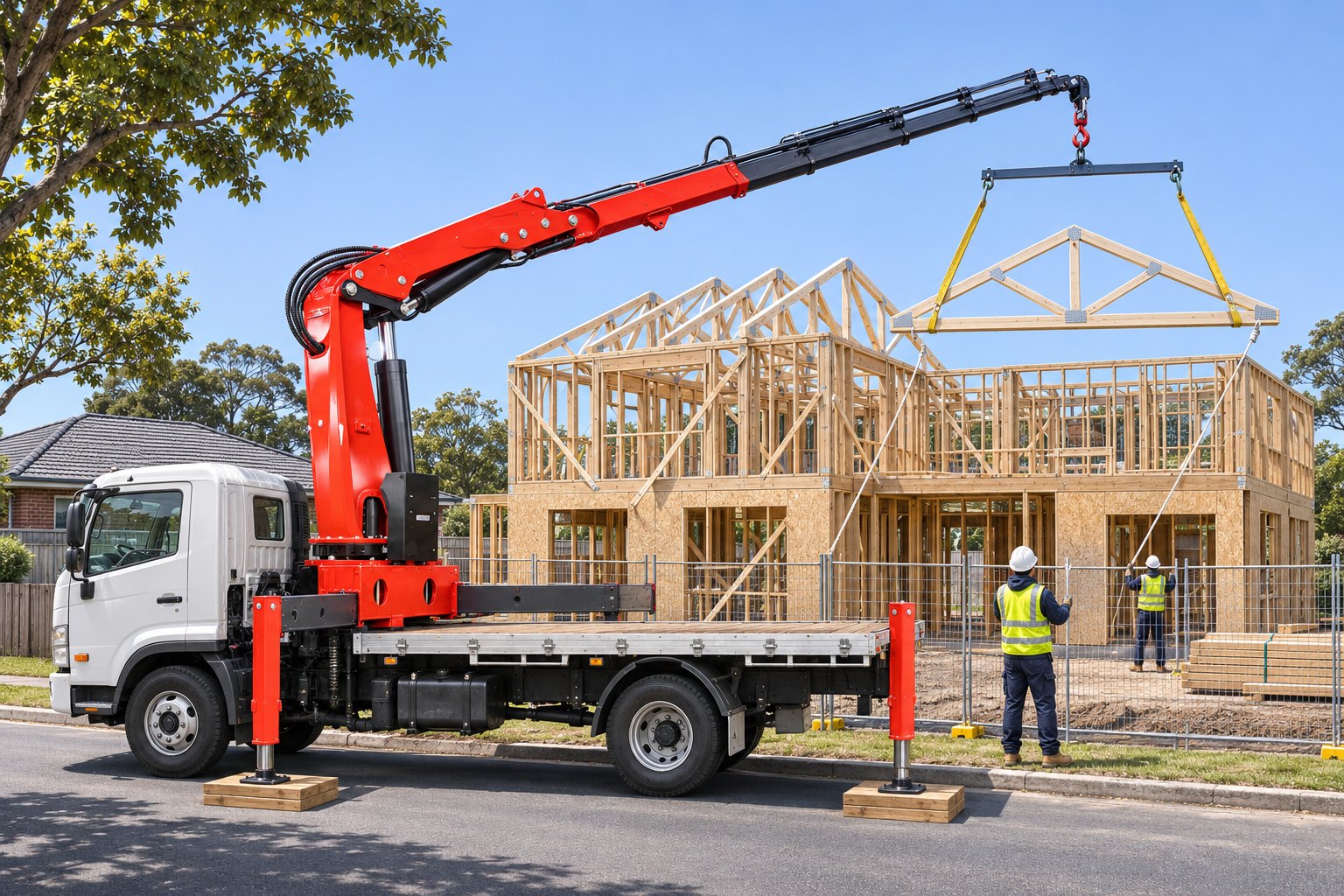

A floating crane is a crane operating from a floating hull, such as a vessel, barge, pontoon or floating dock, rather than from the ground. The term covers enormous crane vessels that install complete offshore platform decks as well as compact hydraulic cranes bolted to a harbour work pontoon. Every one of them shares a difficulty that a land crane never encounters: its foundation moves. When the crane lifts, the hull heels and trims, while waves and wind introduce additional dynamic loads.
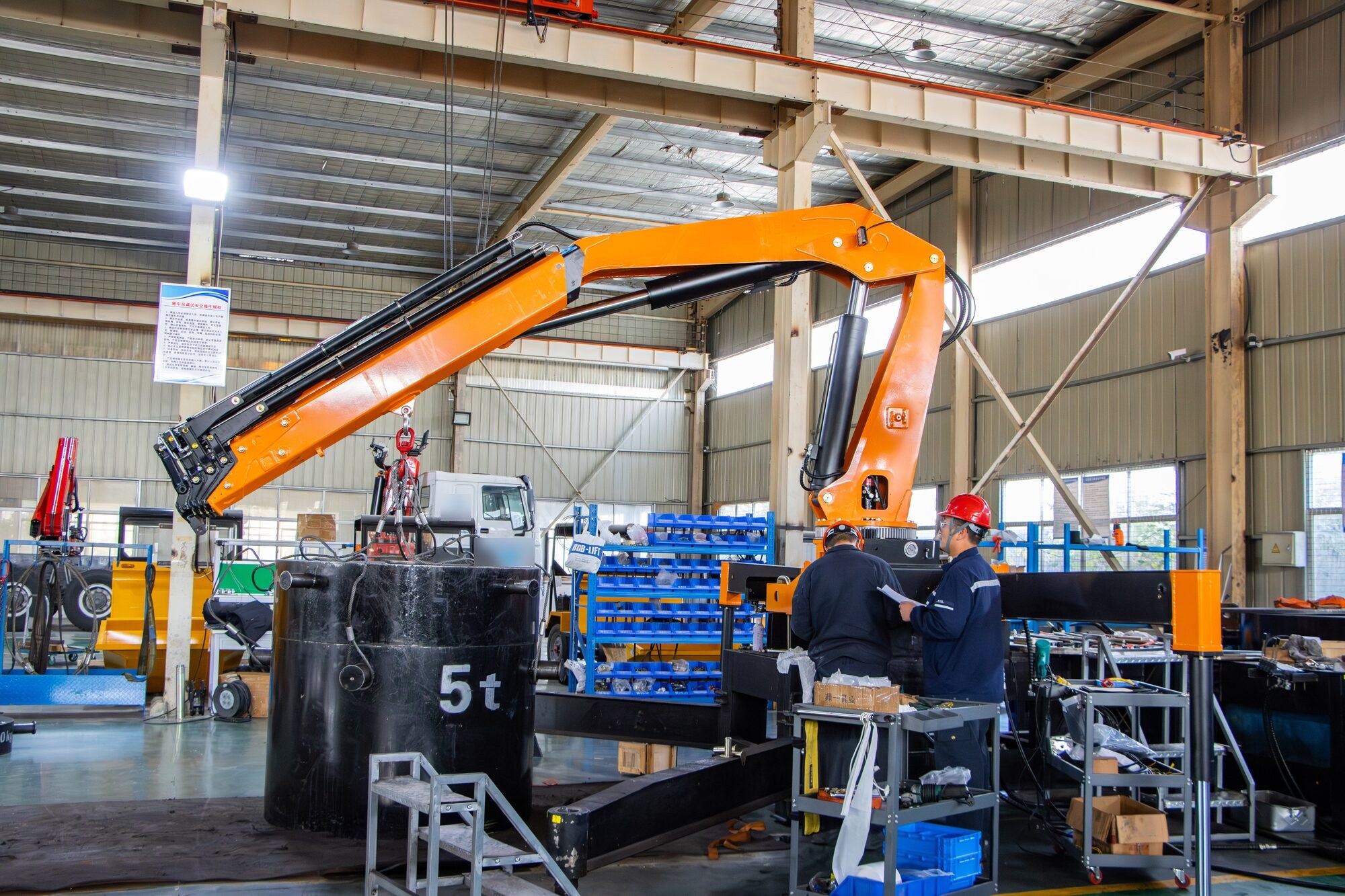
We have manufactured cranes in Xuzhou since 2003, including marine knuckle boom and telescopic cranes that customers install on workboats, barges and pontoons, although we do not build or sell vessels ourselves. This guide explains the principal types of floating crane and their typical applications, how large they become, and why a crane on water requires different operating rules. It also shows when a compact crane on a pontoon is all the floating crane a particular job actually requires.
Key takeaways
- “Floating crane”, “crane vessel”, “crane barge” and “crane ship” all describe a crane operating from a floating hull.
- The principal types are sheerlegs, which cannot slew, revolving crane vessels and derrick barges, semi-submersible crane vessels, and compact hydraulic cranes on work barges, pontoons and floating docks.
- The largest crane vessels lift more than 10,000 t. Sleipnir’s two cranes are rated at 20,000 t together.
- On water, the hull heels and trims under load, and waves and wind introduce dynamic loads, so a crane rated for land operation must be derated before it operates on a barge.
- In the United States, 29 CFR 1926.1437 specifies list and trim limits, additional safety devices and regular inspections of the barge itself.
- For loads up to approximately 25 t in sheltered water, a hydraulic marine crane on your own pontoon or work barge is often sufficient. MIAOXUE supplies the crane only, not the barge, and our marine cranes are not offshore cranes.
What is a floating crane?
Wikipedia’s article on the crane vessel treats crane vessel, crane ship, crane barge and floating crane as one family: a vessel with a crane built for heavy lifts. It notes that modern crane ships typically lift more than 1,500 t [1]. In everyday usage the term is considerably broader, because port operators and marine construction contractors also describe a crane on a pontoon, a work barge or a floating dock as a floating crane.
US crane rules draw a useful line. 29 CFR 1926.1437 separates “floating cranes/derricks”, which are designed for marine use by permanent attachment to a barge, pontoon or vessel, from “land cranes/derricks” that are simply placed on a barge. The first category has load charts calculated specifically for operation on water, whereas the second category carries land load charts, so its rated capacity must be reduced before it is used afloat [2]. That distinction underlies most of the practical advice in this guide.
Types of floating crane and what each is used for
Floating cranes differ in two fundamental respects: whether the crane can slew independently of the hull, and what type of hull supports it. For example, a sheerleg barge and a semi-submersible crane vessel may lift similar loads but operate in completely different ways. The table summarises the principal configurations.
| Type | How it lifts | Typical work |
|---|---|---|
| Sheerleg (shear-leg) crane | A-frame at the bow or stern; luffs but does not slew, so the whole hull is moved to place the load | Salvage, shipbuilding, heavy cargo, bridge sections |
| Revolving crane vessel or derrick barge | Slewing crane on a ship or barge; turns the load without moving the hull | Port and coastal construction, offshore installation |
| Semi-submersible crane vessel | One or two very large slewing cranes on a column-stabilised hull | Offshore construction and platform installation |
| Catamaran gantry or hammerhead barge | Fixed gantry or hammerhead spanning two hulls | Bridge piers and long loads in sheltered water |
| Hydraulic crane on a work barge or pontoon | Knuckle boom or telescopic marine crane bolted to a deck pedestal | Harbour, river and marina work; loading materials, mooring blocks, small boats |
| Floating dock crane | Crane on the side wall or deck of a floating dry dock | Ship repair and outfitting while the ship is in the dock |
Summary compiled by MIAOXUE, November 2026, from the Wikipedia articles on crane vessels and floating sheerlegs and our own product range.
Sheerleg crane (floating sheerleg)
A floating sheerleg carries a large A-frame, the shear legs, hinged at one end of the hull. It can luff the A-frame to change reach, but it cannot rotate the crane independently of the hull [3]. After the lift, tugs or the vessel’s own thrusters reposition the entire barge above the set-down point. The load always remains on the hull’s line of maximum stability, and ballast at the opposite end can counterbalance it. Consequently, a sheerleg is more economical to build and maintain than a slewing crane of similar capacity, although positioning takes longer. Larger sheerlegs usually have their own propulsion, while smaller units are pontoons towed to site. Typical applications include salvage, shipbuilding, heavy cargo handling and bridge construction.
Revolving crane vessel and derrick barge
A revolving crane vessel or derrick barge carries a slewing crane that rotates the load without moving the hull. This is the most versatile arrangement, because the crane can pick cargo from its own deck and place it anywhere within its working radius. The disadvantages are higher cost and complexity, and the sea states in which it can operate safely are limited [1]. Semi-submersible crane vessels develop the concept further: their reduced waterplane area makes them respond less, and more slowly, to waves and swell, and ballasting adjusts their stability to suit each load.
Hydraulic crane on a work barge or pontoon
At the smaller end of the scale, a floating crane is frequently a hydraulic marine crane mounted on a pedestal on a flat-deck barge or pontoon. It slews like a revolving crane, folds or telescopes like a truck mounted crane, and is driven by a hydraulic power unit installed on deck. This is the category of crane that we manufacture. Our barge crane guide explains how to size one for a particular barge, and the deck crane guide covers the same cranes on cargo vessels.
Floating dock cranes
A floating dry dock is a U-shaped pontoon with floodable buoyancy chambers. It sinks to let a ship in, then pumps out its ballast and lifts the ship clear of the water [4]. Shipyards often install cranes along the top of the dock walls or on the deck to handle components, tools and equipment while the ship is out of the water. A floating dock crane therefore operates on a structure whose trim and heel change as the dock ballasts and deballasts. If you mean the fixed cranes found on quays and in ports, see our overview of what types of cranes are used at docks.
How big do floating cranes get?
The capacity range is enormous. The chart places the published capacities of several well-known crane vessels beside our own marine cranes, using a logarithmic scale so that 3 t and 20,000 t fit on one axis. The vessels belong to other operators, and we list them only as public examples with no commercial connection.

The largest floating crane in the world, measured by crane capacity, is on the semi-submersible crane vessel Sleipnir. Its two revolving cranes are rated at 10,000 t each and can lift 20,000 t together in tandem. In September 2019 it lifted a 15,300 t topside, a record at the time [1]. The older Thialf can lift 14,200 t in tandem at a radius of 31.2 m [1].
Rankings depend on what you include. The single-hull vessel Pioneering Spirit is listed with a 20,000 t sheerleg-type jacket lift system and a 48,000 t topside lift system, but those are purpose-built lifting systems rather than a revolving crane [1]. Among sheerleg barges, Wikipedia lists Gulliver at 4,000 t and Taklift 4, now HEBO-Lift 10, at 2,200 t [3].
History illustrates how rapidly the scale increased. In 1950, Derrick Barge Four carried a revolving crane of 150 tons, and barges of this type changed the direction of offshore construction, because platform jackets and decks could then be built on shore as modules [1]. Our largest marine crane, the 25 t SQZ500T, has one sixth of that capacity, which is the appropriate scale for harbour and river operations rather than heavy lift work.
Why a crane on water behaves differently
On land, outriggers and firm ground keep a crane level, but on water the hull itself is the foundation, and it moves continuously. Several separate effects combine, as described below.
- Heel and list. A load positioned over the side tilts the hull towards it. The heeling moment increases with the load and with its distance from the centreline, so an identical lift heels a small pontoon considerably more than a large barge.
- Trim. A load over the bow or stern tilts the hull longitudinally, which is why sheerlegs compensate with ballast at the opposite end.
- Side load on the boom. When the hull heels, the hook no longer hangs vertically below the boom tip, so the load pulls sideways on the boom and slewing mechanism, a condition that land load charts do not consider.
- Ballast and free surface. Ballast water corrects heel and trim, but liquid moving freely in a partially filled tank reduces stability. That is why OSHA requires a subdivided hull with watertight bulkheads for floating cranes [2].
- Waves and wash. The boom tip moves with all six motions of the hull, and the movement grows with distance from the hull’s centre of motion [1]. Swinging loads and sudden snatch loads during pick-up and set-down are the critical moments.
- Wind. On open water, wind acts simultaneously on the boom, the load and the hull, with no surrounding structures to provide shelter.
The consequence is derating: a crane on water usually lifts less than an identical crane on firm ground. A crane designed for marine use has load charts that already incorporate these effects, whereas a land crane placed on a barge requires its chart to be reduced by its manufacturer or a qualified person. Exactly how far a particular barge will heel during a particular lift is a stability calculation for your naval architect. Our barge crane guide shows a first estimate for a work barge and a small pontoon, so we do not repeat it here.
Rules for cranes on floating platforms
In the United States, construction work with any crane on a barge, pontoon or vessel falls under 29 CFR 1926.1437, “Floating cranes/derricks and land cranes/derricks on barges”. The following requirements matter most when you are planning a floating crane operation [2].
- Extra safety devices: a list and trim device at the operator’s station, a positive equipment house lock, and a wind speed and direction indicator whenever a competent person decides that wind is a factor.
- List and trim limits for floating cranes: Table M1 allows 5° of list and 5° of trim for equipment rated 25 tons or less, 7° for equipment over 25 tons, and 10° for derricks.
- Load charts on water: the manufacturer’s charts for operations on water must not be exceeded, and must take into account a wind speed of at least 40 miles per hour.
- Land cranes on barges: rated capacity must be reduced for list, trim, wave action and wind, and list and trim may not exceed 5° or the crane maker’s limit, whichever is less. The crane must be fixed to the deck, corralled, or held by rails or a cable system so it cannot shift.
- Inspecting the barge, not only the crane: the deck fixings are checked every shift, and flooding, deck load and watertightness every month. The external hull, including four-corner draft readings, is inspected annually, and the internal hull by a marine engineer, marine architect or licensed surveyor every four years.
The US consensus standard is ASME B30.8, Floating Cranes and Floating Derricks, which applies to cranes and derricks mounted on barges or pontoons [5]. In the UK, regulation 4 of LOLER 1998 requires lifting equipment to have “adequate strength and stability for each load”, with particular regard to the stress at its mounting or fixing point [6]. On a pontoon, that fixing point is the pedestal and the deck structure beneath it.
A clear statement about our own products is necessary here. MIAOXUE marine cranes have no class-society certification and are not offshore cranes; they are designed for harbour, river, coastal and sheltered-water operations. If your project, insurer or flag state requires class approval of the crane, resolve that requirement before selecting equipment. Our article on the differences between marine cranes and offshore cranes explains where the line falls.
When a pontoon crane is enough
Most people searching for a floating crane do not actually need a crane vessel. They need to lift a few tonnes from a barge, pontoon or floating dock repeatedly, at a predictable reach. In that situation, a hydraulic marine crane on your own hull is often simpler than hiring a floating crane for every individual job. It is usually sufficient under the following conditions.
- Your heaviest load, including slings and hook, stays within about 25 t close to the crane and one or two tonnes at full reach.
- You operate in a harbour, river, lake or other sheltered water, not offshore.
- You already own, or will build, a barge or pontoon large enough to carry the crane and its lifts within the permitted heel.
- You lift frequently enough that a permanently installed crane saves significant time.
The table presents nine of our marine cranes, and every figure comes from the current technical drawings for each model. The load at maximum radius is the most important value on a pontoon, because it shows what the crane can handle at the outer edge of its working range.
| Model | Boom | Max capacity | Max working radius | Load at max radius | Slewing | Self-weight |
|---|---|---|---|---|---|---|
| SQ3.2ZA3T | Knuckle | 3,200 kg | 7.7 m | 680 kg | 360° | 1,190 kg |
| SQ5ZA3T | Knuckle | 5,000 kg | 8.05 m | 1,100 kg | 360° | 2,060 kg |
| SQ8ZA4T | Knuckle | 8,000 kg | 10.52 m | 1,420 kg | 360° | 2,470 kg |
| SQ12ZA5T | Knuckle | 12,000 kg | 12.0 m | 1,500 kg | 360° | 4,200 kg |
| SQZ500T | Knuckle | 25,000 kg | 18.0 m | 2,000 kg | 360° | 6,474 kg |
| SQ5SA3T | Telescopic | 5,000 kg | 9.06 m | 1,060 kg | 360° | 1,850 kg |
| SQ10SA4T | Telescopic | 10,000 kg | 15.5 m | 1,050 kg | 360° | 3,250 kg |
| SQ16SA5T | Telescopic | 16,000 kg | 22.3 m | 1,050 kg | 360° | 5,800 kg |
| SQ20SA5T | Telescopic | 20,000 kg | 22.0 m | 1,500 kg | 360° | 6,950 kg |
Source: MIAOXUE technical drawings (dimensions and load chart sheets), current versions, November 2026. Our full ranges are on the knuckle boom marine cranes and telescopic boom marine cranes pages, and both are listed under marine cranes.
Two patterns stand out. Knuckle boom models fold into a compact package on deck and reach 7.7 m to 18.0 m. Telescopic models reach further for their size, up to 22.3 m on the SQ16SA5T, and hold about 1 to 1.5 t at full reach. Our comparison of knuckle boom vs telescopic marine cranes goes into the choice. The self-weight column is also important, because the crane itself loads the pontoon and raises its centre of gravity.

Example scenario (an illustration, not a customer record): a marine contractor runs a flat-deck work pontoon in a harbour. It needs to set mooring blocks of up to 1,400 kg, including the slings, at about 12 m from the crane. The SQ12ZA5T drawing shows 1,500 kg at its 12.0 m maximum radius, so the crane covers the lift. Before ordering, the contractor’s naval architect checks the pontoon’s heel and freeboard for that lift and the crane’s own weight, and the yard designs the deck reinforcement under the pedestal.
If you searched for a floating crane barge for sale, please note exactly what we supply. MIAOXUE supplies the crane only, together with its mounting dimensions, technical drawings and installation guidance, while the barge, pontoon or vessel comes from your shipyard or owner. For mounting details, see our pedestal crane guide.
Hire a floating crane or fit a crane to your pontoon?
Consider the following questions before you decide.
- How heavy is the heaviest lift, and how far out? Hundreds of tonnes, or a lift far beyond a compact crane’s reach, indicates a hired crane vessel or sheerleg. A few tonnes within approximately 20 m indicates a pontoon crane.
- How frequently do you lift? A single bridge section or salvage operation suits a hired floating crane, whereas daily loading suits a crane on your own hull.
- Where is the operating location? Open sea usually calls for offshore-rated equipment and class approval. Sheltered water is the appropriate environment for a marine crane like ours.
- Is the hull large enough? Your naval architect should verify heel, trim and freeboard with the crane at its worst-case lift.
- Who is the competent person? Someone must take responsibility for the barge inspections, the list and trim indicator and the wind limits that the regulations require.
If the answers point to a crane on your own pontoon, our marine crane buying guide walks through the choice step by step, and buying a marine crane from China covers drawings, testing and shipping. For how the hydraulics of a ship crane work, see our ship crane working principle guide.
Frequently asked questions
What is the largest floating crane in the world?
By crane capacity, the semi-submersible crane vessel Sleipnir, whose two revolving cranes lift 20,000 t together in tandem, according to Wikipedia’s list of crane vessels. It established a 15,300 t lifting record in 2019. Certain purpose-built lifting systems on other vessels have higher ratings but are not revolving cranes.
What is a sheerleg crane?
A sheerleg, or shear-leg, crane is a floating crane with a large A-frame hinged at one end of the hull. It luffs to change its reach but cannot slew, so the entire barge is repositioned to place the load. Operators use sheerlegs for salvage, shipbuilding, heavy cargo and bridge construction.
What is a floating dock crane?
It is a crane installed on a floating dry dock, usually on the side walls or deck, to lift components and equipment while a ship is docked. Because the dock ballasts up and down, the crane operates on a structure whose heel and trim can change during the operation.
Can I put a land crane on a barge?
In the US it is allowed under 29 CFR 1926.1437, but its land rated capacity must be reduced for list, trim, waves and wind. List and trim may not exceed 5° or the maker’s limit, and the crane must be secured so it cannot shift. A crane designed specifically for marine use avoids much of that engineering effort.
Are MIAOXUE marine cranes offshore cranes?
No. Our marine cranes have no class-society certification and are not offshore cranes. They are intended for work barges, pontoons, workboats and cargo vessels operating in harbours, rivers and sheltered coastal water. We supply the crane only, not the barge or vessel.
How we compiled this guide
We compiled the crane vessel types, the capacities in the chart and the lift records from the Wikipedia articles “Crane vessel”, “Floating sheerleg” and “Dry dock”, read in November 2026. The vessels named belong to other operators and appear only as public examples. The rules come from the official eCFR text of 29 CFR 1926.1437, the ASME B30.8 scope page and LOLER 1998 on legislation.gov.uk. Every figure in the MIAOXUE table comes from the current technical drawings of each model. The photo shows a customer’s workboat in Egypt. Achord Chan, Product Operations Director, reviewed the guide in November 2026. It does not replace a naval architect’s stability check, your crane manual or the law where you work.
Send us your pontoon and load details
Tell us your heaviest load, the reach you require and the dimensions of your barge or pontoon. We will recommend a suitable marine crane with its technical drawings and load chart, so that your naval architect can verify the stability calculation. Every crane carries a 12-month warranty on the whole machine, common spare parts leave the factory within 48 hours, and our service team answers within 12 hours. Contact us for a quotation.