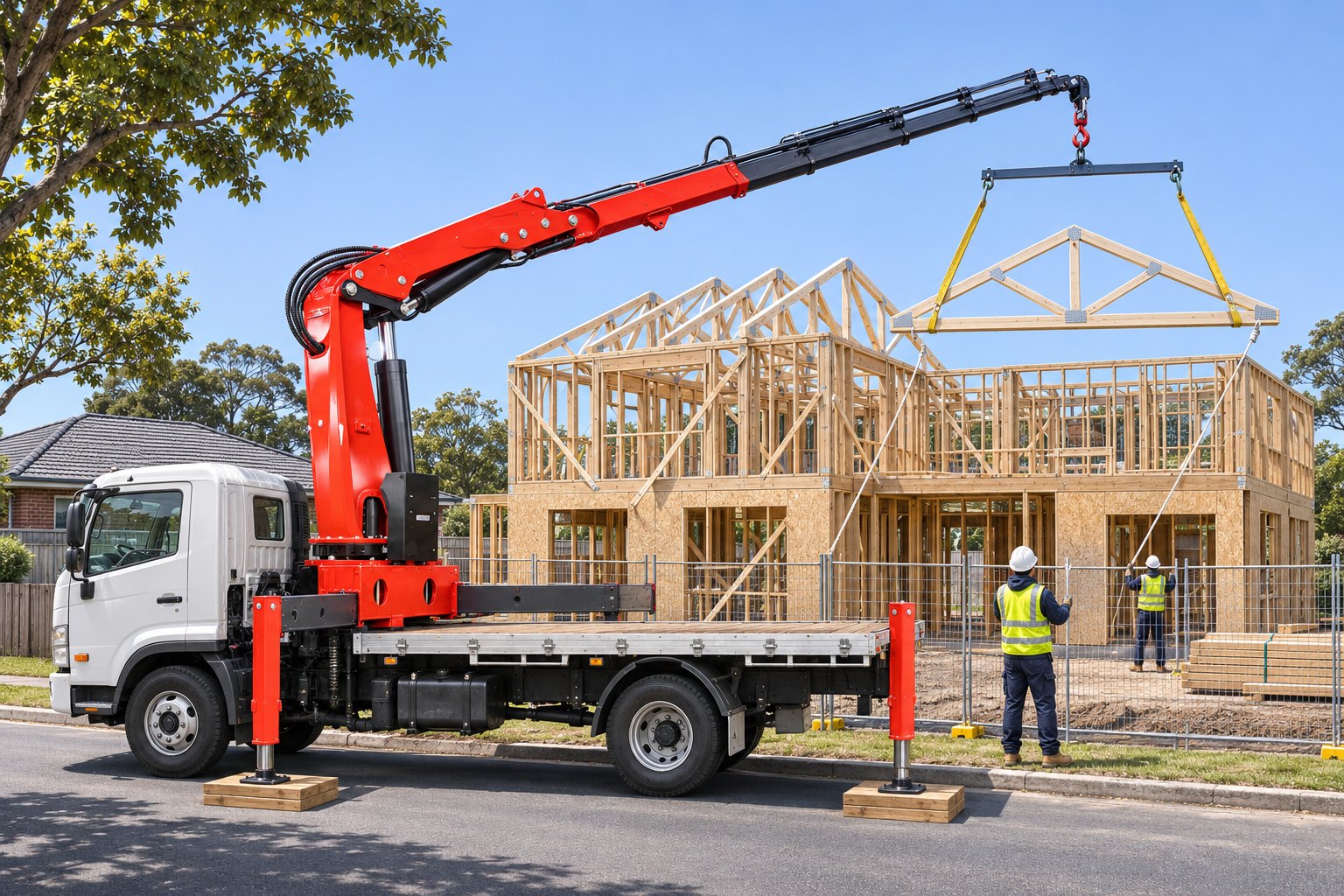

A below-the-hook lifting device is equipment that hangs between a crane’s hook and the load to hold, grip or balance it. Common examples are lifting beams, spreader beams, plate clamps, vacuum lifters, lifting magnets, grabs, C-hooks, crane pallet forks, tongs and drum lifters. Slings and shackles are not included, because they are rigging with rules of their own. In the United States, the reference standard is ASME B30.20, which covers marking, inspection, testing, maintenance and operation, while ASME BTH-1 sets the design criteria. Whatever device you choose, its weight is part of the load the crane has to carry.
We have built truck mounted cranes in Xuzhou since 2003, and buyers often ask what they can safely hang under the hook. This November 2026 rewrite of our 2022 note adds the device types, the standards and the rules, and uses a real load chart to show how a device changes what the crane can lift.
Key takeaways
- A below-the-hook (or under-the-hook) device sits between the hook and the load. Slings, shackles and hooks are rigging, with other rules.
- ASME B30.20 covers the marking, inspection, testing, maintenance and operation of these devices, and ASME BTH-1 covers their design. OSHA treats B30.20 as the reference for inspections.
- On US construction sites, custom-design grabs, hooks and clamps must be marked with their safe working load and proof-tested to 125 percent of their rated load before first use.
- The device’s own weight comes off the crane’s rated load at every radius, so a heavy vacuum lifter or magnet can turn a safe lift into an overload.
- In Great Britain, LOLER requires a thorough examination of a lifting accessory at least every 6 months, or under an examination scheme.
What is a below-the-hook lifting device?
It is any device that connects a load to the crane’s hook and is not a sling. ASME’s product sheet for B30.20 describes the scope as “equipment used for attaching loads to a hoist” [1]. It names five groups: structural and mechanical lifting devices, vacuum lifting devices, lifting magnets operated close to the load, remotely operated lifting magnets, and scrap and material handling grapples. “Under-the-hook lifting device” means the same thing.
Slings are a separate category. In a 1998 letter, OSHA said that below-the-hook lifting devices are not similar to the slings covered by 29 CFR 1910.184 [2]. That rule covers slings of chain, wire rope, metal mesh, fiber rope and synthetic web. Hooks, shackles and slings are explained in our crane rigging guide and crane hook guide.
Types of below-the-hook lifting devices
Each type of below-the-hook device is built for a particular load shape and surface. The table lists the common families, what each one usually lifts and what to check first.
| Device | Typical loads | How it holds the load | Check before use |
|---|---|---|---|
| Spreader beam or lifting beam | Long or flexible loads, panels, machinery | A beam with several pick points, hung from slings or one hook | Rated load and pick-point spacing for your load |
| Plate clamp | Single steel plates and sections | A jaw that grips the plate edge | Plate thickness range and lifting direction |
| Vacuum lifter | Steel plate, glass, stone, concrete panels and pipes | Suction pads held by a vacuum pump | Clean pads, vacuum gauge, warning device, power reserve |
| Lifting magnet | Steel plate, bar, tube and scrap | A permanent, electro or battery magnet | Rating for that thickness, air gap and temperature |
| Grab or grapple | Logs, scrap, rock, bulk material | Hydraulic shells or tines that close around the load | Grab weight, rotator and hoses |
| C-hook or coil lifter | Steel and wire coils | A C-shaped arm through the coil eye | Balance with and without the coil |
| Crane pallet forks | Palletised goods, bricks, board | Tines under the pallet, often self-levelling | Fork capacity and load centre |
| Tongs or scissor clamp | Blocks, kerbs, bales | Scissor arms that grip harder as the load rises | Minimum and maximum grip width |
| Drum lifter | Drums and barrels | Jaws that engage the drum rim | Drum type and condition of the rim |

Spreader beams and lifting beams look alike but carry the load differently. As general practice, a spreader beam sits between two angled slings and works mainly in compression, while a lifting beam hangs from one point and carries the load in bending. Either way, the beam keeps sling legs close to vertical, as our rigging guide explains for long, flexible loads.
The specialised devices are even narrower. HSE warns that vacuum lifting devices “should not be treated as ‘general purpose’ lifting equipment as they are designed for particular types of loads and environments” [3]. For magnets, HSE notes that rated loads are normally quoted for a specific thickness of material [4]. It also says that paint, rust, scale, oil, ice or snow on either surface increases the air gap, and a magnet’s grip falls rapidly as that gap grows. Choose the device for the load, never the other way round.
What do ASME B30.20 and ASME BTH-1 cover?
ASME B30.20, Below-the-Hook Lifting Devices, is the safety standard for owners and users. ASME’s sheet for the 2013 edition says it applies “to the marking, construction, installation, inspection, testing, maintenance, and operation” of the equipment [1]. That edition added requirements for personnel competence, the marking and inspection of operating controls, and the duties of owners and operators.
ASME BTH-1, Design of Below-the-Hook Lifting Devices, is the design companion. ASME’s page for the 2023 edition says it “provides minimum structural, mechanical, and electrical design criteria” for B30.20 devices [5]. It adds that “BTH-1 addresses only design requirements” and “does not replace B30.20”. The criteria are minimums that “may be increased at the discretion of the lifting device manufacturer or a qualified person”.
Put simply, BTH-1 is for the engineer who designs the device, and B30.20 is for the people who mark, inspect, use and maintain it. ASME says both are used with the other volumes of the B30 series, so the crane, hook and slings keep their own standards.
What do OSHA and UK rules say about below-the-hook devices?
OSHA has no section written only for below-the-hook devices, so it points to ASME. Asked in 1998 whether it recognises B30.20 as the reference point for inspections, OSHA answered “the answer is yes” [2]. A 2004 letter added that an employer who follows B30.20 sections 20-1.3.1 through 20-1.3.7 and 20-1.3.9 for inspections “would be considered to be in compliance with OSHA requirements” [6]. In 2002, OSHA wrote that it may use the General Duty Clause and consult B30.20, and stated plainly: “Non-engineered devices should not be used” [7].
On US construction sites, one rule is mandatory. 29 CFR 1926.251(a)(4) covers “Special custom design grabs, hooks, clamps, or other lifting accessories” for units such as modular panels and prefabricated structures. They “shall be marked to indicate the safe working loads and shall be proof-tested prior to use to 125 percent of their rated load.” The 2004 letter added that the test weight must be determined “through accurate and reliable means”. Under 29 CFR 1926.1417(a), the employer must also follow the crane manufacturer’s procedures, “including its use with attachments”.
In Great Britain, the Lifting Operations and Lifting Equipment Regulations 1998 (LOLER) call these devices accessories for lifting. Regulation 2 defines one as “work equipment for attaching loads to machinery for lifting”. Regulation 7 requires accessories to be marked with their safe working load and “in such a way that it is possible to identify the characteristics necessary for their safe use”. Where conditions cause deterioration, regulation 9 requires a thorough examination of “an accessory for lifting, at least every 6 months”, or in accordance with an examination scheme.
HSE’s vacuum guidance shows the difference [3]. An attachment permanently fixed to a crane is examined every 12 months, but one moved between machines counts as a lifting accessory and is examined every 6 months. HSE also lists BS EN 13155, “Cranes. Safety. Non-fixed load lifting attachments”, as a current standard.
How much capacity does the device take from the crane?
All of its weight, kilogram for kilogram. OSHA’s crane rule, 29 CFR 1926.1401, defines load as the object and “the load-attaching equipment, such as, the load block, ropes, slings, shackles, and any other ancillary attachment”. For truck cranes in general industry, 29 CFR 1910.180 says that “the weight of all auxiliary handling devices such as hoist blocks, hooks, and slings shall be considered a part of the load rating”. HSE says the weight of a magnet and its accessories “should be taken into account” when assessing the crane’s capacity [4].
Two ratings then apply: the device’s own rated load and the crane’s rated load at the working radius. The lower figure governs. For mobile cranes, HSE adds that the crane maker “may advise against using a magnetic attachment or require de-rating the normal SWL when using magnets”, because of the magnet’s weight and inertia during slewing. Our guides to the crane safe working load and how to read a crane load chart explain the crane side of the check.
Example scenario (an illustration, not a customer record): a steel stockholder wants to unload single plates from a trailer with a MIAOXUE SQ6.3ZA4 knuckle boom crane. Its drawing gives a maximum capacity of 6,300 kg and a lifting moment of 13.2 t·m. The load chart rates 1,500 kg at 8.3 m and 1,190 kg at 10.2 m. The plate weighs an ASSUMED 1,100 kg. The yard compares an ASSUMED 40 kg plate clamp on a 5 kg link with an ASSUMED 300 kg battery vacuum lifter.
| Set-up | Gross load | At 8.3 m (rated 1,500 kg) | At 10.2 m (rated 1,190 kg) |
|---|---|---|---|
| Plate + clamp + link | 1,145 kg | Passes, 355 kg to spare | Passes, only 45 kg to spare |
| Plate + vacuum lifter | 1,400 kg | Passes, 100 kg to spare | Fails, 210 kg over |
It’s the same plate and the same crane, but the heavier device turns the 10.2 m lift into an overload. The fix is to park closer, so the set-down point sits at 8.3 m or less, and a 45 kg margin is too thin for the clamp lift too. Check whether your chart already deducts the hook. Every MIAOXUE crane is listed with a load moment limiter, as our article on the lifting moment of a crane explains, but it can’t know the rated load of the clamp or lifter.
Which below-the-hook devices suit a truck mounted crane?
On a knuckle boom truck mounted crane, the device hangs from the hook or from a rotator at the boom tip. Hydraulic devices need extra control functions and hoses, and electric ones need a power supply on the truck. The common pairings are listed below.
- Grabs and grapples. A grab needs a rotator and two extra hydraulic functions, and its weight comes off the load chart, as our guide to knuckle boom crane attachments explains. Log grapples are covered in our timber crane guide.
- Crane pallet forks. Building supply yards use them for board, bricks and blocks, and our article on the drywall delivery crane shows how fork weight changes the sum.
- Lifting frames and spreader beams. These suit containers and boats, covered in how to lift a shipping container with a crane and how to lift a boat with a crane.
- Lifting magnets. HSE says that on mobile lifting equipment, “the generator or alternator” must have enough capacity for the magnet. Ask the crane maker before you fit one.
- Vacuum lifters. For lifts “above 10 metres”, HSE says safety arms should be used, or another way of stopping the load falling if the vacuum is lost.

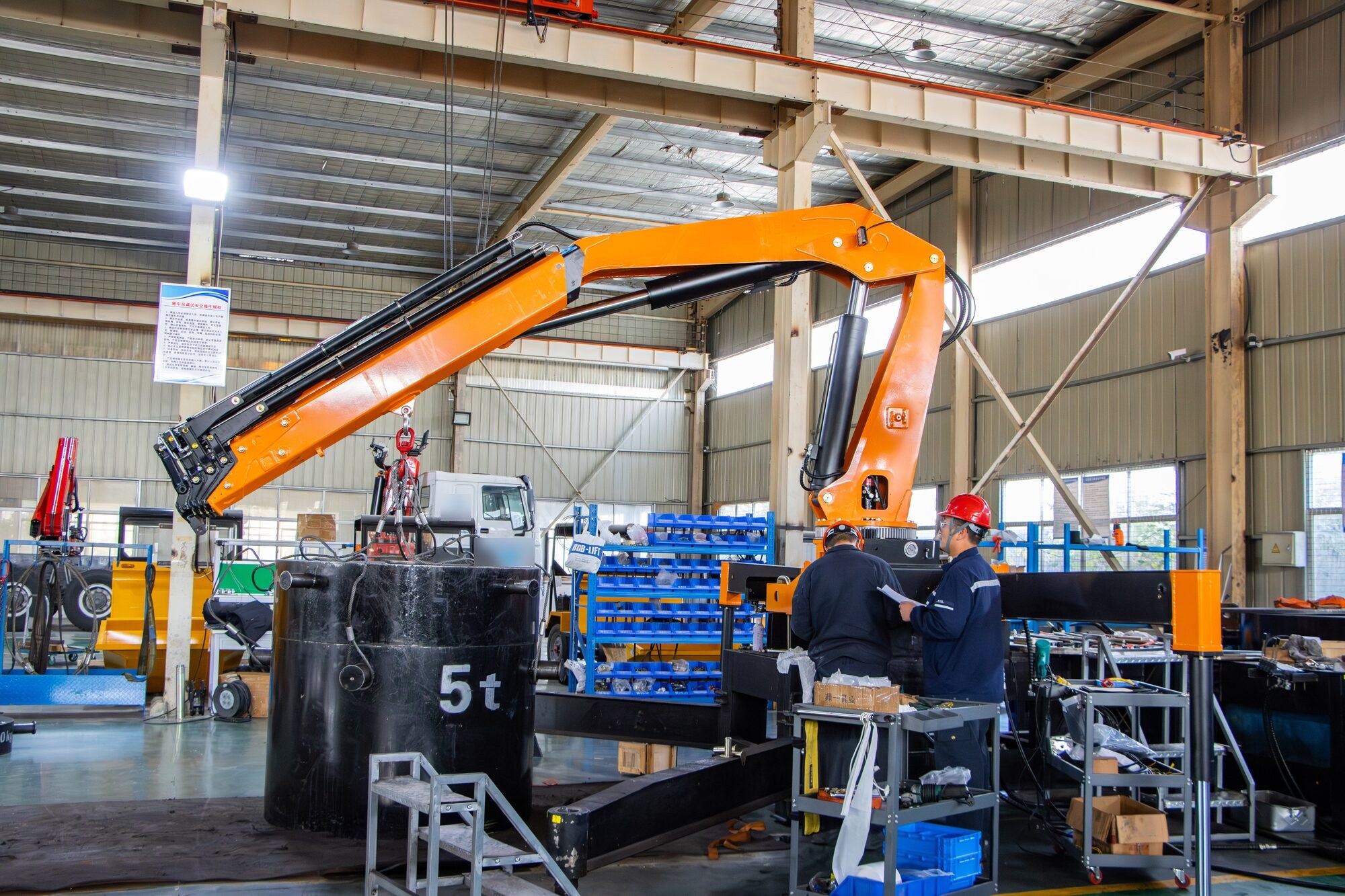
MIAOXUE makes the cranes. Our factory photos show SQ8ZA4 and SQ5ZA4 cranes tested with grabs, and we confirm grab and rotator options for each model in the quotation. Clamps, vacuum lifters, magnets, forks and spreader beams are supplied separately. Tell us the device and its weight, and we’ll check the crane’s hydraulics and load chart.
How to inspect and use a below-the-hook device safely
Start with the device maker’s manual, since it sets the checks for that exact design. Between the formal inspections under B30.20 or LOLER, a short check before each lift catches most problems.
- Read the marking. The rated load must be legible, and the device must suit this load’s thickness, width or shape. If a device has no marking at all, don’t use it.
- Look for damage. Check for cracks, bent arms, worn teeth or pads and loose bolts.
- Check power and controls. Inspect hoses, cables, plugs, batteries and the vacuum gauge, and check that a magnet’s battery back-up alarm works, as HSE lists.
- Clean the contact faces. HSE says to wipe all surfaces before a vacuum lift, because loose material “can cause leaks and have caused loads to drop”.
- Make a trial lift. Raise the load a few centimetres and hold it, then confirm it is level and secure before you travel.
- Keep people clear. Under 29 CFR 1926.1425(b), while a suspended load is not moving, the only employees allowed in the fall zone are those hooking, unhooking or guiding it, or making its initial attachment. HSE advises carrying magnet and vacuum loads low, where practicable no higher than 1.5 m.
- Remove defects from service. Tag a damaged device until a competent person has repaired and released it.
Training matters as much as hardware: HSE says magnetic lifting devices “should be operated only by trained persons”. Record the device in your crane lift plan and your truck mounted crane inspection checklist. A proof test of a custom device is not the same as a crane load test, which our crane load test guide explains.
What are the advantages of below-the-hook lifting devices?
The 2022 version of this page listed the advantages, and they still hold, with conditions.
- Faster attachment. A clamp, magnet, vacuum lifter or grab picks up the load without slinging it, and a grab lets one operator load a truck alone.
- Fewer hands near the load. When nobody has to fit slings under a plate or a log, fewer people stand in the fall zone.
- Better load shape. A spreader beam keeps sling legs near vertical, so long or flexible loads are not squeezed or bent.
- Repeatable handling. A device made for one product picks it up the same way every time.
The limits are just as real. Every device costs capacity and suits only the loads it was designed for. HSE names vacuum failure and loss of power among the causes of dropped loads, and custom devices need a proof test on US construction sites.
How to choose a below-the-hook lifting device
Choose the device from the load first, then confirm the crane can carry both. These seven steps cover most purchases.
- Define the load: material, shape, surface, temperature and the heaviest piece.
- Pick the device family from the table, and ask the maker whether your load suits its design.
- Match the rating. The device’s rated load must cover the heaviest piece, within any stated thickness or width range.
- Check the crane. Add the device weight to the load and rigging, then compare the total with the load chart at your longest radius.
- Check the connection and power. Confirm the hook or rotator fit, the hydraulic functions, and any electrical supply.
- Ask for documents. Request the design basis (for example ASME BTH-1 or EN 13155), the marking, the manual and, for a custom device, the proof test record.
- Plan inspection and training before the first lift.
Frequently asked questions
What is the difference between ASME B30.20 and ASME BTH-1?
ASME B30.20 is the safety standard for marking, construction, installation, inspection, testing, maintenance and operation of below-the-hook lifting devices. ASME BTH-1 sets the minimum structural, mechanical and electrical design criteria for those devices. ASME says BTH-1 does not replace B30.20; the two are used together.
Is a spreader bar a below-the-hook lifting device?
Yes, in general. Spreader bars and lifting beams are usually treated as structural lifting devices, one of the groups ASME B30.20 covers. The slings and shackles that connect them to the hook and the load are rigging, which follows its own rules for slings and hardware.
How often must below-the-hook lifting devices be inspected?
Check the device before each use, then follow the maker’s schedule. In the US, OSHA’s 2004 letter accepts inspections that follow ASME B30.20 sections 20-1.3.1 to 20-1.3.7 and 20-1.3.9. In Great Britain, LOLER requires a thorough examination of an accessory for lifting at least every 6 months, or under an examination scheme.
Do below-the-hook lifting devices need a proof test?
On US construction sites, special custom design grabs, hooks, clamps and other lifting accessories must be marked with their safe working load and proof-tested to 125 percent of their rated load before use, under 29 CFR 1926.251(a)(4). For standard devices, follow the maker’s documents and ASME B30.20.
Does the weight of a lifting device count against crane capacity?
Yes. OSHA defines the load as the object plus all load-attaching equipment, so the device weight comes off the crane’s rated load at every radius. Add the device, the rigging and the load together, and check the total against the load chart at your working radius.
How we compiled this guide
We took the scope of ASME B30.20 from ASME’s product sheet for the 2013 edition, and the scope of ASME BTH-1 from ASME’s page for the 2023 edition. We did not quote the paid standards themselves. The US position comes from OSHA’s interpretation letters of 1998, 2002 and 2004 and from 29 CFR 1926.251, 1926.1401, 1926.1417, 1926.1425 and 1910.180 on osha.gov. The UK position comes from LOLER regulations 2, 7 and 9 as made in 1998 on legislation.gov.uk, and from HSE’s guidance on lifting magnets and vacuum lifting equipment. All pages were read in November 2026. The crane figures come from the current MIAOXUE technical drawing and load chart of the SQ6.3ZA4, and the scenario uses clearly marked assumed weights. The device table, the chart and the advice on spreader and lifting beams reflect general practice. Achord Chan, Product Operations Director, reviewed the guide before publication. It does not replace the device maker’s manual, the crane’s operator’s manual or the regulations where you work.
Planning to use a lifting device with your crane?
Tell us the loads, the device you plan to use and its weight, the working radius and the country where the crane will operate. We will recommend a knuckle boom or telescopic boom truck mounted crane and send its dimension drawing and load chart, so you can check the device weight at your radius. Every crane carries a 12-month warranty on the whole machine, common spare parts leave the factory within 48 hours, and our service team answers within 12 hours. Contact us for a quotation.