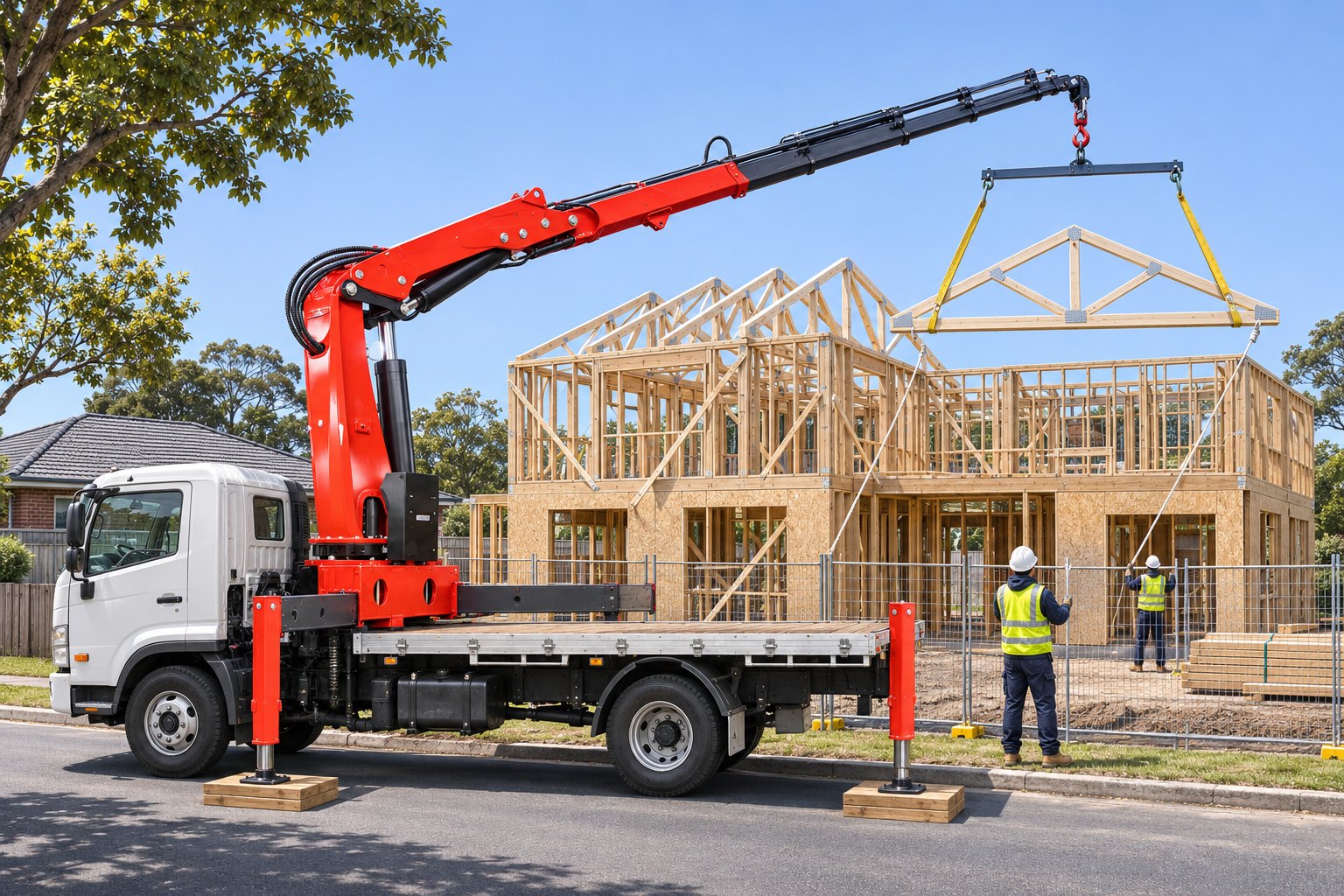
A crane load test is a check in which a crane lifts a known, measured load, usually at or above its rated load, to prove that its structure, hydraulics, brakes and safety devices work as designed. When a test is required, how heavy the test load is and who signs the report depend on the standard or regulation that applies where the crane works.
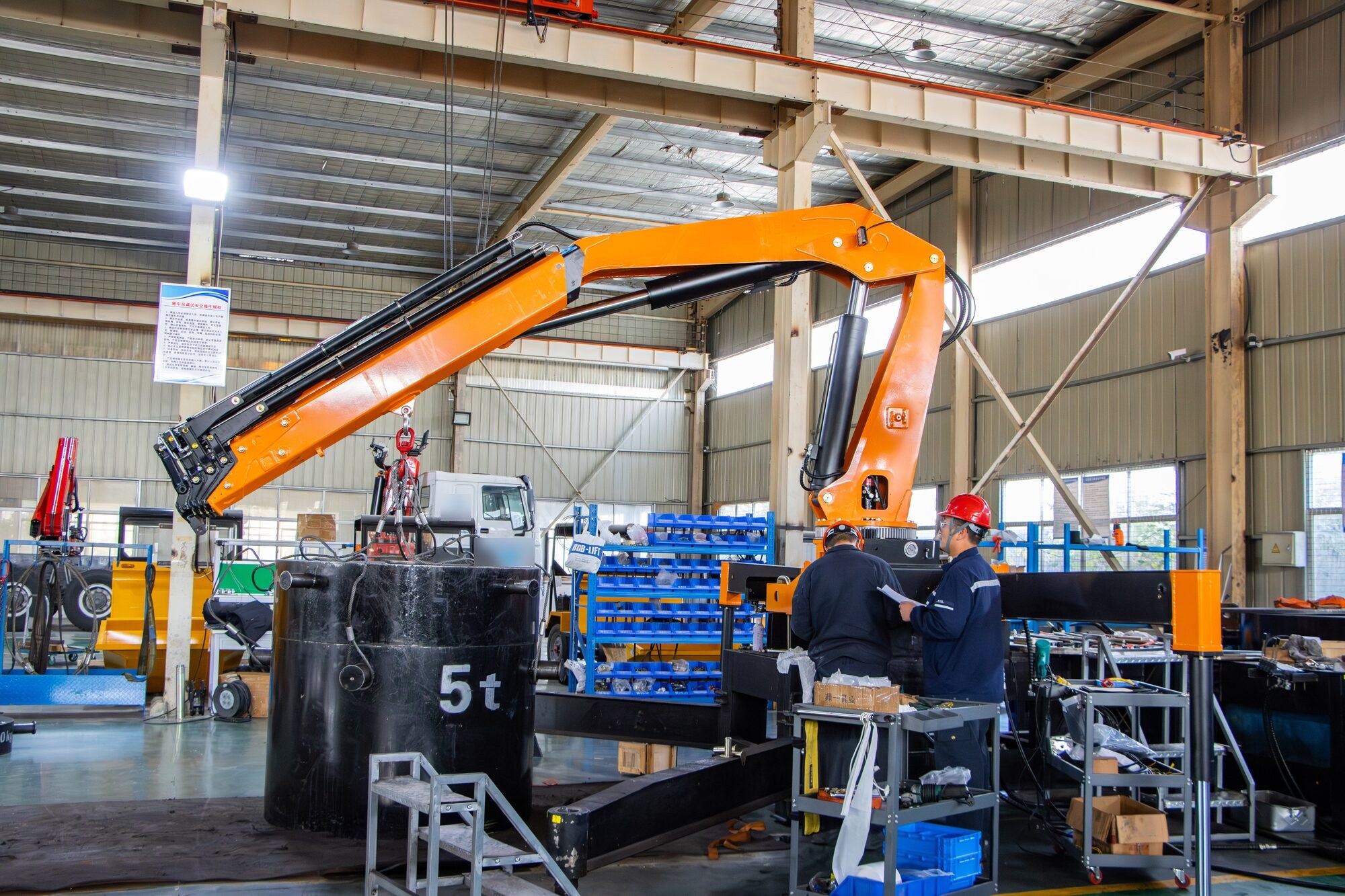
MIAOXUE has built truck mounted cranes in Xuzhou, Jiangsu, since 2003, and every crane we ship is run through lifting, slewing and outrigger functions under load on our own test bay first. This guide explains the types of crane testing, what the main standards and regulations ask for, when a test load crane check is needed, and what to ask your supplier before shipment.
Key takeaways
- Crane testing includes functional, rated load, overload (proof), static, dynamic and stability tests.
- EN 12999 lists functional, static, dynamic and stability tests for loader cranes; ASME B30.22 contains its own testing section.
- LOLER 1998 requires thorough examinations, but HSE says most lifting equipment does not need routine load testing.
- OSHA 1910.180 limits test loads to 110 percent of the rated load at any selected working radius.
- Keep the test, examination and load chart documents together, and ask for a test video of your own crane before shipment.
What is a crane load test?
“Crane load test” is a broad name that, in practice, covers a few different checks, and each one answers a different question about the crane.
- Functional test: The crane runs through every movement, usually without load, and the limit switches, overload protection and emergency stop are verified. OSHA calls this an operational test.
- Rated load test: The crane lifts its rated load, or a specified amount above it, at selected points on the load chart.
- Overload or proof test: A load above the rated load, held briefly to demonstrate a structural margin. The factor is set by the standard, because excessive overload can damage a crane.
- Static test: The test load is lifted just clear of the ground and held still, to verify the structure and hydraulics hold it without permanent deformation.
- Dynamic test: The crane moves with the test load on the hook, so the cylinders, valves, slewing gear and brakes are checked while they work.
- Stability test: A check that the crane, with outriggers positioned as the manual specifies, remains stable.
A load test is not an inspection: an inspection looks for wear, cracks and leaks, while a test applies a known load and records the response. Our truck mounted crane inspection checklist covers the daily and periodic checks.
Because the permissible load changes with radius, boom extension and outrigger configuration, one lift close to the column demonstrates little about the structure at full reach. Agree with the examiner which configurations will be tested, and record the load chart capacity beside each result.
What do EN 12999, ASME B30.22, LOLER and OSHA require?
Truck mounted knuckle boom and telescopic cranes are regulated differently in different markets. EN 12999 and ASME B30.22 are sold by the standards bodies, so this section covers only what their official summary pages show, plus the public texts of LOLER and OSHA.
EN 12999: loader cranes (Europe)
EN 12999 is the European standard for hydraulic loader cranes. The current edition, EN 12999:2020+A1:2025, “specifies minimum requirements for design, calculation, examinations and tests” [1]. Its testing clause has separate parts for the functional, static, dynamic and stability tests and for test documentation, and the A1 amendment turned one additional stability test into a recommendation. The instructions clause is where the manufacturer explains in-service examination and testing.
ASME B30.22: articulating boom cranes (United States)
ASME B30.22 is the American safety standard for articulating boom cranes. It covers cranes “articulated by hydraulic cylinders” and “mounted on a vehicle or stationary installation” [2]. The 2023 edition has a chapter on inspection, testing and maintenance, with its own section on testing [3]. Check the edition named in your contract or local regulations for the exact test load and procedure.
LOLER 1998 and HSE guidance (Great Britain)
LOLER is a law about thorough examination, not a test standard. Regulation 9 says lifting equipment must be thoroughly examined before it is put into service for the first time, and after installation where its safety depends on the installation conditions. Where it is exposed to conditions that cause deterioration, it must be examined “at least every 12 months” for most lifting equipment, at least every 6 months for equipment that lifts people, or under an examination scheme, and again after exceptional circumstances [4].
For the full set of duties, see our guide to LOLER for lorry loaders, including when an examination falls due and what the report must contain.
HSE adds that an examination before first use is not needed if the equipment has a Declaration of Conformity less than one year old and was not assembled on site. On testing, HSE states: “Most lifting equipment does not need routine testing as part of the thorough examination”, and “some overload tests can cause damage to lifting equipment” [5], so the competent person decides whether a load test is needed.
OSHA regulations (United States)
In construction, OSHA’s crane regulations list “articulating cranes (such as knuckle-boom cranes)” in their scope, with a limited exclusion for knuckle boom truck cranes that only deliver material to a site [6]. The inspection regulation, 29 CFR 1926.1412, is built on inspections rather than load tests. After a repair or adjustment that relates to safe operation, a qualified person must inspect the crane before use, and that inspection “must include functional testing of the repaired/adjusted parts”. The annual inspection also includes functional testing [7].
In general industry, 29 CFR 1910.180 covers crawler, locomotive and truck cranes. The manufacturer runs operational tests on each new production crane, and “certified production-crane test results shall be made available”. For repaired or altered cranes, written reports must show the test procedures, and “test loads shall not exceed 110 percent of the rated load at any selected working radius” [8]. Some US states add their own regulations.
| Point | EN 12999 (Europe) | ASME B30.22 (US) | LOLER 1998 (GB) | OSHA (US) |
|---|---|---|---|---|
| What it is | Design and test standard for loader cranes | Safety standard for articulating boom cranes | Law on lifting operations and thorough examination | Federal workplace regulations: 1926 Subpart CC (construction), 1910.180 (general industry) |
| Test types named | Functional, static, dynamic and stability tests | Testing section in the inspection, testing and maintenance chapter | Testing only if the competent person decides it is needed | Functional testing after repairs and at the annual inspection; operational and rated load tests in 1910.180 |
| Test load stated on the public page | Not shown in the public preview | Not shown in the public summary | None set; HSE warns overload tests can cause damage | 1910.180: not more than 110 percent of rated load |
| When | Tests set out in the standard; in-service checks as the manufacturer’s instructions say | As the standard and the manufacturer set out | Before first use, after installation, every 6 or 12 months or by scheme, after exceptional events | Before use after repair or adjustment; at least every 12 months |
| Records | Test documentation clause | Per the standard | Written report with the Schedule 1 items | Monthly kept 3 months; annual kept 12 months |
When is a crane load test required?
Across these regulations, the same occasions appear repeatedly:
- At the factory, before shipment: The manufacturer tests each new crane, and 1910.180 expects the operational test results to be made available.
- After mounting on the truck: Safety now depends on the chassis fixings and outriggers, and LOLER requires an examination where safety depends on installation conditions. Our guide to crane outriggers and ground bearing pressure explains why the set-up matters.
- After major repair or modification: For example, a replacement boom section, welded repair or new slewing ring requires verification before the crane returns to service, including functional testing under OSHA.
- At periodic thorough examinations: In Great Britain, at least every 12 months for a crane that lifts goods, with a load test only if the competent person decides.
- After an exceptional event: An overload, a tip, a collision or a long time out of use are examples of what LOLER calls “exceptional circumstances”.
Who carries out crane testing?
It depends on the stage: the factory test is run by the crane manufacturer, but once the crane is in use, the owner is responsible for having it examined and, where needed, tested.
- Great Britain: A competent person who is “sufficiently independent and impartial”. HSE says this person may work for another company or be chosen from the employer’s own staff, but should not be the same person who services the equipment [9].
- United States: OSHA uses “qualified person” for inspections after repair and for the annual inspection, and “competent person” for the check before each shift.
- Insurers and clients: Many require an independent inspection body, so confirm which one they accept.
Test weights or water bags: what makes up the test load?
A test load has to be measured and documented rather than estimated, and there are two common ways to make one.
Certified test weights are steel or concrete blocks with a marked mass. They stack to build the required load, as in our test bay, and are accurate and repeatable, but a large test load means transporting considerable steel.

A water bag load test uses a strong bag that hangs from the hook and is filled with water. A load cell or dynamometer between the hook and the bag indicates the actual load as the bag fills. Because the load is applied gradually, the test crew can stop at any intermediate value. The empty bags are compact to transport, which suits on-site and marine crane testing. LEEA 051 is the industry code for how these bags are designed, inspected and used [10].
What records and certificates should you keep?
A test that is not documented is difficult to prove later, so keep these papers with the crane’s file:
- The factory test record: Model, serial number, date, the individual tests performed and the responsible inspector.
- The load chart and manual for the exact model and boom set-up. A test result is always read against the chart, and our guide on how to read a crane load chart shows how.
- The thorough examination report: In Great Britain, LOLER Schedule 1 lists what it must contain, including the safe working load, any defects, the latest date for the next examination and “particulars of any test” carried out [11].
- Inspection records: Under 1926.1412, monthly inspection records are kept for at least three months and annual ones for at least 12 months.
- Test load evidence: Weight certificates, or the calibration certificate of the load cell used during the test.
What to ask your supplier before shipment
Once the crane is in a container, any problem costs more time and money to correct, so ask these questions while it is still at the factory:
- Has my crane been load tested? Ask which functions were tested under load.
- Can I see a test video of my own crane? Ask for the serial number to be visible, so you can identify your particular crane.
- Can my inspector attend? Ask whether an inspection company of your choice may witness the test.
- Which standard does the crane meet, and which documents come with it? Obtain them before the balance payment, not after delivery.
- Will the load chart and manual match my exact crane? Verify the model, boom configuration and options such as a winch.
- Who will mount the crane, and who examines it after mounting? Arrange this with your local inspector in advance.
- What happens if the test reveals a problem? Agree in writing that the crane is repaired and tested again before it is dispatched.
At MIAOXUE, every crane is mounted on our test bay and run through lifting, slewing and outrigger functions under load before packing, as our Quality and Testing page shows. You may request a test video showing the serial number, or send an inspection company of your choice. Step 6 of our guide to buying a truck mounted crane from China covers the wider buying process, and our crane shipping guide picks up from there.
Example scenario (an illustration, not a customer record): a fleet operator in the United Kingdom orders a knuckle boom crane and requests a factory test video showing the serial number. A local body builder installs the crane on the operator’s truck, and an independent competent person carries out the thorough examination before first use. The video, test documentation and examination report are then kept in a single file with the crane.
Frequently asked questions
What is a water bag load test?
It is a crane load test that uses a bag filled with water as the test load. A calibrated load cell displays the load as the bag fills, so the load is applied gradually and the operation can be stopped at any intermediate value.
How heavy should a crane test load be?
It depends on the regulation and the type of test: OSHA 1910.180 says test loads shall not exceed 110 percent of the rated load at the selected radius. EN 12999 and ASME B30.22 set their own test loads in the full standards. Follow your contract standard and the manufacturer’s manual.
Does a crane need a load test every year?
Not always: a yearly inspection or thorough examination is common, but a load test is a separate, additional step. In Great Britain, HSE says most lifting equipment does not need routine testing, and the competent person decides. Some local regulations do require regular load tests.
What is the difference between a static and a dynamic load test?
In a static test the load is lifted just clear of the ground and held still, to check the structure and hydraulics hold it. In a dynamic test the crane moves with the load, to check the cylinders, valves, slewing and brakes while they work, and EN 12999 lists both as separate tests.
Is a factory load test enough once the crane is on my truck?
Usually not on its own, because the factory test proves the crane itself but not its installation. After mounting, safety also depends on the truck frame, the fixings and the outriggers, so plan an examination before first use, as LOLER requires in Great Britain; the examiner may ask for a test.
How we compiled this guide
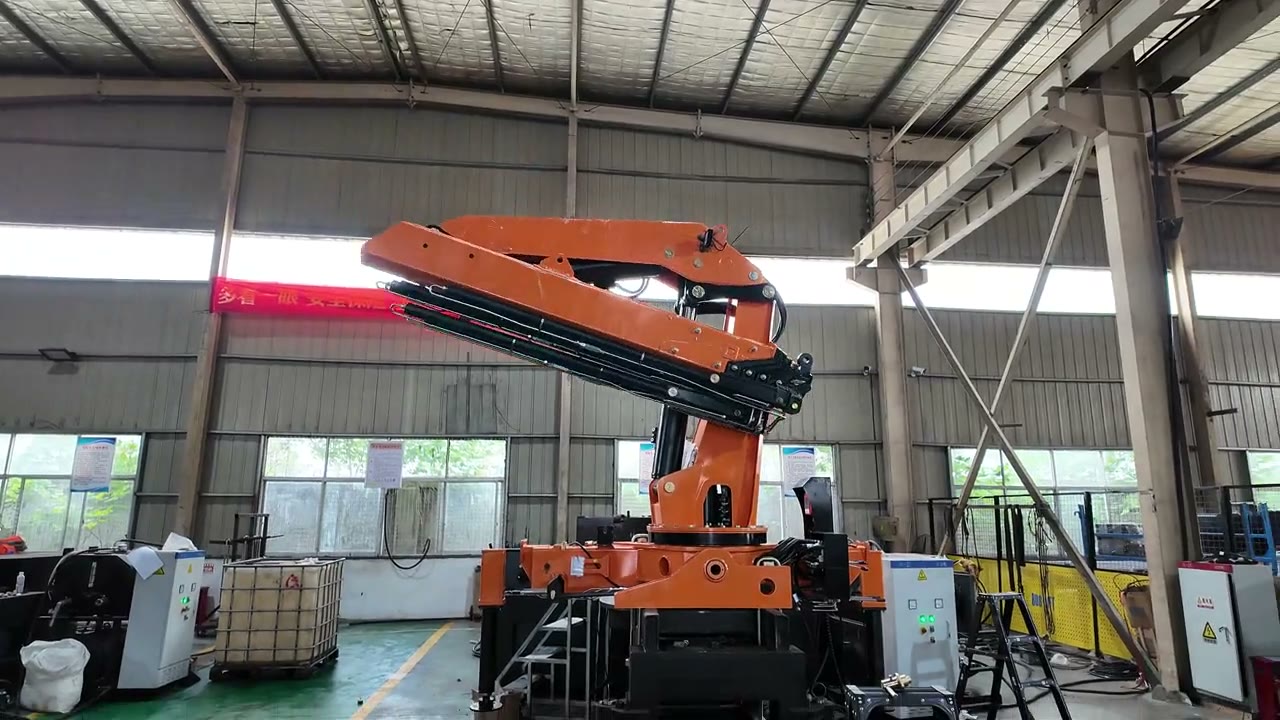
The regulations come from the official pages linked above: OSHA’s 29 CFR 1926.1400, 1926.1412 and 1910.180, the LOLER 1998 text on legislation.gov.uk, HSE guidance, and the public summary pages for EN 12999 and ASME B30.22, as they stood in November 2026. Where a public page shows no test load figure, we have not given one. The videos and photo are real footage from our Xuzhou factory. Reviewed by Achord Chan, Product Operations Director, in November 2026, the guide does not replace the standards, the crane’s manual or the advice of your inspector.
See your crane tested before it ships
Tell us the heaviest load you need to lift, the working radius, your truck model and the country where the crane will operate. We will recommend a suitable model with its technical drawing and load chart. Every crane has a 12-month warranty on the whole machine, common spare parts are dispatched within 48 hours and our service team replies within 12 hours, while lead time and shipping are confirmed with your quotation. Browse our knuckle boom truck cranes, read about truck mounting and export, or contact us to start.