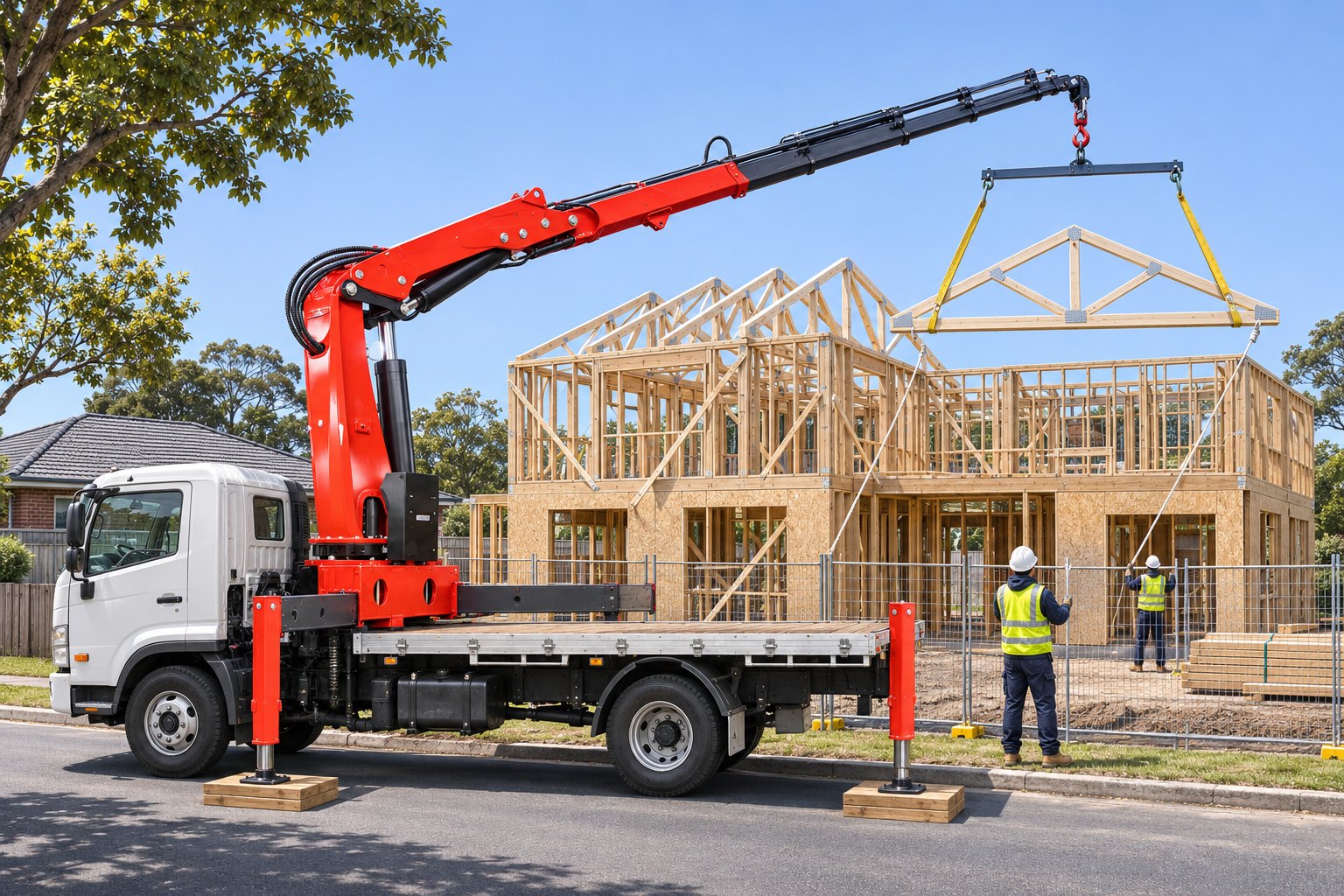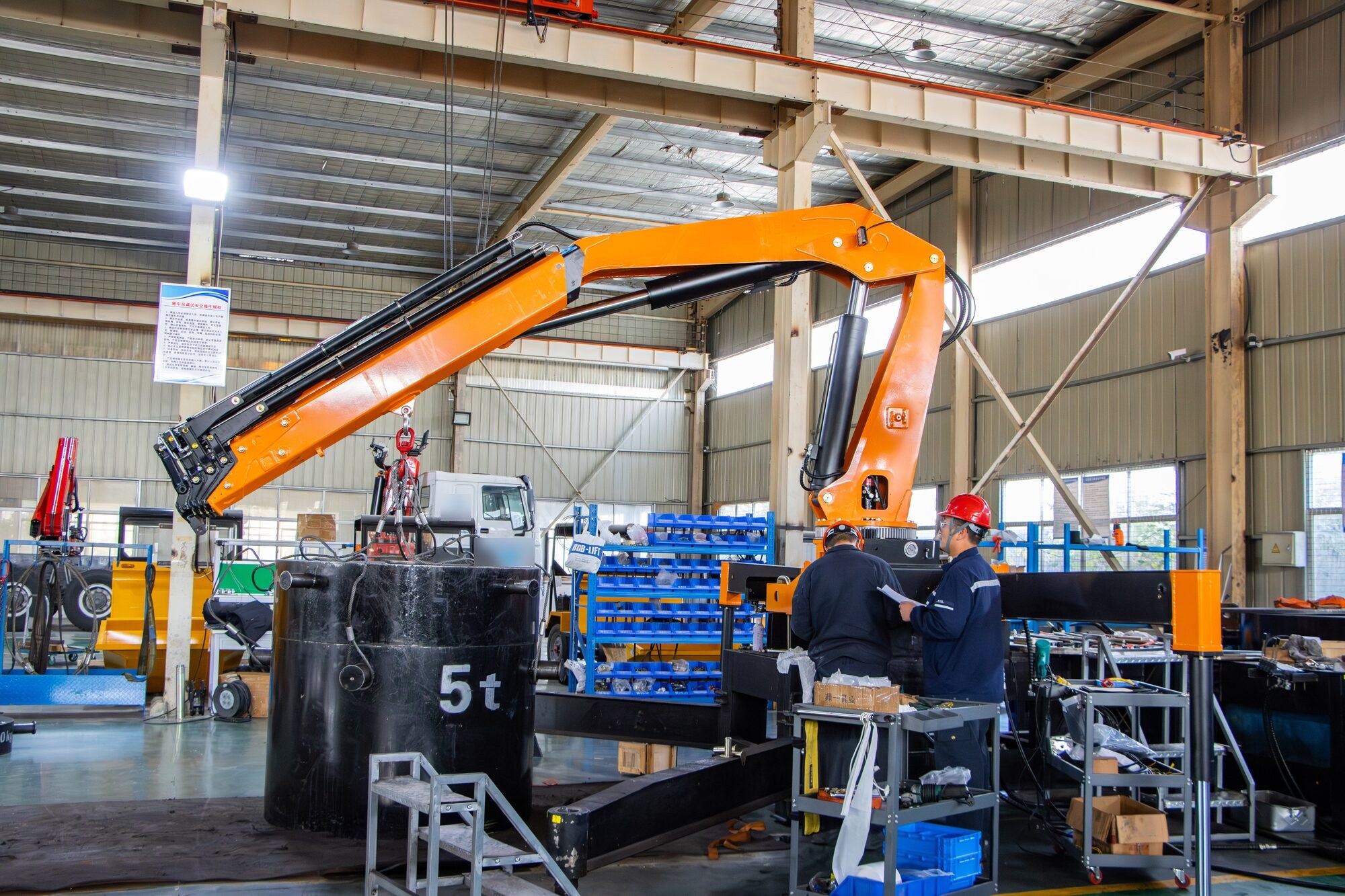

An anti-two-block device is a limit switch at the boom head that stops the hook block from being pulled into the boom tip sheaves on a crane that lifts on a hoist rope. It is often shortened to A2B, and the contact it prevents is called two-blocking. In the usual design, a small weight hangs on a chain around the hoist rope. When the rising hook block lifts that weight, the switch trips, the operator gets a warning and the crane stops the motions that would close the gap: hoisting up, telescoping out and booming down. In the United States, 29 CFR 1926.1416 requires the device on telescopic boom cranes manufactured after February 28, 1992, and on articulating cranes with a load hoist manufactured after December 31, 1999.
We have built truck mounted cranes in Xuzhou since 2003, and buyers of rope-hoist cranes frequently ask us what an A2B switch does and whether the regulations apply to their particular crane. This guide explains what two-blocking is, the three motions that cause it and how the system works. It then compares the A2B switch with other crane limit switches, quotes the regulations word for word, and sets out a daily test and the questions to ask before you buy.
Key takeaways
- Two-blocking is contact between the hook block (or overhaul ball) and the boom head. Continued power can break the hoist rope and release the block and the load.
- Three motions close the gap: hoisting up, telescoping the boom out without paying out rope, and lowering the boom. On a telescopic crane it can happen without anyone operating the hoist lever.
- A typical anti-two-block system hangs a weight on a chain around the hoist rope. When the block lifts the weight, a switch alerts the operator and automatically locks out the motions that close the gap.
- US regulations require the device on telescopic cranes manufactured after February 28, 1992, and on articulating cranes with a load hoist manufactured after December 31, 1999. A failed device must be repaired within 7 calendar days, with marked rope and a spotter meanwhile.
- Test it at the beginning of every shift, slowly and without a load, and never bypass it. When you buy, ask for every limit device on the quoted model to be listed in the quotation and the manual.
What is two-blocking on a crane?
Two-blocking is the moment when the lower block meets the upper block. The US crane rule, 29 CFR 1926.1401, describes the component as one “that is uppermost on the hoist line such as the load block, hook block, overhaul ball, or similar component”. Two-blocking occurs when it “comes in contact with the boom tip, fixed upper block or similar component”. The definition continues: “This binds the system and continued application of power can cause failure of the hoist rope or other component.”
The real danger is whatever falls afterwards. OSHA published its proposal for the current crane rule in the Federal Register in 2008. It warned that two-blocking “can result in the crane dropping the load, the headache ball, or another component, creating an extreme hazard to employees below”. The same document cites a study of US construction crane deaths from 1984 to 1994 that counted 502 fatalities, 11 of them (2%) from two-blocking [1].
One case described in that document shows how quickly it happens: in 2004 a rigger and operator-in-training was extending the boom of a “60-ton hydraulic boom truck crane” before a lift. The auxiliary line ball struck the auxiliary sheave head, knocking the sheave and ball from the boom, and the falling ball killed the trainee. OSHA noted that he “apparently did not understand that extending a hydraulic boom would move the sheave head toward the ball”. Our guide to crane accidents and how to prevent them compares two-blocking with the other common causes.
Which crane motions cause two-blocking?
Any motion that shortens the rope between the boom head and the hook block can cause it, and on a rope-hoist crane there are three. Hoisting up is the obvious one, while telescoping out is the one that surprises operators, because the boom head travels away from the winch while the rope length remains identical. OSHA’s 2008 text explains that “telescoping the boom out … moves the boom’s block closer to the load end of the hoist cable”, so on these cranes “two-blocking can occur even when the cable hoist is not being operated”.
Lowering the boom is the third motion, and a 2022 safety alert from WorkSafe Queensland lists “hoist up, tele out and boom down” as the functions a mobile crane’s hoist limit typically disables. The same alert says that where the head sheave distance changes with boom angle, the limit should be set at the angle where the hook block is closest to the sheaves.
| Motion | Effect on the gap below the boom head | Typical anti-two-block response |
|---|---|---|
| Hoist up | Winds rope onto the drum and raises the hook block | Stopped when the block lifts the weight |
| Telescope out | Moves the boom head away while the rope length stays the same | Stopped, unless the winch pays out rope at the same time |
| Boom down | Can shorten the gap, depending on how the rope is reeved | Stopped on most mobile crane systems |
| Hoist down | Pays out rope and opens the gap | Used to recover from a tripped switch |
That is why experienced operators of telescopic cranes pay out rope continuously as they extend the boom. For how a telescopic boom is built and why it always lifts on the rope, see our guide to the telescopic boom crane.
How does an anti-two-block device work?
Most systems on mobile and truck mounted cranes use a weight, a chain and a switch. WorkSafe Queensland describes the arrangement this way: “On most mobile cranes, the hoist limit generally includes a small weight hanging from chain(s) hooked up to a limit switch”. The alert continues: “As soon as the upward motion of the hook block hits this weight, a switch is activated”. The weight surrounds the working line immediately above the hook block, so the block lifts it well before any metal contact occurs.

The switch then has to talk to the crane’s controls, and as general practice the signal travels by a cable along the boom, often on a spring-loaded reel that follows the telescoping sections. The alternative is radio from a battery-powered transmitter at the boom head, which is what buyers usually mean by a wireless anti-two-block system. Both versions do the same job: they warn the operator and cut the motions that close the gap, while lowering the hook stays available to open it again.
OSHA’s 2008 text separates two categories of device: “The automatic prevention device automatically stops two blocking from occurring. The warning device warns the operator when two blocking is about to occur.” For very small cranes, the regulation provides a third route. Under 29 CFR 1926.1441(d)(2), equipment rated at 2,000 pounds or less may instead be designed so that “no damage or load failure will occur”. The regulation gives an example, namely “using a power unit that stalls in response to a two-block situation”.

Anti-two-block vs hoist limit switch vs slewing limit switch
“Crane limit switch” covers several different devices, and buyers frequently confuse them, but the anti-two-block switch is essentially the hoist upper limit of a mobile crane. Overhead and gantry cranes have their own hoist upper limit switch under 29 CFR 1910.179, and WorkSafe Queensland notes that many tower cranes use a geared limit on the rope drum. A slewing limit is a different idea again, because as general practice it stops rotation at a set angle, for example to keep the boom away from the cab or from an energised power line.
| Device | What it watches | What it stops | Where the rule appears |
|---|---|---|---|
| Anti-two-block device (A2B switch) | Hook block rising into the boom head | Hoist up, telescope out, boom down | 29 CFR 1926.1416(d)(3) |
| Hoist upper limit switch (overhead and gantry cranes) | Upper travel of the load block | Hoisting up | 29 CFR 1910.179(n)(4) |
| Boom hoist limiting device | Boom raised past its minimum allowable radius | Boom up | 29 CFR 1926.1416(d)(1) |
| Slewing limit switch | Rotation angle | Slewing past a set zone | Crane manufacturer’s specification |
| Load moment limiter | Load × radius against the load chart | Motions that increase the moment | 29 CFR 1926.1416(e)(4) |
An A2B switch does not protect against overload, and a load moment limiter is a device that compares the load and radius with the load chart, and it does not stop two-blocking either. Every MIAOXUE crane is listed with a load moment limiter, as our article on the lifting moment of a crane explains, but it cannot see the gap under the boom head.
Our guide to the load moment indicator compares it with an anti-two-block device and explains what each system can and cannot see.
What does OSHA 29 CFR 1926.1416 require?
The anti-two-block rules sit in 29 CFR 1926.1416(d)(3), under “Category I operational aids”. The requirement depends on the category of crane and its date of manufacture.
- Telescopic boom cranes “manufactured after February 28, 1992, must be equipped with a device which automatically prevents damage” from contact between the load block, overhaul ball or similar component and the boom tip. It “must prevent such damage at all points where two-blocking could occur.”
- Lattice boom cranes made after February 28, 1992 need a device that either prevents damage or “warns the operator in time”. Those manufactured after November 8, 2011 need automatic prevention. Some work is exempt, such as dragline, clamshell, magnet, pile driving and “marine operations that do not involve hoisting personnel”.
- Articulating cranes “manufactured after December 31, 1999, that are equipped with a load hoist” must have a device that automatically prevents damage from the same contact.
Under 1926.1416(b), “Operations must not begin unless the listed operational aids are in proper working order”. The exception is a device under repair while the employer uses the temporary alternative measures. If the device stops working during a lift, paragraph (c) says the operator “must safely stop operations” until those measures are in place or the device works again. Category I aids must be repaired “no later than 7 calendar days after the deficiency occurs”. If parts are ordered within 7 days, the repair must be done within 7 days of receiving them.
For a telescopic crane, the temporary alternative measure is to “Clearly mark the cable” at a point that gives the operator time to stop the hoist, “and use a spotter when extending the boom”. For an articulating crane where two-blocking can happen only by hoisting, it is the mark “or use a spotter”. Where it can happen without the hoist moving, the rule again asks for the mark and a spotter when extending the boom. Any “More protective alternative measures specified by the crane/derrick manufacturer” must be followed.
Three more paragraphs matter in daily work: first, the shift inspection in 29 CFR 1926.1412(d)(1)(xiv) covers “Safety devices and operational aids for proper operation”. Second, under 29 CFR 1926.1417(k), these devices “must not be used as a substitute for the exercise of professional judgment by the operator”. Third, under 1417(j), the operator must report a needed repair in writing, and the employer must tell affected employees at the start of each shift about the repair and all alternative measures.
Knuckle boom owners should also note the scope of the rule. 29 CFR 1926.1400(c)(17) excludes articulating/knuckle-boom truck cranes that deliver material to a construction site “when used to transfer materials from the truck crane to the ground, without arranging the materials in a particular sequence for hoisting”. The exclusion does not apply when the crane holds material in place while it is attached, or handles prefabricated components or structural steel. Outside the United States, check the regulations of your own country. In Europe, Annex I of the Machinery Directive 2006/42/EC requires lifting machinery to be built so that “the amplitude of movement of its components is kept within the specified limits”.
Which truck mounted cranes can two-block?
Any crane that lifts on a hoist rope can two-block. A knuckle boom crane without a winch cannot two-block in this sense, because its hook hangs from a short link at the boom tip and has no rope to wind in. Add a winch and the picture changes, as our crane winch guide explains: the hook now hangs on rope that runs to a sheave at the boom tip.
- Telescopic truck mounted cranes always lift on the winch rope, and on our telescopic boom truck mounted cranes the winch is standard, so hoisting up, telescoping out and booming down all affect the gap.
- Knuckle boom cranes without a winch lift on the boom-tip hook, so the rope-hoist hazard does not arise.
- Knuckle boom cranes with a winch (a J in our model code, TJ on marine cranes) lift on rope over a boom-tip sheave. Extending the boom sections can close the gap too, the case 1926.1416(d)(3)(iii) covers when two-blocking “could occur without movement of the load hoist”.
The length of a telescopic boom demonstrates why extension matters, because on each of the cranes below the boom head moves several metres further out as the boom extends. Unless the winch pays out rope at the same time, that movement draws the hook block toward the head.
| Model | Max. lifting capacity | Boom length, retracted → extended | Extension |
|---|---|---|---|
| SQ5SA4 | 5,000 kg | 4.2 m → 12 m | 7.8 m |
| SQ8SA5 | 8,000 kg | 5.4 m → 18.8 m | 13.4 m |
| SQ10SA5 | 10,000 kg | 6.12 m → 19.7 m | 13.58 m |
| SQ16SA5 | 16,000 kg | 6.3 m → 22.6 m | 16.3 m |

Two-blocking also loads the rope, sheaves and hook far beyond their normal duty, so if it ever happens, stop and have the crane inspected before further use. Our guides to crane wire rope and sheaves and the crane hook explain what to check.
How do you test an anti-two-block device before each shift?
Test the device at the start of every shift, before you attach a load. WorkSafe Queensland advises: “During the daily inspection, the hoist limit switch should be checked to confirm it is functioning correctly”. The rule for overhead cranes, 29 CFR 1910.179(n)(4)(i), gives a good model: the limit is “tried out under no load”, and the block “inched” into the limit or run in at slow speed. Follow the procedure in your crane’s operating manual first, and use the following steps only as a general outline.
- Inspect before you power up. Confirm that the weight hangs freely on the line you will use, the chain is not tangled or caught on the block, and the switch body, cable or reel, or radio transmitter battery is undamaged.
- Inch the empty hook up slowly. With no load and a clear area, hoist up at low speed until the block lifts the weight. The warning must activate and hoisting must stop immediately.
- Check the other locked motions. With the switch tripped, try telescope out and boom down only if your manual describes this check, and confirm that neither motion responds.
- Reset by lowering the hook. Lower the block until the weight hangs free again and confirm that normal operation returns.
- Re-check after any change in reeving. After changing the number of rope falls or installing a new rope, transfer the weight to the working line and repeat the test.
- If it fails, stop. Do not start work; report the defect in writing, tag the crane and use only the temporary measures your rules allow until the repair is done.
Record the result with the rest of the pre-use check, as listed in our truck mounted crane inspection checklist. A spotter is a person who watches the gap and signals the operator, so when one is used as a temporary measure, agree the stop signal first, using our crane hand signals guide.
Why must you never bypass an anti-two-block switch?
Recent incidents show what happens when the device is switched off or set wrongly, and WorkSafe Queensland’s alert describes four dropped hook blocks in three years. In one, the hoist limits had been disabled so loads could be lifted higher. In another, on a 130-tonne mobile crane, the anti-two-block device malfunctioned and the hook block ran over the boom tip onto the crane’s deck.
The alert states that “All safety features provided by the crane manufacturer, including the hoist limit, must remain operational”. It allows an override only for rigging tasks such as commissioning, dismantling or changing rope falls. It also says limits should work “irrespective of the hoist speed, the number of rope falls or the boom luff angle”. The overhead crane rule adds that the hoist limit switch “shall never be used as an operating control”. In other words, never use the switch as a convenient way to stop the hook.
Training matters as much as hardware, since the 2004 fatality began with a trainee who did not realise that extension moves the head toward the ball. Our crane operator licence guide explains how operators are trained and qualified.
What should you ask when you buy a truck mounted crane?
Ask the manufacturer to identify every limit device fitted to the exact model and configuration you are quoted, and to list them in the quotation and the operator’s manual. A general description such as “safety system” is not enough, so these questions are useful:
- Which limit devices are fitted to this model and configuration, and which motions does each one stop?
- Does the crane have an anti-two-block device? Is it cable or radio, and where is it described in the manual?
- How is the limit set when the number of rope falls changes, and how is it tested before each shift?
- Which spare parts are recommended, such as the weight, chain or switch?
- Do the devices meet the rules where the crane will work, given its type and date of manufacture?
Every MIAOXUE crane is listed with a load moment limiter. For any other device, ask us to confirm in writing what is fitted to the model you are quoted. The reach and load figures come from each model’s technical drawing and load chart, read as shown in our guide on how to read a crane load chart.
Frequently asked questions
What does anti two block mean on a crane?
It means preventing the hook block or overhaul ball from being pulled into the boom head. An anti-two-block device senses the block approaching the head, warns the operator and stops hoisting up, telescoping out and booming down before contact.
Is an anti-two-block device required by OSHA?
Yes, for most construction cranes, because under 29 CFR 1926.1416(d)(3), telescopic boom cranes made after February 28, 1992 and articulating cranes with a load hoist made after December 31, 1999 must have a device that automatically prevents two-block damage. Lattice boom cranes have separate dates and specific exemptions.
Can you operate a crane if the anti-two-block device is not working?
Only under the temporary measures the rule allows while it is repaired. For a telescopic crane, that means marking the hoist rope where the operator can see it and using a spotter when extending the boom. The repair must be done within 7 calendar days, and the manufacturer’s stricter measures, if any, apply.
How does a wireless anti-two-block system work?
It uses the same weight, chain and switch at the boom head, but a battery-powered radio transmitter sends the signal to a receiver in the crane’s control system instead of a cable on a reel. Check the transmitter battery as part of the daily test.
Can a knuckle boom crane two-block?
Only when it lifts on a winch rope, because without a winch the hook hangs from a link at the boom tip and there is no rope to wind into the head. With a winch, hoisting up or extending the boom sections can close the gap, so the same rules on testing and never bypassing the device apply.
How we compiled this guide
We compiled the rules from the official eCFR text of 29 CFR 1926.1400, 1926.1401, 1926.1412, 1926.1416, 1926.1417, 1926.1441 and 1910.179 as it stood in November 2026. The background and fatality figures come from OSHA’s 2008 proposed crane rule in the Federal Register (73 FR 59714). The description of how a mobile crane hoist limit works, and the incidents, come from WorkSafe Queensland’s 2022 alert on crane hoist limits. The European wording comes from Annex I of the Machinery Directive on legislation.gov.uk. The boom lengths come from the current MIAOXUE technical drawings of the SQ5SA4, SQ8SA5, SQ10SA5 and SQ16SA5. The descriptions of cable and radio signal paths and of slewing limits are general practice, not taken from a single source. The diagrams are our own work, and Achord Chan, Product Operations Director, reviewed the guide before publication. It does not replace the crane’s operator’s manual or the regulations where you work.
Need a telescopic or knuckle boom crane with the right limit devices?
Tell us the loads, the working radius, whether you require a winch, and the country where the crane will operate. We will recommend a telescopic or knuckle boom truck mounted crane and send its dimension drawing and load chart. You can ask us to list in the quotation the devices fitted to that model. Every crane carries a 12-month warranty on the whole machine, common spare parts leave the factory within 48 hours, and our service team answers within 12 hours. Contact us for a quotation.